


Sleep-disordered breathing in a population-based cohort: behavioral outcomes at 4 and 7 years
- PMID: 22392181
- PMCID: PMC3313633
- DOI: 10.1542/peds.2011-1402
Sleep-disordered breathing in a population-based cohort: behavioral outcomes at 4 and 7 years
Abstract
Objectives: Examine statistical effects of sleep-disordered breathing (SDB) symptom trajectories from 6 months to 7 years on subsequent behavior.
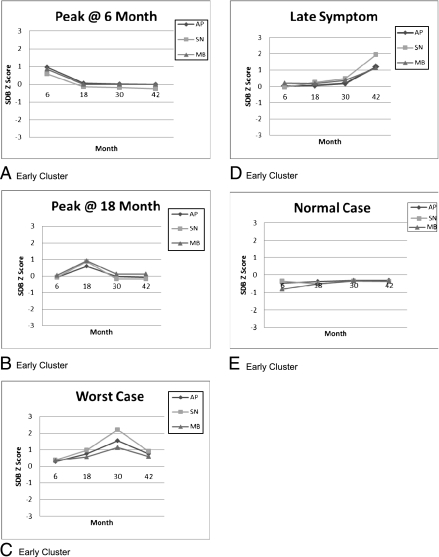
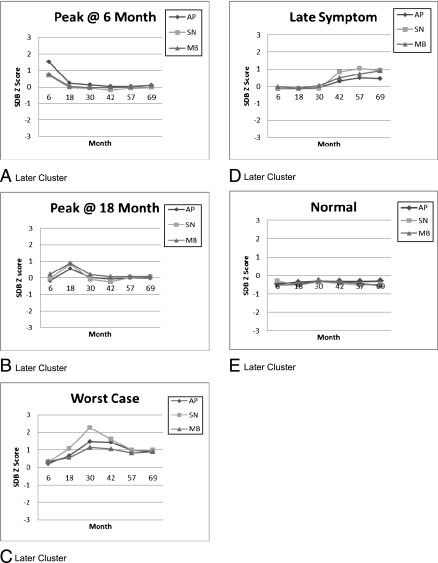
Methods: Parents in the Avon Longitudinal Study of Parents and Children reported on children's snoring, mouth breathing, and witnessed apnea at ≥2 surveys at 6, 18, 30, 42, 57, and 69 months, and completed the Strengths and Difficulties Questionnaire at 4 (n = 9140) and 7 (n = 8098) years. Cluster analysis produced 5 "Early" (6-42 months) and "Later" (6-69 months) symptom trajectories ("clusters"). Adverse behavioral outcomes were defined by top 10th percentiles on Strengths and Difficulties Questionnaire total and subscales, at 4 and 7 years, in multivariable logistic regression models.
Results: The SDB clusters predicted ≈20% to 100% increased odds of problematic behavior, controlling for 15 potential confounders. Early trajectories predicted problematic behavior at 7 years equally well as at 4 years. In Later trajectories, the "Worst Case" cluster, with peak symptoms at 30 months that abated thereafter, nonetheless at 7 years predicted hyperactivity (1.85 [1.30-2.63]), and conduct (1.60 [1.18-2.16]) and peer difficulties (1.37 [1.04-1.80]), whereas a "Later Symptom" cluster predicted emotional difficulties (1.65 [1.21-2.07]) and hyperactivity (1.88 [1.42-2.49]) . The 2 clusters with peak symptoms before 18 months that resolve thereafter still predicted 40% to 50% increased odds of behavior problems at 7 years.
Conclusions: In this large, population-based, longitudinal study, early-life SDB symptoms had strong, persistent statistical effects on subsequent behavior in childhood. Findings suggest that SDB symptoms may require attention as early as the first year of life.
Figures
Comment in
-
Sleep-disordered breathing early in life predicts later behavioral problems in children.J Pediatr. 2012 Sep;161(3):567-8. doi: 10.1016/j.jpeds.2012.07.007. J Pediatr. 2012. PMID: 22916979 No abstract available.
-
Parent-reported sleep-disordered breathing symptoms early in life predict childhood behavioural problems at age 4 and 7 years.Evid Based Med. 2013 Apr;18(2):77-8. doi: 10.1136/eb-2012-100821. Epub 2012 Aug 28. Evid Based Med. 2013. PMID: 22930340 No abstract available.
References
-
- Li HY, Lee LA. Sleep-disordered breathing in children. Chang Gung Med J. 2009;32(3):247–257 - PubMed
-
- Sahin U, Ozturk O, Ozturk M, Songur N, Bircan A, Akkaya A. Habitual snoring in primary school children: prevalence and association with sleep-related disorders and school performance. Med Princ Pract. 2009;18(6):458–465 - PubMed
-
- Beebe DW, Gozal D. Obstructive sleep apnea and the prefrontal cortex: towards a comprehensive model linking nocturnal upper airway obstruction to daytime cognitive and behavioral deficits. J Sleep Res. 2002;11(1):1–16 - PubMed
-
- Beebe DW. Neurobehavioral effects of obstructive sleep apnea: an overview and heuristic model. Curr Opin Pulm Med. 2005;11(6):494–500 - PubMed
-
- Owens JA. Neurocognitive and behavioral impact of sleep disordered breathing in children. Pediatr Pulmonol. 2009;44(5):417–422 - PubMed
Publication types
MeSH terms
Grants and funding
LinkOut - more resources
Full Text Sources
Other Literature Sources
Medical
