


Weight loss in obese older adults increases serum sclerostin and impairs hip geometry but both are prevented by exercise training
- PMID: 22392834
- PMCID: PMC3361603
- DOI: 10.1002/jbmr.1560
Weight loss in obese older adults increases serum sclerostin and impairs hip geometry but both are prevented by exercise training
Abstract
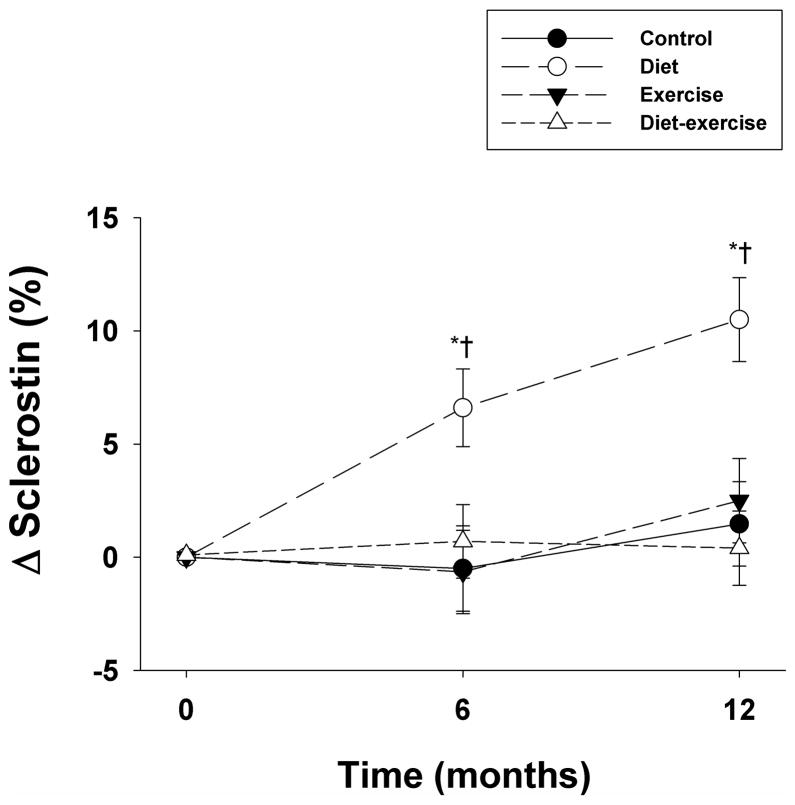
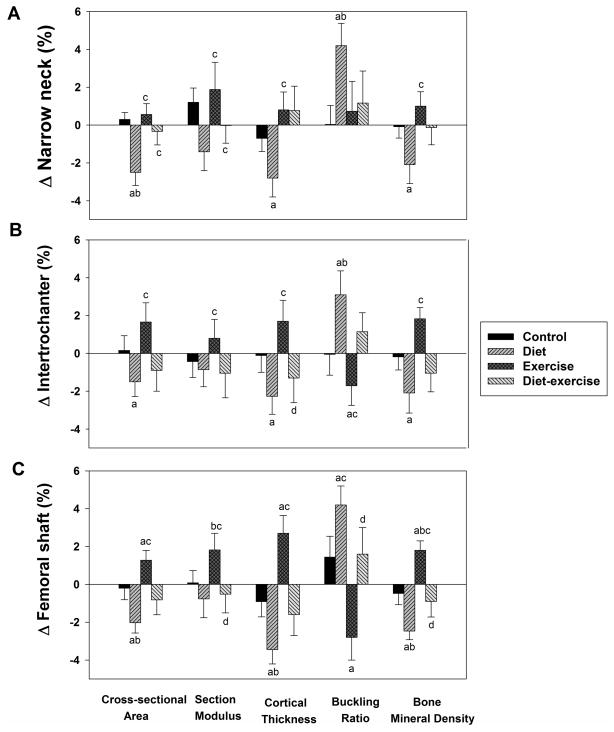
We reported that weight loss induces bone loss which is prevented by exercise training; however, the mechanism for this observation remains unclear. Sclerostin, an inhibitor of bone formation, has been found to increase in states of unloading and may mediate the changes in bone metabolism associated with weight loss and exercise. The objective of the study was to determine the effect of lifestyle intervention in obese older adults on sclerostin levels, and on hip geometry parameters. A total of 107 obese (body mass index [BMI] ≥ 30 kg/m(2)) older (≥65 years) adults were randomly assigned to control, diet, exercise, and combined diet-exercise for 1 year. Sclerostin levels were measured by ELISA at baseline, 6 months, and 12 months, while hip geometry parameters were obtained from bone mineral density (BMD) images done by dual-energy X-ray absorptiometry using hip structure analysis at baseline and 12 months. Both the diet and diet-exercise groups had significant decreases in body weight (-9.6% and -9.4%, respectively), whereas weight was stable in the exercise and control groups. Sclerostin levels increased significantly and progressively in the diet group (6.6% ± 1.7% and 10.5% ± 1.9% at 6 and 12 months, respectively, all p < 0.05), whereas they were unchanged in the other groups; in particular, they were stable in the diet-exercise group (0.7% ± 1.6% and 0.4% ± 1.7% at 6 and 12 months, respectively, all p = 0.05). Hip geometry parameters showed significant decreases in cross-sectional area, cortical thickness, and BMD; and increases in buckling ratio at the narrow neck, intertrochanter, and femoral shaft. These negative changes on bone geometry were not observed in the diet-exercise group. Significant correlations between changes in sclerostin and changes in certain hip geometry parameters were also observed (p < 0.05). In conclusion, the increase in sclerostin levels with weight loss that was prevented by exercise may partly mediate the negative effects of weight loss on bone metabolism and the osteoprotective effect of exercise training.
Copyright © 2012 American Society for Bone and Mineral Research.
Conflict of interest statement
All authors state that they have no conflicts of interest.
Figures
References
-
- Villareal DT, Apovian CM, Kushner RF, Klein S. Obesity in older adults: technical review and position statement of the American Society for Nutrition and NAASO, The Obesity Society. Am J Clin Nutr. 2005;82:923–934. [also published in: Obes Res. 2005: 13:1849–1863] - PubMed
-
- Villareal DT, Fontana L, Weiss EP, et al. Bone Mineral Density Response to Caloric Restriction-Induced Weight Loss or Exercise-Induced Weight Loss: A Randomized Controlled Trial. Arch Intern Med. 2006;166:2502–2510. - PubMed
Publication types
MeSH terms
Substances
Grants and funding
- R01 AG025501/AG/NIA NIH HHS/United States
- DK20579/DK/NIDDK NIH HHS/United States
- P30 DK056341/DK/NIDDK NIH HHS/United States
- P60 DK020579/DK/NIDDK NIH HHS/United States
- R01-AG025501/AG/NIA NIH HHS/United States
- P30-DK56341/DK/NIDDK NIH HHS/United States
- UL1 TR001449/TR/NCATS NIH HHS/United States
- UL1 RR024992/RR/NCRR NIH HHS/United States
- UL1 TR000041/TR/NCATS NIH HHS/United States
- UL1-RR024992/RR/NCRR NIH HHS/United States
- R01-AG031176/AG/NIA NIH HHS/United States
- R01 AG031176/AG/NIA NIH HHS/United States
- P30 DK020579/DK/NIDDK NIH HHS/United States
