


Cardiovascular status of childhood cancer survivors exposed and unexposed to cardiotoxic therapy
- PMID: 22393080
- PMCID: PMC3341149
- DOI: 10.1200/JCO.2010.33.7907
Cardiovascular status of childhood cancer survivors exposed and unexposed to cardiotoxic therapy
Abstract
Purpose: To determine whether cardiovascular abnormalities in childhood cancer survivors are restricted to patients exposed to cardiotoxic anthracyclines and cardiac irradiation and how risk factors for atherosclerotic disease and systemic inflammation contribute to global cardiovascular status.
Methods: We assessed echocardiographic characteristics and atherosclerotic disease risk in 201 survivors of childhood cancer with and without exposure to cardiotoxic treatments at a median of 11 years after diagnosis (range, 3 to 32 years) and in 76 sibling controls.
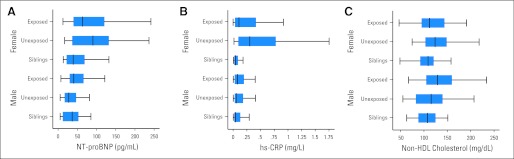
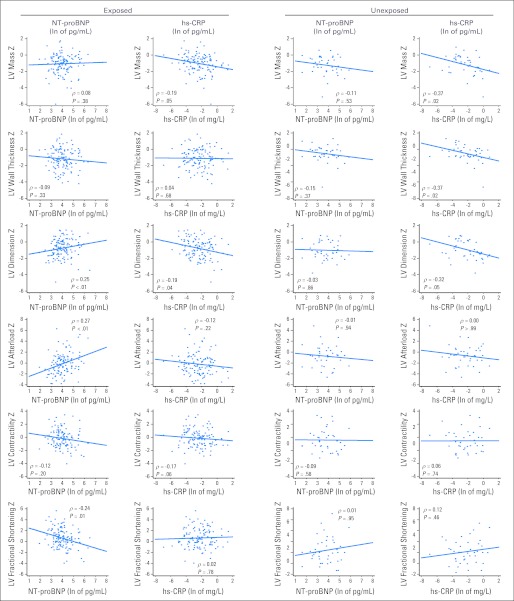
Results: The 156 exposed survivors had below normal left ventricular (LV) mass, wall thickness, contractility, and fractional shortening and above normal LV afterload. The 45 unexposed survivors also had below normal LV mass overall, and females had below normal LV wall thickness. Exposed and unexposed survivors, compared with siblings, had higher levels of N-terminal pro-brain natriuretic peptide (81.7 and 69.0 pg/mL, respectively, v 39.4 pg/mL), higher mean fasting serum levels of non-high-density lipoprotein cholesterol (126.5 and 121.1 mg/dL, respectively, v 109.8 mg/dL), higher insulin levels (10.4 and 10.5 μU/mL, respectively, v 8.2 μU/mL), and higher levels of high-sensitivity C-reactive protein (2.7 and 3.1 mg/L, respectively, v 0.9 mg/L; P < .001 for all comparisons). Age-adjusted, predicted-to-ideal 30-year risk of myocardial infarction, stroke, or coronary death was also higher for exposed and unexposed survivors compared with siblings (2.16 and 2.12, respectively, v 1.70; P < .01 for both comparisons).
Conclusion: Childhood cancer survivors not receiving cardiotoxic treatments nevertheless have cardiovascular abnormalities, systemic inflammation, and an increased risk of atherosclerotic disease. Survivorship guidelines should address cardiovascular concerns, including the risk of atherosclerotic disease and systemic inflammation, in exposed and unexposed survivors.
Conflict of interest statement
Authors' disclosures of potential conflicts of interest and author contributions are found at the end of this article.
Figures
References
-
- Mariotto AB, Rowland JH, Yabroff KR, et al. Long-term survivors of childhood cancers in the United States. Cancer Epidemiol Biomarkers Prev. 2009;18:1033–1040. - PubMed
-
- Oeffinger KC, Mertens AC, Sklar CA, et al. Chronic health conditions in adult survivors of childhood cancer. N Engl J Med. 2006;355:1572–1582. - PubMed
-
- Möller TR, Garwicz S, Barlow L, et al. Decreasing late mortality among five-year survivors of cancer in childhood and adolescence: A population-based study in the Nordic countries. J Clin Oncol. 2001;19:3173–3181. - PubMed
Publication types
MeSH terms
Substances
Grants and funding
- U01 HD052104/HD/NICHD NIH HHS/United States
- HL078522/HL/NHLBI NIH HHS/United States
- HL095127/HL/NHLBI NIH HHS/United States
- R01 HL087000/HL/NHLBI NIH HHS/United States
- HL094100/HL/NHLBI NIH HHS/United States
- F31 HL094100/HL/NHLBI NIH HHS/United States
- HD052102/HD/NICHD NIH HHS/United States
- HL053392/HL/NHLBI NIH HHS/United States
- HL087000/HL/NHLBI NIH HHS/United States
- R01 CA127642/CA/NCI NIH HHS/United States
- HL079233/HL/NHLBI NIH HHS/United States
- HL007188/HL/NHLBI NIH HHS/United States
- R01 HL095127/HL/NHLBI NIH HHS/United States
- K30 HL004537/HL/NHLBI NIH HHS/United States
- T32 HL007188/HL/NHLBI NIH HHS/United States
- HD80002/HD/NICHD NIH HHS/United States
- HL087708/HL/NHLBI NIH HHS/United States
- CA068484/CA/NCI NIH HHS/United States
- R01 HL078522/HL/NHLBI NIH HHS/United States
- AI50274/AI/NIAID NIH HHS/United States
- U01 HD052102/HD/NICHD NIH HHS/United States
- R13 HL087708/HL/NHLBI NIH HHS/United States
- U01 AI050274/AI/NIAID NIH HHS/United States
- HD052104/HD/NICHD NIH HHS/United States
- CA127642/CA/NCI NIH HHS/United States
- P01 CA068484/CA/NCI NIH HHS/United States
- HL072705/HL/NHLBI NIH HHS/United States
- R01 HL053392/HL/NHLBI NIH HHS/United States
- HL004537/HL/NHLBI NIH HHS/United States
- R01 HL072705/HL/NHLBI NIH HHS/United States
LinkOut - more resources
Full Text Sources
Medical
Research Materials
