


The Diesel Exhaust in Miners study: a cohort mortality study with emphasis on lung cancer
- PMID: 22393207
- PMCID: PMC3373218
- DOI: 10.1093/jnci/djs035
The Diesel Exhaust in Miners study: a cohort mortality study with emphasis on lung cancer
Erratum in
- J Natl Cancer Inst. 2014 Aug 106(8):dju192 doi:10.1093/jnci/dju192
Abstract
Background: Current information points to an association between diesel exhaust exposure and lung cancer and other mortality outcomes, but uncertainties remain.
Methods: We undertook a cohort mortality study of 12 315 workers exposed to diesel exhaust at eight US non-metal mining facilities. Historical measurements and surrogate exposure data, along with study industrial hygiene measurements, were used to derive retrospective quantitative estimates of respirable elemental carbon (REC) exposure for each worker. Standardized mortality ratios and internally adjusted Cox proportional hazard models were used to evaluate REC exposure-associated risk. Analyses were both unlagged and lagged to exclude recent exposure such as that occurring in the 15 years directly before the date of death.
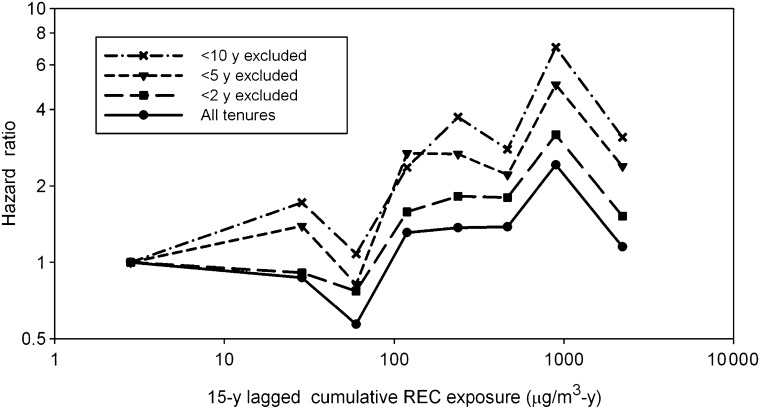
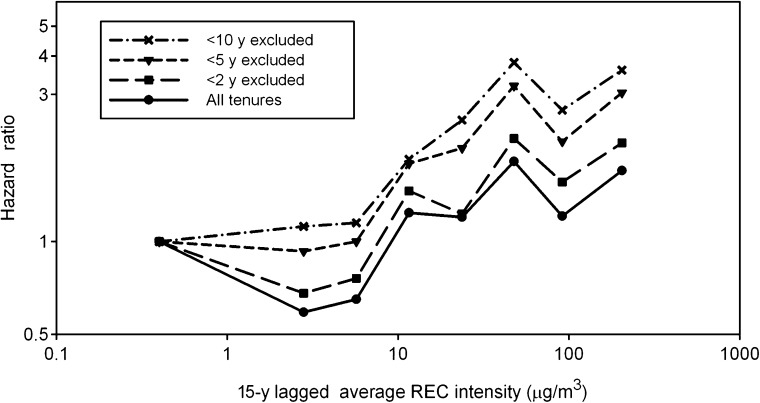
Results: Standardized mortality ratios for lung cancer (1.26, 95% confidence interval [CI] = 1.09 to 1.44), esophageal cancer (1.83, 95% CI = 1.16 to 2.75), and pneumoconiosis (12.20, 95% CI = 6.82 to 20.12) were elevated in the complete cohort compared with state-based mortality rates, but all-cause, bladder cancer, heart disease, and chronic obstructive pulmonary disease mortality were not. Differences in risk by worker location (ever-underground vs surface only) initially obscured a positive diesel exhaust exposure-response relationship with lung cancer in the complete cohort, although it became apparent after adjustment for worker location. The hazard ratios (HRs) for lung cancer mortality increased with increasing 15-year lagged cumulative REC exposure for ever-underground workers with 5 or more years of tenure to a maximum in the 640 to less than 1280 μg/m(3)-y category compared with the reference category (0 to <20 μg/m(3)-y; 30 deaths compared with eight deaths of the total of 93; HR = 5.01, 95% CI = 1.97 to 12.76) but declined at higher exposures. Average REC intensity hazard ratios rose to a plateau around 32 μg/m(3). Elevated hazard ratios and evidence of exposure-response were also seen for surface workers. The association between diesel exhaust exposure and lung cancer risk remained after inclusion of other work-related potentially confounding exposures in the models and were robust to alternative approaches to exposure derivation.
Conclusions: The study findings provide further evidence that exposure to diesel exhaust increases risk of mortality from lung cancer and have important public health implications.
Figures
Comment in
-
The problem with Diesel.J Natl Cancer Inst. 2012 Jun 6;104(11):796-7. doi: 10.1093/jnci/djs137. Epub 2012 Mar 5. J Natl Cancer Inst. 2012. PMID: 22393208 No abstract available.
-
Re: The diesel exhaust in miners study: a nested case-control study of lung cancer and diesel exhaust and a cohort mortality study with emphasis on lung cancer.J Natl Cancer Inst. 2012 Dec 5;104(23):1841; author reply 1848-9. doi: 10.1093/jnci/djs413. Epub 2012 Oct 19. J Natl Cancer Inst. 2012. PMID: 23087444 No abstract available.
-
Re: The diesel exhaust in miners study: a nested case-control study of lung cancer and diesel exhaust, a cohort mortality study with emphasis on lung cancer, and the problem with diesel.J Natl Cancer Inst. 2012 Dec 5;104(23):1843-5; author reply 1847-9. doi: 10.1093/jnci/djs415. Epub 2012 Oct 19. J Natl Cancer Inst. 2012. PMID: 23087446 No abstract available.
-
Re: The diesel exhaust in miners study: a nested case-control study of lung cancer and diesel exhaust and a cohort mortality study with emphasis on lung cancer.J Natl Cancer Inst. 2012 Dec 5;104(23):1842-3; author reply 1848-9. doi: 10.1093/jnci/djs416. Epub 2012 Oct 19. J Natl Cancer Inst. 2012. PMID: 23087448 No abstract available.
-
Re: The diesel exhaust in miners study: a nested case-control study of lung cancer and diesel exhaust and a cohort mortality study with emphasis on lung cancer.J Natl Cancer Inst. 2012 Dec 5;104(23):1846-7; author reply 1848-9. doi: 10.1093/jnci/djs423. Epub 2012 Oct 19. J Natl Cancer Inst. 2012. PMID: 23087449 No abstract available.
-
Environmental emissions, public health and lung cancer risk.Ann Oncol. 2016 Feb;27(2):211-2. doi: 10.1093/annonc/mdv579. Epub 2015 Nov 23. Ann Oncol. 2016. PMID: 26598543 No abstract available.
-
The hidden impact of a healthy-worker effect on the results of the Diesel Exhaust in Miners Study.Eur J Epidemiol. 2016 Aug;31(8):803-4. doi: 10.1007/s10654-016-0161-7. Epub 2016 May 25. Eur J Epidemiol. 2016. PMID: 27226080 Free PMC article. No abstract available.
-
Re: "The hidden impact of a healthy-worker effect on the results of the Diesel Exhaust in Miners Study".Eur J Epidemiol. 2016 Aug;31(8):805-6. doi: 10.1007/s10654-016-0188-9. Epub 2016 Aug 12. Eur J Epidemiol. 2016. PMID: 27518301 No abstract available.
References
-
- Garshick E, Schenker MB, Munoz A, et al. A retrospective cohort study of lung cancer and diesel exhaust exposure in railroad workers. Am Rev Respir Dis. . 1988;137(4):820–825. - PubMed
-
- Steenland K, Silverman D, Zaebst D. Exposure to diesel exhaust in the trucking industry and possible relationships with lung cancer. Am J Ind Med. . 1992;21(6):887–890. - PubMed
-
- Neumeyer-Gromen A, Razum O, Kersten N, Seidler A, Zeeb H. Diesel motor emissions and lung cancer mortality - Results of the second follow-up of a cohort study in potash miners. Int J Cancer. . 2009;124(8):1900–1906. - PubMed
Publication types
MeSH terms
Substances
Grants and funding
LinkOut - more resources
Full Text Sources
Medical
