


Short-term effects of high-frequency chest compression and positive expiratory pressure in patients with cystic fibrosis
- PMID: 22393338
- PMCID: PMC3279471
- DOI: 10.4021/jocmr697w
Short-term effects of high-frequency chest compression and positive expiratory pressure in patients with cystic fibrosis
Abstract
Background: Cystic fibrosis patients require daily airway clearance therapies. The primary objective of this study was to compare the short-term efficacy of high-frequency chest compression and positive expiratory pressure mask on expectorated sputum, pulmonary function, and oxygen saturation in patients with CF hospitalized for an acute pulmonary exacerbation.
Methods: A controlled randomized cross-over trial with 24 hours between treatments was used. Thirty-four CF patients (26 ± 6.5 years) were included in the study. Before and 30 minutes after each treatment were recorded: pulmonary function testing, oxygen saturation, and perceived dyspnea. Preference for the two devices was assessed.
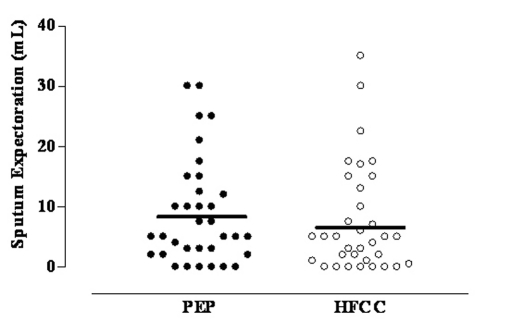
Results: No statistically significant difference between high-frequency chest compression and positive expiratory pressure mask was found in sputum production and in lung function testing. A reduction in SpO(2) was found after positive expiratory pressure mask (98 ± 1.0% versus 97 ± 1.2%; P < 0.001). Both treatments induced a statistically significant increase in Borg scale for dyspnea without differences between them. Patients reported greater satisfaction with positive expiratory pressure mask than with high-frequency chest compression (P < 0.001).
Conclusion: High-frequency chest compression and positive expiratory pressure mask have comparable short-term effects on expectorated sputum and lung function. Although positive expiratory pressure mask was associated with a lower SpO(2), it was better tolerated than high-frequency chest compression.
Keywords: Airway clearance therapies; High-frequency chest compression; Sputum; Cystic fibrosis.
Figures
References
-
- Rowe SM, Miller S, Sorscher EJ. Cystic fibrosis. N Engl J Med. 2005;352(19):1992–2001. - PubMed
-
- Pisi G, Chetta A. Airway clearance therapy in cystic fibrosis patients. Acta Biomed. 2009;80(2):102–106. - PubMed
-
- Hansen LG, Warwick WJ. High-frequency chest compression system to aid in clearance of mucus from the lung. Biomed Instrum Technol. 1990;24(4):289–294. - PubMed
-
- Kluft J, Beker L, Castagnino M, Gaiser J, Chaney H, Fink RJ. A comparison of bronchial drainage treatments in cystic fibrosis. Pediatr Pulmonol. 1996;22(4):271–274. - PubMed
-
- Warwick WJ, Wielinski CL, Hansen LG. Comparison of expectorated sputum after manual chest physical therapy and high-frequency chest compression. Biomed Instrum Technol. 2004;38(6):470–475. - PubMed
LinkOut - more resources
Full Text Sources