Review
. 2012 Mar;2(3):a006486.
doi: 10.1101/cshperspect.a006486.

Vascular normalization as a therapeutic strategy for malignant and nonmalignant disease

Affiliations
Review

Vascular normalization as a therapeutic strategy for malignant and nonmalignant disease

Shom Goel et al. Cold Spring Harb Perspect Med. 2012 Mar.

Abstract

Pathological angiogenesis-driven by an imbalance of pro- and antiangiogenic signaling-is a hallmark of many diseases, both malignant and benign. Unlike in the healthy adult in which angiogenesis is tightly regulated, such diseases are characterized by uncontrolled new vessel formation, resulting in a microvascular network characterized by vessel immaturity, with profound structural and functional abnormalities. The consequence of these abnormalities is further modification of the microenvironment, often serving to fuel disease progression and attenuate response to conventional therapies. In this article, we present the "vascular normalization" hypothesis, which states that antiangiogenic therapy, by restoring the balance between pro- and antiangiogenic signaling, can induce a more structurally and functionally normal vasculature in a variety of diseases. We present the preclinical and clinical evidence supporting this concept and discuss how it has contributed to successful treatment of both solid tumors and several benign conditions.


Figures
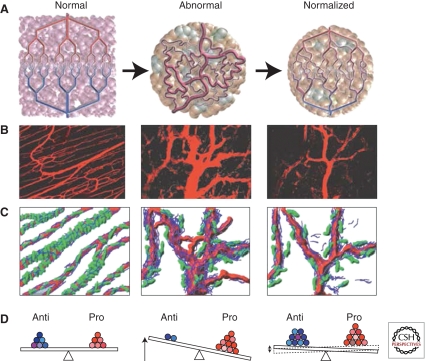
Figure 1.
Figure 1.
Proposed role of vessel normalization in the response of tumors to antiangiogenic therapy. (A) Tumor vasculature is structurally and functionally abnormal. It is proposed that antiangiogenic therapies initially improve both the structure and the function of tumor vessels. However, sustained or aggressive antiangiogenic regimens may eventually prune away these vessels, resulting in a vasculature that is both resistant to further treatment and inadequate for the delivery of drugs or oxygen. (B) Dynamics of vascular normalization induced by VEGFR2 blockade. On the left is a two-photon image showing normal blood vessels in skeletal muscle; subsequent images show human colon carcinoma vasculature in mice at day 0 and day 3 after administration of VEGR2-specific antibody. (C) Diagram depicting the concomitant changes in pericyte (green) and basement membrane (blue) coverage during vascular normalization. (D) These phenotypic changes in the vasculature may reflect changes in the balance of pro- and antiangiogenic factors in the tissue. (Figure adapted from Jain 2005; reprinted with permission from the American Association for the Advancement of Science © 2005.)
Figure 2.
Figure 2.
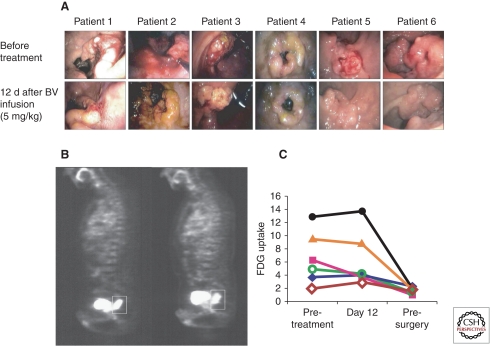
Direct effects of antiangiogenic therapy in human patients with locally advanced adenocarcinoma of the rectum. (A) Six patients were treated with locally advanced rectal cancer underwent sigmoidoscopy before (upper panels) and 12 days after (lower panels) a single dose of bevacizumab (antihuman VEGF antibody). Tumors appear notably less hyperaemic after treatment, associated with a quantifiable decrease in tumor blood flow. (B) Positron emission tomography (PET) scanning using fluoro-deoxyglucose (FDG). Despite the reduction in tumor blood flow, the amount of extravasated FDG is similar before (left panel) and after (right panel) bevacizumab treatment, implying improved functionality of surviving vessels. (C) Graphical representation of FDG uptake on PET scanning for six patients. Again, there is no difference in tumor uptake of FDG between pretreatment values and those 12 days after a single dose of bevacizumab. (Figure adapted from Willett et al. 2004; reprinted, with permission, from Nature Publishing Group © 2004.)

References

    1. Abramsson A, Lindblom P, Betsholtz C 2003. Endothelial and nonendothelial sources of PDGF-B regulate pericyte recruitment and influence vascular pattern formation in tumors. J Clin Invest 112: 1142–1151 - PMC - PubMed
    1. Ader I, Delmas C, Bonnet J, Rochaix P, Favre G, Toulas C, Cohen-Jonathan-Moyal E 2003. Inhibition of Rho pathways induces radiosensitization and oxygenation in human glioblastoma xenografts. Oncogene 22: 8861–8869 - PubMed
    1. Algire GH, Chalkley HW 1945. Vascular reactions of normal and malignant tissues in vivo. I. Vascular reactions of mice to wounds and to normal and neoplastic transplants. J Natl Cancer Inst 6: 73–85
    1. Ansiaux R, Baudelet C, Jordan BF, Beghein N, Sonveaux P, De Wever J, Martinive P, Gregoire V, Feron O, Gallez B 2005. Thalidomide radiosensitizes tumors through early changes in the tumor microenvironment. Clin Cancer Res 11: 743–750 - PubMed
    1. Ansiaux R, Baudelet C, Jordan BF, Crokart N, Martinive P, DeWever J, Gregoire V, Feron O, Gallez B 2006. Mechanism of reoxygenation after antiangiogenic therapy using SU5416 and its importance for guiding combined antitumor therapy. Cancer Res 66: 9698–9704 - PubMed

Publication types

MeSH terms

LinkOut - more resources