. 2012 Mar 6:13:84.
doi: 10.1186/1471-2164-13-84.

C57Bl/6 N mice on a western diet display reduced intestinal and hepatic cholesterol levels despite a plasma hypercholesterolemia

Affiliations

C57Bl/6 N mice on a western diet display reduced intestinal and hepatic cholesterol levels despite a plasma hypercholesterolemia

Charles Desmarchelier et al. BMC Genomics. .

Abstract

Background: Small intestine and liver greatly contribute to whole body lipid, cholesterol and phospholipid metabolism but to which extent cholesterol and phospholipid handling in these tissues is affected by high fat Western-style obesogenic diets remains to be determined.

Methods: We therefore measured cholesterol and phospholipid concentration in intestine and liver and quantified fecal neutral sterol and bile acid excretion in C57Bl/6 N mice fed for 12 weeks either a cholesterol-free high carbohydrate control diet or a high fat Western diet containing 0.03% (w/w) cholesterol. To identify the underlying mechanisms of dietary adaptations in intestine and liver, changes in gene expression were assessed by microarray and qPCR profiling, respectively.

Results: Mice on Western diet showed increased plasma cholesterol levels, associated with the higher dietary cholesterol supply, yet, significantly reduced cholesterol levels were found in intestine and liver. Transcript profiling revealed evidence that expression of numerous genes involved in cholesterol synthesis and uptake via LDL, but also in phospholipid metabolism, underwent compensatory regulations in both tissues. Alterations in glycerophospholipid metabolism were confirmed at the metabolite level by phospolipid profiling via mass spectrometry.

Conclusions: Our findings suggest that intestine and liver react to a high dietary fat intake by an activation of de novo cholesterol synthesis and other cholesterol-saving mechanisms, as well as with major changes in phospholipid metabolism, to accommodate to the fat load.


Figures
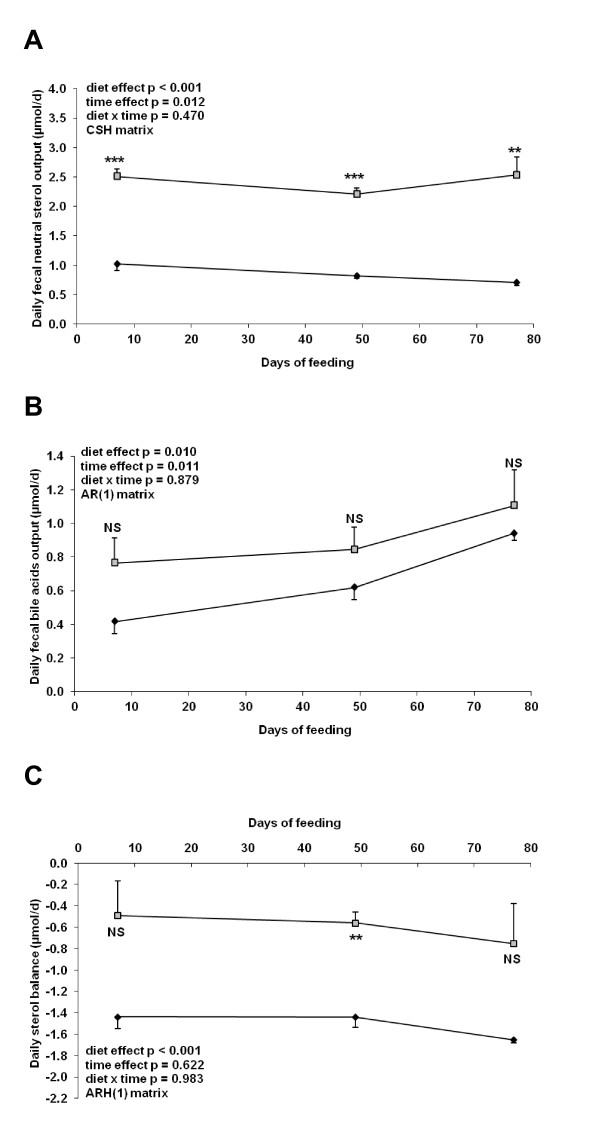
Figure 1
Figure 1
Sterol balance data obtained from mice fed the different diets for 12 weeks. Feces were collected at three time points during the feeding trial and neutral sterol and bile acids content was measured by gas chromatography-mass spectrometry A: Daily fecal neutral sterol output. B: Daily fecal bile acids output. C: Daily sterol balance measured by subtracting fecal neutral sterol and bile acids output from cholesterol intake. Symbols: black diamonds, control diet; grey squares, Western diet. Data are presented as mean ± SEM (n = 5). ** p < 0.01; *** p < 0.001, NS: not significant.
Figure 2
Figure 2
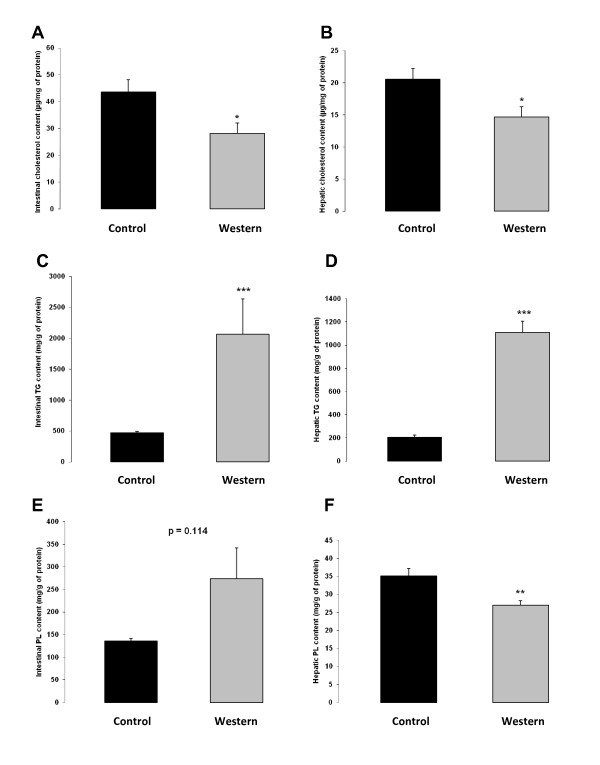
Cholesterol, TG and PL content in intestine and liver of mice fed the different diets for 12 weeks. A: Cholesterol concentration in the upper small intestine (n = 5). B: Cholesterol concentration in the liver (n = 12). C: TG concentration in the upper small intestine (n = 5-6). D: TG concentration in the liver (n = 11-12). E: PL concentration in the upper small intestine (n = 5-6). F: PL concentration in the liver (n = 11-12). Control diet: black bar; Western diet: grey bar. Data are presented as mean ± SEM. * p < 0.05; ** p < 0.01; *** p < 0.001.
Figure 3
Figure 3
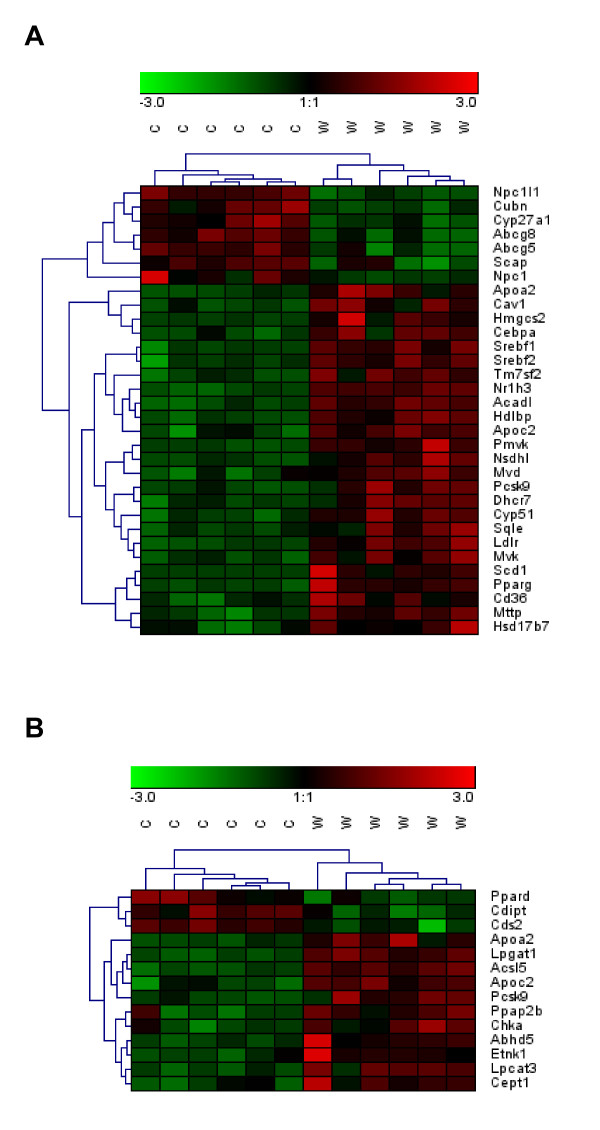
Heat map diagrams of differentially expressed genes in the small intestine upon Western diet feeding. A: Standard scores of differentially expressed genes related to cholesterol metabolism (GO Biological Processes: cholesterol metabolic process, cholesterol biosynthetic process, cholesterol transport, cholesterol homeostasis, positive regulation of cholesterol efflux, regulation of cholesterol efflux, cholesterol efflux, regulation of cholesterol metabolic process, regulation of cholesterol storage, regulation of cholesterol biosynthetic process, reverse cholesterol transport). B: Standard scores of differentially expressed genes related to PL metabolism (GO Biological Processes: PL metabolic process, PL biosynthetic process, PL catabolic process, PL efflux, PL transport). Capital letters indicate: C, control; W, Western diet. Differentially expressed genes with a q-value ≤ 0.05 were included in the analysis. Green and red indicate down- and up-regulation of gene expression, respectively.
Figure 4
Figure 4
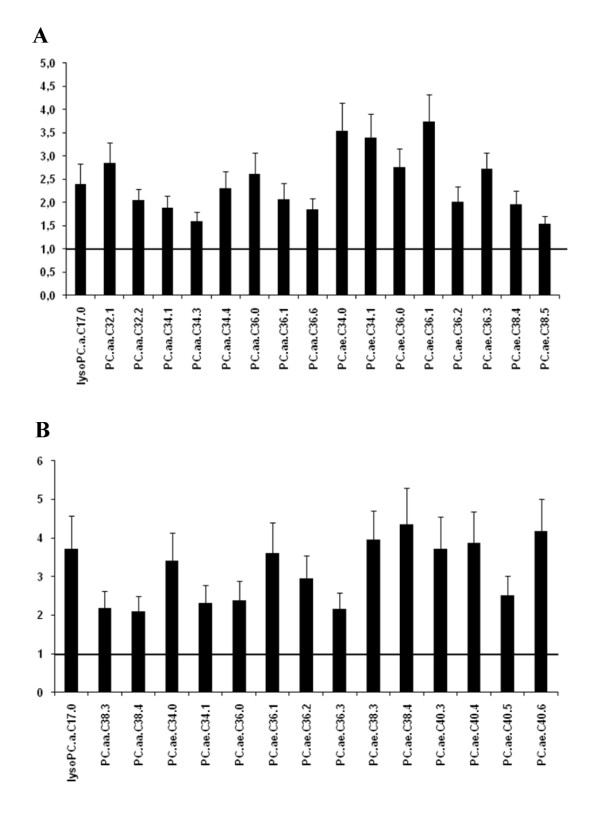
Effect of a chronic Western diet on the level of phosphatidylcholine species. Hepatic and intestinal PC levels were detected using LC-MS/MS. A: Significantly regulated PC in the small intestine (n = 6). B: Significantly regulated PC in the liver (n = 6). Data are presented as fold change (Western diet versus control) ± SEM. Abbreviations: PC.aa.: phosphatidylcholine diacyl; PC.ae.: phosphatidylcholine acyl-alkyl; lysoPC.a.: lysophosphatidylcholine acyl.
Figure 5
Figure 5
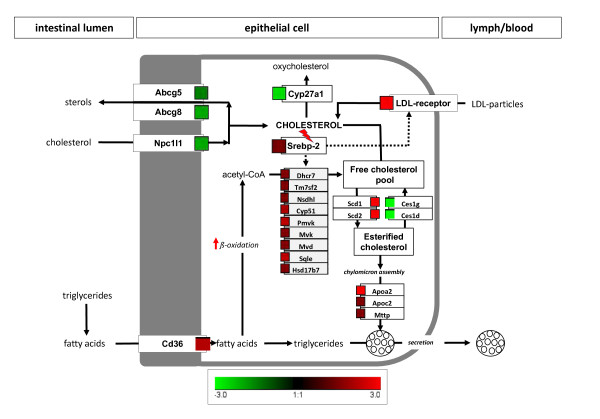
Effect of a chronic Western diet on the expression of genes related to cholesterol metabolism in the small intestine. Fold changes are displayed next to differentially expressed genes with color code provided. Red squares indicate upregulated genes; green squares indicate downregulated genes. Cholesterol concentration was found to be decreased whereas TG concentration was found to be increased in mice receiving the Western diet. Abbreviations and fold changes are listed in Table 2.

References

    1. Grundy SM. Obesity, metabolic syndrome, and cardiovascular disease. J Clin Endocrinol Metab. 2004;89(6):2595–2600. doi: 10.1210/jc.2004-0372. - DOI - PubMed
    1. Enas AE. Hypertriglyceridemia and elevated lipoprotein(a) are major risk factors for coronary events in middle-aged men. Am J Cardiol. 1996;78(7):859–860. - PubMed
    1. Austin MA, Hokanson JE, Edwards KL. Hypertriglyceridemia as a cardiovascular risk factor. Am J Cardiol. 1998;81(4A):7B–12B. - PubMed
    1. Van Gaal LF, Mertens IL, De Block CE. Mechanisms linking obesity with cardiovascular disease. Nature. 2006;444(7121):875–880. doi: 10.1038/nature05487. - DOI - PubMed
    1. Iqbal J, Hussain MM. Intestinal lipid absorption. Am J Physiol Endocrinol Metab. 2009;296(6):E1183–1194. doi: 10.1152/ajpendo.90899.2008. - DOI - PMC - PubMed

Publication types

MeSH terms