Clinical Trial
. 2012 May 31;119(22):5285-93.
doi: 10.1182/blood-2011-06-359430. Epub 2012 Mar 6.

PF4/heparin-antibody complex induces monocyte tissue factor expression and release of tissue factor positive microparticles by activation of FcγRI

Affiliations
Clinical Trial

PF4/heparin-antibody complex induces monocyte tissue factor expression and release of tissue factor positive microparticles by activation of FcγRI

Raj S Kasthuri et al. Blood. .

Abstract

Heparin-induced thrombocytopenia (HIT) is a potentially devastating form of drug-induced thrombocytopenia that occurs in patients receiving heparin for prevention or treatment of thrombosis. Patients with HIT develop autoantibodies to the platelet factor 4 (PF4)/heparin complex, which is termed the HIT Ab complex. Despite a decrease in the platelet count, the most feared complication of HIT is thrombosis. The mechanism of thrombosis in HIT remains poorly understood. We investigated the effects of the HIT Ab complex on tissue factor (TF) expression and release of TF-positive microparticles in peripheral blood mononuclear cells and monocytes. To model these effects ex vivo, we used a murine mAb specific for the PF4/heparin complex (KKO), as well as plasma from patients with HIT. We found that the HIT Ab complex induced TF expression in monocytes and the release of TF-positive microparticles. Further, we found that induction of TF is mediated via engagement of the FcγRI receptor and activation of the MEK1-ERK1/2 signaling pathway. Our data suggest that monocyte TF may contribute to the development of thrombosis in patients with HIT.


Figures
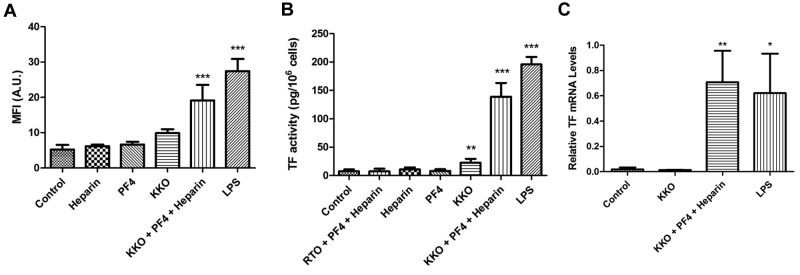
Figure 1
Figure 1
The HIT Ab complex induces TF expression in PBMCs and monocytes. (A) PBMCs were incubated for 6 hours with the different reagents, and the number of TF+/CD14+ double-positive events was measured with flow cytometry. Results are expressed as MFI (of the anti-TF Ab on CD14+ cells). (B) Measurement of cellular TF activity. An additional control consisted of RTO (isotype control Ab for KKO, 100 μg/mL) + heparin + PF4. TF activity was measured with a 1-stage clotting assay. (C) Monocytes were incubated in media alone (control), KKO (100 μg/mL), KKO (100 μg/mL) + heparin (1 U/mL) + PF4 (10 μg/mL), and LPS (1 μg/mL) for 2 hours. Total RNA was isolated from the cells, and TF mRNA levels were determined by real-time PCR. Results are presented as relative TF mRNA levels compared with HPRT. Results are from 5 independent experiments. ***P < .001, **P < .01, and *P < .05 compared with control.
Figure 2
Figure 2
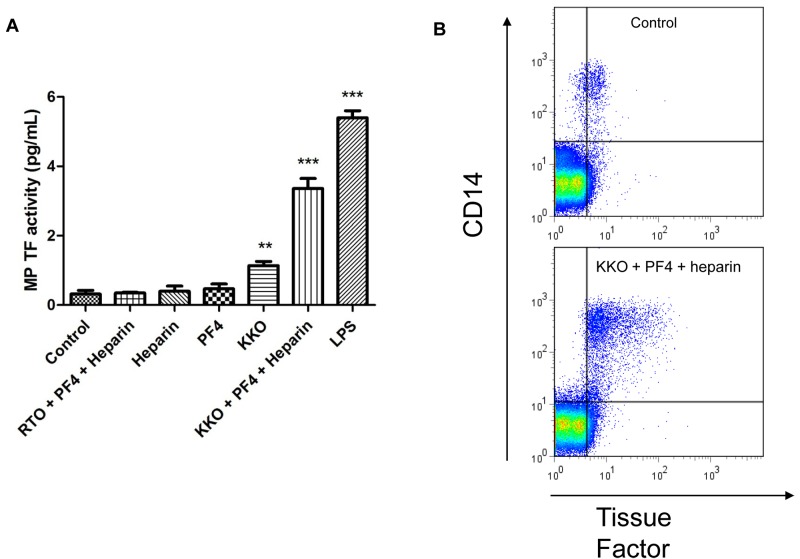
The HIT Ab complex induces release of TF+ MPs from PBMCs. PBMCs were incubated for 6 hours at 37°C under the same experimental conditions as outlined under Figure 1B. (A) MPs were isolated from the cell supernatant fluid, and MP TF activity was measured with a 2-stage chromogenic assay. (B) The number of TF+ MPs was determined with flow cytometry–based detection of TF+/CD14+ events. The top plot shows the number of MPs from PBMCs incubated with media alone (control), and the bottom plot shows the number of MPs from PBMCs incubated with the HIT Ab complex. Increases were seen in the number of TF+/CD14+ MPs and the MFI of TF (later not shown). Results are from 5 independent experiments. ***P < .001 and **P < .01 compared with control.
Figure 3
Figure 3
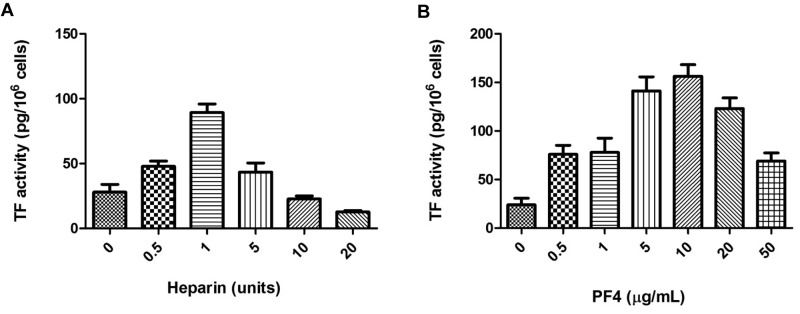
Effect of varying the concentrations of PF4 and heparin on the induction of TF expression in PBMCs. (A) Increasing amounts of heparin were added to PBMCs containing 100 μg/mL KKO and 10 μg of PF4. Samples were incubated for 6 hours at 37°C, and TF activity was measured with a one-stage clotting assay. (B) Increasing amounts of PF4 were added to PBMCs containing 100 μg/mL KKO and 1 U/mL heparin. TF activity was measured with a one-stage clotting assay. Results are from 3 independent experiments.
Figure 4
Figure 4
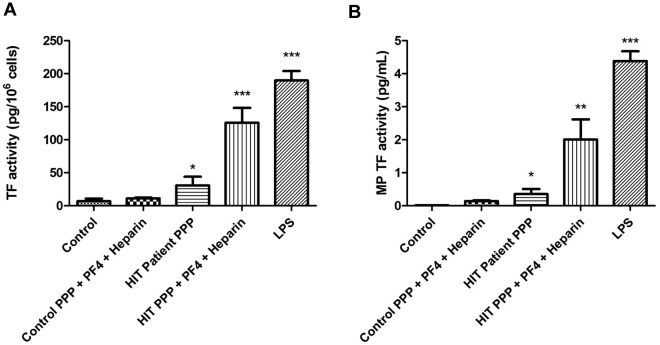
Plasma from patients with HIT induces TF in PBMCs. Plasma from healthy volunteers (n = 3) and from patients with HIT (n = 3) was heat-inactivated and used in the place of RTO and KKO, respectively. (A) TF activity in PBMCs. (B) MP TF activity in MPs isolated from the cell supernatant fluid. ***P < .001, **P < .01, and *P < .05 compared with control.
Figure 5
Figure 5
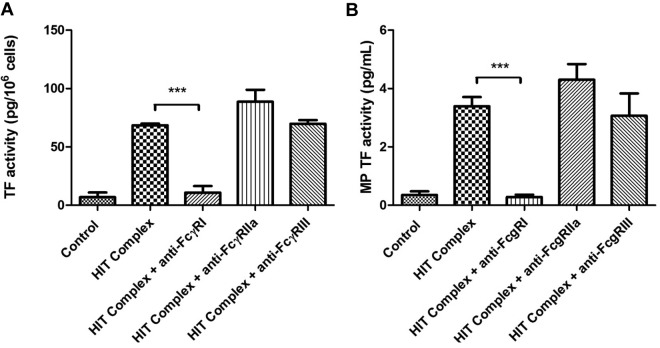
Role of different Fc receptors in the induction of TF expression in PBMCs by the HIT Ab complex. PBMCs were preincubated for 30 minutes with either anti-FcγRI Ab (10 μg/mL), anti-FcγRII Ab (10 μg/mL), or anti-FcγRIII Ab (10 μg/mL) before the addition of control Ab or KKO (100 μg/mL) + heparin (1 U/mL) + PF4 (10 μg/mL). (A) TF activity in PBMCs. (B) MP TF activity in MPs isolated from the cell supernatant fluid. The results are from 3 independent experiments. Complex refers to addition of KKO + PF4 + heparin. ***P < .001.
Figure 6
Figure 6
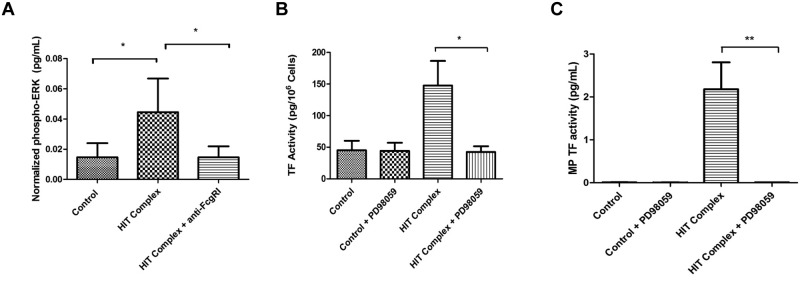
Role of ERK-1/2 in the induction of TF expression in monocytes by the HIT Ab complex. (A) Monocytes were preincubated for 30 minutes with anti-FcγRI Ab (10 μg/mL) or control Ab before the addition of KKO (100 μg/mL) + heparin (1 U/mL) + PF4 (10 μg/mL). Total ERK1 and phospho-ERK1/2 were measured by ELISA. (B-C) Monocytes were preincubated for 1 hour with MEK1 inhibitor PD98059 (50 μg/mL) or control Ab before the addition of KKO (100 μg/mL) + heparin (1 U/mL) + PF4 (10 μg/mL). Cellular TF (B) and MP TF activity in MPs isolated from the cell supernatant fluid (C) were measured. The results are from 3 independent experiments. The HIT complex refers to addition of KKO + PF4 + heparin. **P < .01 and *P < .05.

Comment in

References

    1. Arepally GM, Ortel TL. Clinical practice. Heparin-induced thrombocytopenia. N Engl J Med. 2006;355(8):809–817. - PubMed
    1. Fahey VA. Heparin-induced thrombocytopenia. J Vasc Nurs. 1995;13(4):112–116. - PubMed
    1. Zucker MB, Katz IR. Platelet factor 4: production, structure, and physiologic and immunologic action. Proc Soc Exp Biol Med. 1991;198(2):693–702. - PubMed
    1. Poncz M, Rauova L, Cines DB. The role of surface PF4: glycosaminoglycan complexes in the pathogenesis of heparin-induced thrombocytopenia (HIT). Pathophysiol Haemost Thromb. 2006;35(1-2):46–49. - PubMed
    1. Slungaard A. Platelet factor 4: a chemokine enigma. Int J Biochem Cell Biol. 2005;37(6):1162–1167. - PubMed

Publication types

MeSH terms