. 2012 Mar 6:8:574.
doi: 10.1038/msb.2012.6.

The clock gene circuit in Arabidopsis includes a repressilator with additional feedback loops

Affiliations

The clock gene circuit in Arabidopsis includes a repressilator with additional feedback loops

Alexandra Pokhilko et al. Mol Syst Biol. .

Abstract

Circadian clocks synchronise biological processes with the day/night cycle, using molecular mechanisms that include interlocked, transcriptional feedback loops. Recent experiments identified the evening complex (EC) as a repressor that can be essential for gene expression rhythms in plants. Integrating the EC components in this role significantly alters our mechanistic, mathematical model of the clock gene circuit. Negative autoregulation of the EC genes constitutes the clock's evening loop, replacing the hypothetical component Y. The EC explains our earlier conjecture that the morning gene Pseudo-Response Regulator 9 was repressed by an evening gene, previously identified with Timing Of CAB Expression1 (TOC1). Our computational analysis suggests that TOC1 is a repressor of the morning genes Late Elongated Hypocotyl and Circadian Clock Associated1 rather than an activator as first conceived. This removes the necessity for the unknown component X (or TOC1mod) from previous clock models. As well as matching timeseries and phase-response data, the model provides a new conceptual framework for the plant clock that includes a three-component repressilator circuit in its complex structure.


Conflict of interest statement

The authors declare that they have no conflict of interest.

Figures
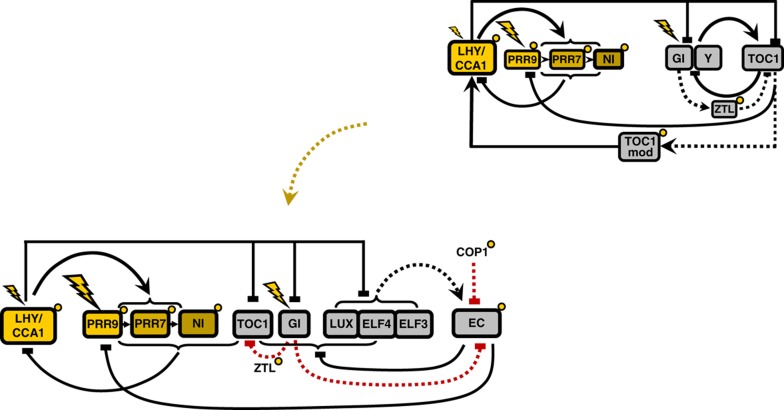
Figure 1
Figure 1
The revised outline of the Arabidopsis circadian clock. Elements of the morning and evening loops are shown in yellow and grey, respectively. Proteins are shown only for EC, ZTL and COP1 for simplicity. Transcriptional regulation is shown by solid lines. EC protein complex formation is denoted by a dashed black line. Post-translational regulation of TOC1 and the EC by GI, ZTL and COP1 are shown by red dashed lines. Acute light responses in gene transcription are shown by flashes. Post-translational regulation by light is shown by small yellow circles. The previous outline circuit (Pokhilko et al, 2010) is shown on the upper right.
Figure 2
Figure 2
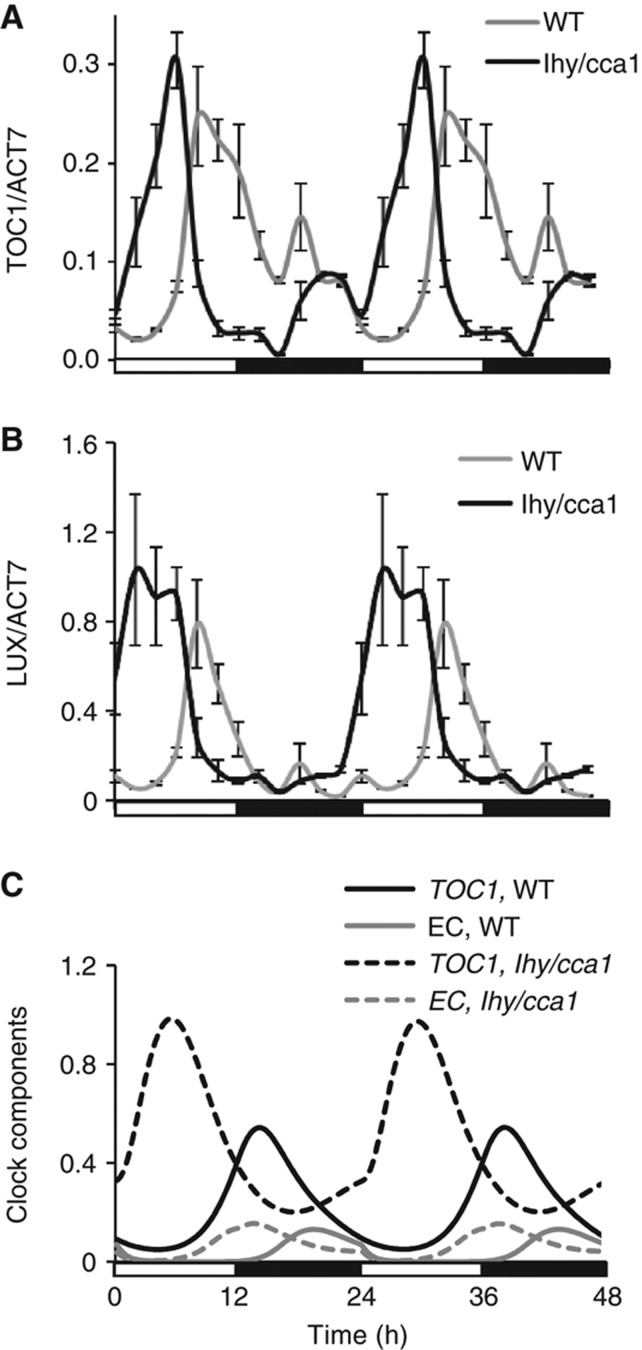
Regulation of TOC1 and LUX expression in the evening circuit of the clock. The phase advance of TOC1 (A) and LUX (B) expression in the lhy/cca1 double mutant (black line) compared with WT (grey line) was measured by qRT–PCR assays of plants grown under 12L:12D cycles, as described in Supplementary information. (C) Model simulations demonstrate that in both WT and lhy/cca1 plants, the increase in EC (grey lines) coincides with the time of the fall in the expression of the EC's target genes (such as TOC1, black lines). Data are double-plotted to facilitate comparison to simulations. Light conditions are shown by open and filled bars below the figure.
Figure 3
Figure 3
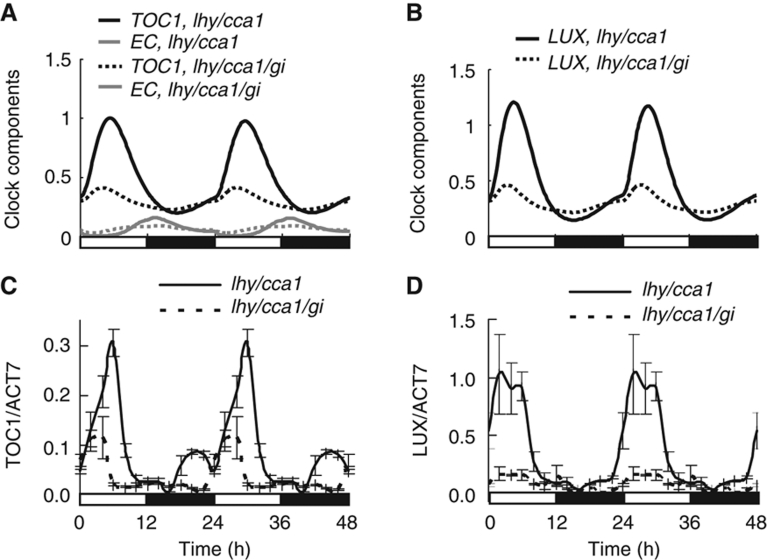
The role of GI in the regulation of TOC1 expression by the evening loop. Model simulations demonstrate lower peak levels of TOC1 (A) and LUX (B) expression (black lines) in lhy/cca1/gi (dotted lines) compared with lhy/cca1 mutants under 12L:12D cycles. This results from increased EC levels (grey lines) during the morning in the lhy/cca1/gi mutant. (C, D) qRT–PCR measurements of TOC1 and LUX expression in lhy/cca1/gi and lhy/cca1 mutants under 12L:12D. Data are double-plotted to facilitate comparison to simulations.
Figure 4
Figure 4
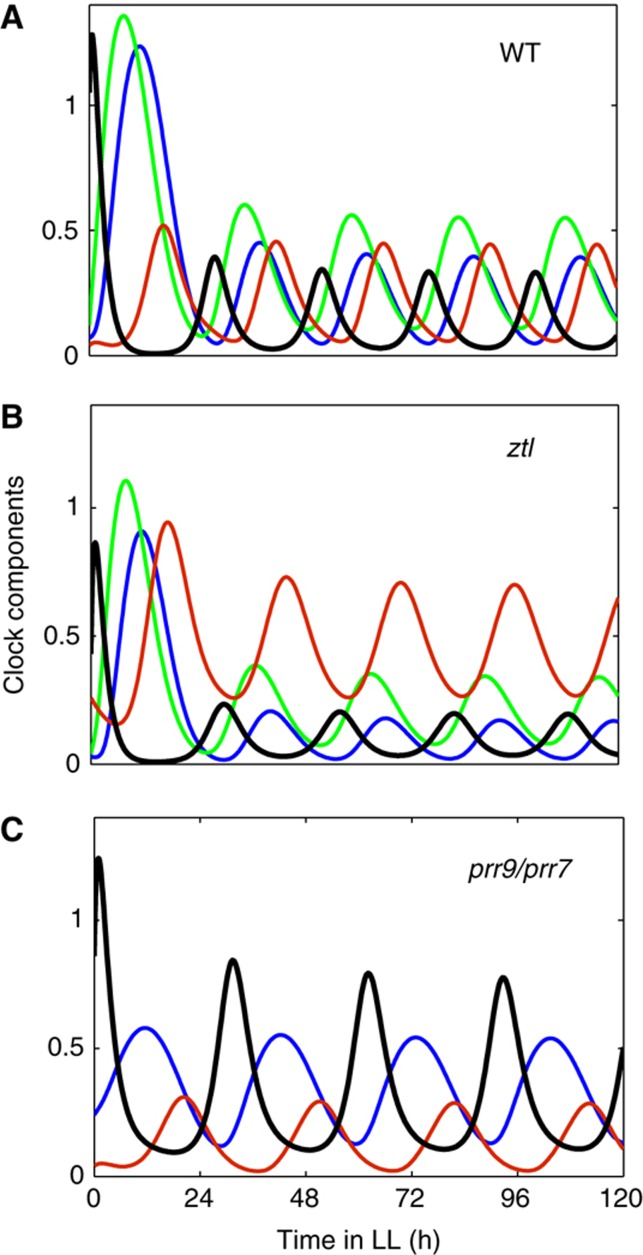
The improved description of ztl and prr7/prr9 mutants is related to the inhibition of LHY/CCA1 expression by TOC1. The simulated level of LHY/CCA1 mRNA (black) and the repressor proteins PRR7, NI and TOC1 (green, blue and red, respectively) are shown for WT (A), ztl mutant (B) and prr7/prr9 mutant (C) plants. Simulations moved from 12L:12D cycles to constant light at time 0, corresponding to dawn in LD.
Figure 5
Figure 5
The effect of TOC1 level on the kinetics of LHY and CCA1 expression. qRT–PCR measurements of CCA1 (A) and LHY (B) mRNA levels, and model simulations of LHY/CCA1 (C) expression in TOC1-ox, toc1 and WT plants under 12L:12D cycles were performed as described in the Supplementary information. TOC1-ox was simulated by adding a constant, unregulated activation of TOC1 transcription with a rate constant equal to 0.3 per hour, which correspond the observed expression level of TOC1 in TOC1-ox (Supplementary Figure S1).
Figure 6
Figure 6
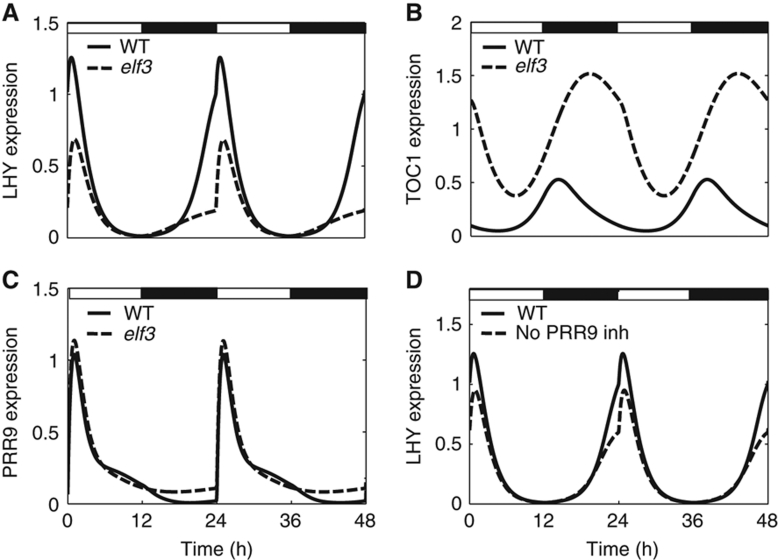
Nighttime inhibition of TOC1 and PRR9 expression by the EC is important for the robust oscillation of LHY/CCA1. Model simulations (dashed lines) of the elf3 mutant (AC) and a hypothetical mutant without inhibition of PRR9 by the EC (D) are shown together with WT simulations (solid lines). The simulations were run under 12L:12D conditions, which are indicated by open (light) and solid (dark) bars.
Figure 7
Figure 7
The mechanism of the PRC in plants. (A) A PRC was simulated by monitoring the phase of peaks of LUX expression after light pulses of 1 h duration given on the second day in darkness after 12L:12D entrainment. Data points were taken from Covington et al (2001) for red light pulses. (BD) The simulated profiles of LUX mRNA (blue) and LHY protein (magenta) with (dashed lines) or without (solid lines) light pulses given at indicated times (arrow)—at 18 h (B), 12 h (C) or at 18 h for a simulated mutant without an acute light response in LHY transcription (D; parameter q1=0). Time 0 refers to the beginning of the second day in darkness.
Figure 8
Figure 8
Core interactions in the clock model form a repressilator circuit. (AC) The sequential expression of LHY/CCA1 (black), PRR genes (blue) and EC genes (green) are sketched relative to a 12L:12D diel cycle. Their regulatory interactions can be explained by double-negative (solid, blunt arrows) or single-positive (dashed arrow) connections, for (A) LHY/CCA1 activation by the EC genes; (B) PRR gene activation by LHY/CCA1; (C) activation of EC genes by PRRs. (D) The core structure of LHY–PRR–EC interactions in the model is shown to include a repressilator, a three-inhibitor ring oscillator (solid lines). Other interactions between LHY, PRRs and the EC (dotted lines) include the activation of PRRs by LHY/CCA1, which was identified as the morning loop, and the autoinhibition of the EC, which represents the evening loop. For clarity, the light inputs, GI and the post-translational regulators are omitted.

References

    1. Alabadi D, Oyama T, Yanovsky MJ, Harmon FG, Mas P, Kay SA (2001) Reciprocal regulation between TOC1 and LHY/CCA1 within the Arabidopsis circadian clock. Science 293: 880–883 - PubMed
    1. Baudry A, Ito S, Song YH, Strait AA, Kiba T, Lu S, Henriques R, Pruneda-Paz JL, Chua NH, Tobin EM, Kay SA, Imaizumi T (2010) F-box proteins FKF1 and LKP2 act in concert with ZEITLUPE to control Arabidopsis clock progression. Plant Cell 22: 606–622 - PMC - PubMed
    1. Chen H, Huang X, Gusmaroli G, Terzaghi W, Lau OS, Yanagawa Y, Zhang Y, Li J, Lee JH, Zhu D, Deng XW (2010) Arabidopsis CULLIN4-damaged DNA binding protein 1 interacts with CONSTITUTIVELY PHOTOMORPHOGENIC1-SUPPRESSOR OF PHYA complexes to regulate photomorphogenesis and flowering time. Plant Cell 22: 108–123 - PMC - PubMed
    1. Chen H, Shen Y, Tang X, Yu L, Wang J, Guo L, Zhang Y, Zhang H, Feng S, Strickland E, Zheng N, Deng XW (2006) Arabidopsis CULLIN4 forms an E3 Ubiquitin Ligase with RBX1 and the CDD complex in mediating light control of development. Plant Cell 18: 1991–2004 - PMC - PubMed
    1. Covington MF, Panda S, Liu XL, Strayer CA, Wagner DR, Kay SA (2001) ELF3 modulates resetting of the circadian clock in Arabidopsis. Plant Cell 13: 1305–1315 - PMC - PubMed

Publication types

MeSH terms