Effect of testosterone supplementation with and without a dual 5α-reductase inhibitor on fat-free mass in men with suppressed testosterone production: a randomized controlled trial
- PMID: 22396515
- PMCID: PMC6035750
- DOI: 10.1001/jama.2012.227
Effect of testosterone supplementation with and without a dual 5α-reductase inhibitor on fat-free mass in men with suppressed testosterone production: a randomized controlled trial
Abstract
Context: Steroid 5α-reductase inhibitors are used to treat benign prostatic hyperplasia and androgenic alopecia, but the role of 5α-dihydrotestosterone (DHT) in mediating testosterone's effects on muscle, sexual function, erythropoiesis, and other androgen-dependent processes remains poorly understood.
Objective: To determine whether testosterone's effects on muscle mass, strength, sexual function, hematocrit level, prostate volume, sebum production, and lipid levels are attenuated when its conversion to DHT is blocked by dutasteride (an inhibitor of 5α-reductase type 1 and 2).
Design, setting, and patients: The 5α-Reductase Trial was a randomized controlled trial of healthy men aged 18 to 50 years comparing placebo plus testosterone enthanate with dutasteride plus testosterone enanthate from May 2005 through June 2010.
Interventions: Eight treatment groups received 50, 125, 300, or 600 mg/wk of testosterone enanthate for 20 weeks plus placebo (4 groups) or 2.5 mg/d of dutasteride (4 groups).
Main outcome measures: The primary outcome was change in fat-free mass; secondary outcomes: changes in fat mass, muscle strength, sexual function, prostate volume, sebum production, and hematocrit and lipid levels.
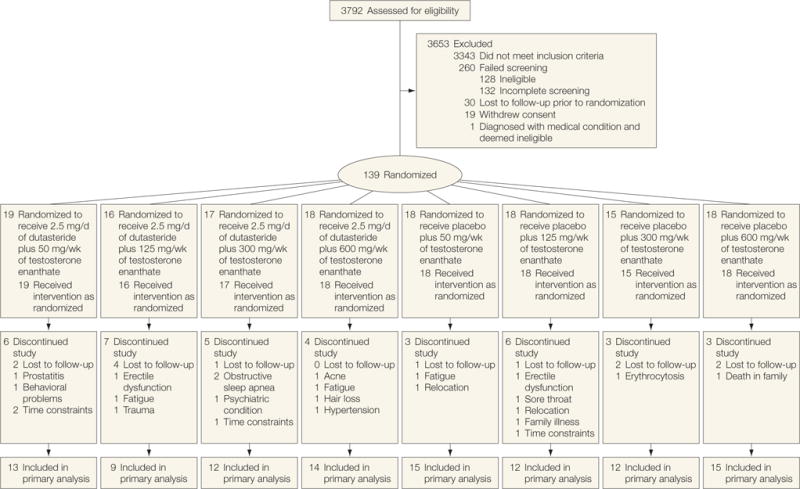
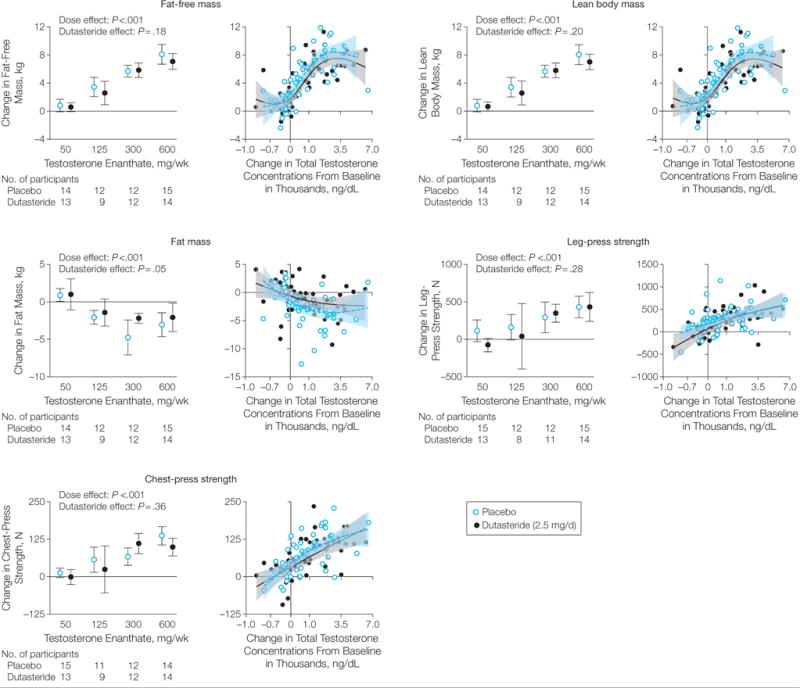
Results: A total of 139 men were randomized; 102 completed the 20-week intervention. Men assigned to dutasteride were similar at baseline to those assigned to placebo. The mean fat-free mass gained by the dutasteride groups was 0.6 kg (95% CI, -0.1 to 1.2 kg) when receiving 50 mg/wk of testosterone enanthate, 2.6 kg (95% CI, 0.9 to 4.3 kg) for 125 mg/wk, 5.8 kg (95% CI, 4.8 to 6.9 kg) for 300 mg/wk, and 7.1 kg (95% CI, 6.0 to 8.2 kg) for 600 mg/wk. The mean fat-free mass gained by the placebo groups was 0.8 kg (95% CI, -0.1 to 1.7 kg) when receiving 50 mg/wk of testosterone enanthate, 3.5 kg (95% CI, 2.1 to 4.8 kg) for 125 mg/wk, 5.7 kg (95% CI, 4.8 to 6.5 kg) for 300 mg/wk, and 8.1 kg (95% CI, 6.7 to 9.5 kg) for 600 mg/wk. The dose-adjusted differences between the dutasteride and placebo groups for fat-free mass were not significant (P = .18). Changes in fat mass, muscle strength, sexual function, prostate volume, sebum production, and hematocrit and lipid levels did not differ between groups.
Conclusion: Changes in fat-free mass in response to graded testosterone doses did not differ in men in whom DHT was suppressed by dutasteride from those treated with placebo, indicating that conversion of testosterone to DHT is not essential for mediating its anabolic effects on muscle.
Trial registration: clinicaltrials.gov Identifier: NCT00493987.
Conflict of interest statement
Figures
Comment in
-
The role of 5α-reductase inhibition in men receiving testosterone replacement therapy.JAMA. 2012 Mar 7;307(9):968-70. doi: 10.1001/jama.2012.259. JAMA. 2012. PMID: 22396520 No abstract available.
-
BPH: 5α-reductase inhibition does not adversely affect muscle mass.Nat Rev Urol. 2012 Mar 20;9(4):178. doi: 10.1038/nrurol.2012.46. Nat Rev Urol. 2012. PMID: 22430169 No abstract available.
-
Reproductive endocrinology: Testosterone metabolite nonessential for androgen effects.Nat Rev Endocrinol. 2012 Mar 20;8(5):256. doi: 10.1038/nrendo.2012.37. Nat Rev Endocrinol. 2012. PMID: 22430879 No abstract available.
-
Re: Effect of testosterone supplementation with and without a dual 5α-reductase inhibitor on fat-free mass in men with suppressed testosterone production: a randomized controlled trial.J Urol. 2012 Sep;188(3):906. doi: 10.1016/j.juro.2012.06.061. Epub 2012 Jul 20. J Urol. 2012. PMID: 22883792 No abstract available.
References
-
- Wilson JD, Griffin JE, Russell DW. Steroid 5 alpha-reductase 2 deficiency. Endocr Rev. 1993;14(5):577–593. - PubMed
-
- Shaw G, Fenelon J, Sichlau M, et al. Role of the alternate pathway of dihydrotestosterone formation in virilization of the Wolffian ducts of the tammar wallaby, Macropus eugenii. Endocrinology. 2006;147(5):2368–2373. - PubMed
-
- Wilson JD, Renfree MB, Auchus RJ, et al. Formation of 5 alpha-reduced androgens in the testes and urogenital tract of the grey short-tailed opossum, Monodelphis domestica. Reprod Fertil Dev. 2009;21(5):649–654. - PubMed
Publication types
MeSH terms
Substances
Associated data
Grants and funding
LinkOut - more resources
Full Text Sources
Medical