. 2010 Oct;1(2):147-57.
Epub 2010 Aug 26.

Insulin, IGF-1 and longevity

Affiliations
Free PMC article

Insulin, IGF-1 and longevity

Diana van Heemst. Aging Dis. 2010 Oct.
Free PMC article

Abstract

It has been demonstrated in invertebrate species that the evolutionarily conserved insulin and insulin-like growth factor (IGF) signaling (IIS) pathway plays a major role in the control of longevity. In the roundworm Caenorhabditis elegans, single mutations that diminish insulin/IGF-1 signaling can increase lifespan more than twofold and cause the animal to remain active and youthful much longer than normal. Likewise, substantial increases in lifespan are associated with mutations that reduce insulin/IGF-1 signaling in the fruit fly Drosophila melanogaster. In invertebrates, multiple insulin-like ligands exist that bind to a common single insulin/IGF-1 like receptor. In contrast, in mammals, different receptors exist that bind insulin, IGF-1 and IGF-2 with different affinities. In several mouse models, mutations that are associated with decreased GH/IGF-1 signaling or decreased insulin signaling have been associated with enhanced lifespan. However, the increased complexity of the mammalian insulin/IGF-1 system has made it difficult to separate the roles of insulin, GH and IGF-1 in mammalian longevity. Likewise, the relevance of reduced insulin and IGF-1 signaling in human longevity remains controversial. However, studies on the genetic and metabolic characteristics that are associated with healthy longevity and old age survival suggest that the conserved ancient IIS pathway may also play a role in human longevity.

Keywords: IGF-1; Insulin; longevity; signaling.


Figures
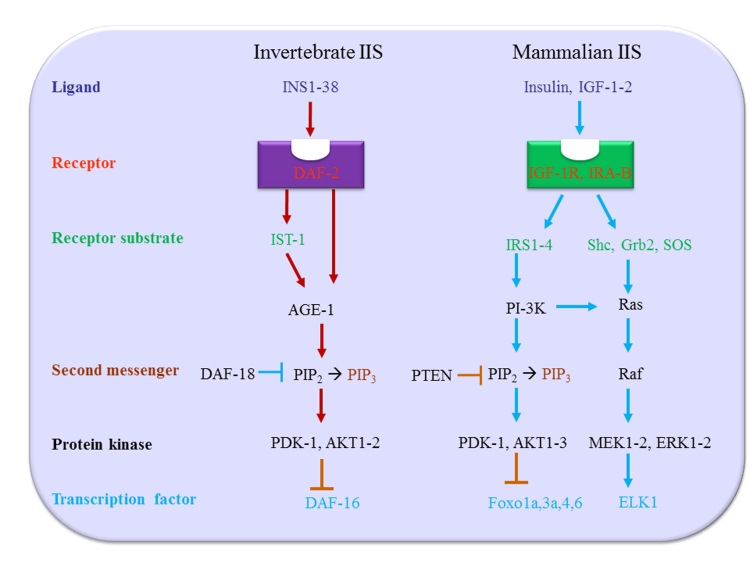
Figure 1.
Figure 1.
Simplified description of the insulin/IGF-1 signal transduction (IIS) pathway in invertebrates and mammals. In the invertebrate C.elegans, multiple insulin/IGF-1 like ligands (INS1–38) bind to a single common receptor (DAF-2). After ligand binding, the signal is transduced from the activated receptor, either directly or via the insulin receptor substrate homolog protein-1 (IST-1) to the phosphatidylinositol 3-kinase (PI-3K) AGE-1 (ageing alteration-1)/AAP-1 [9], which converts phosphatidylinositol 4,5-bisphosphate (PIP2) into phosphatidylinositol 3,4,5-trisphosphate (PIP3). Elevated levels of the second messenger PIP3 activate the 3-phosphoinositide dependent protein kinase-1 (PDK1) and the protein kinases B (PKB1-2 also known as AKT1–2), thus leading to the phosphorylation of DAF-16, a homolog of mammalian FoxO family of transcription factors by PKB1–2/AKT1–2. In mammals, three different insulin/IGF-1 receptor ligands are present: insulin, IGF-1 and IGF-2, which can bind to the insulin receptor isoforms A or B (IRA–B) or the IGF-1 receptor (IGF-1R). Upon ligand binding, activated insulin or IGF-1 receptors phosphorylate several intracellular substrates, including IR substrates (IRS1–4) and the Src-homology-2-containing protein (Shc). The phosphorylated substrates provide specific docking sites for intracellular effectors, including the p85 regulatory subunit of PI-3K and Growth-factor-receptor-bound protein-2 (Grb2). PI-3K converts PIP2 in the second messenger PIP3. Elevated levels of the second messenger activate PDK1 and PKB1–3 (also known as AKT1–3), which culminates, amongst others, in the phosphorylation the mammalian FoxO family of transcription factor members Foxo1a, 3a, 4, 6. Grb2 recruits the GDP/GTP exchange factor Son-of-Sevenless (SOS), upon which the small G-protein Ras is converted in its active conformation, leading to the activation of successively the intracellular kinases Raf (part of the family of mitogen activated protein kinase (MAPK) kinase kinases), Mitogen activated protein kinase/Extracellular-signal-regulated-Kinase kinases MEK1–2 (part of the family of MAPK kinases) and Extracellular-signal-Regulated-Kinases ERK1–2 (part of the family of MAPKs), culminating in the activation of transcription, amongst others, via the transcription factor ELK1 (member of ETS oncogene family).
Figure 2.
Figure 2.
A low insulin drive may be associated with differences in metabolism, low grade inflammation and cellular stress responses.

References

    1. Kenyon CJ. The genetics of ageing. Nature. 2010;464:504–12. - PubMed
    1. Braendle C, Milloz J, Felix MA. Mechanisms and evolution of environmental responses in Caenorhabditis elegans. Curr Top Dev Biol. 2008;80:171–207. - PubMed
    1. Klass M, Hirsh D. Non-ageing developmental variant of Caenorhabditis elegans. Nature. 1976;260:523–5. - PubMed
    1. Gems D, Sutton AJ, Sundermeyer ML, Albert PS, King KV, Edgley ML, Larsen PL, Riddle DL. Two pleiotropic classes of daf-2 mutation affect larval arrest, adult behavior, reproduction and longevity in Caenorhabditis elegans. Genetics. 1998;150:129–55. - PMC - PubMed
    1. Tissenbaum HA, Ruvkun G. An insulin-like signaling pathway affects both longevity and reproduction in Caenorhabditis elegans. Genetics. 1998;148:703–17. - PMC - PubMed

LinkOut - more resources