. 2011 Feb;2(1):49-63.
Epub 2011 Sep 20.

Aging of the subventricular zone neural stem cell niche

Affiliations
Free PMC article

Aging of the subventricular zone neural stem cell niche

Joanne C Conover et al. Aging Dis. 2011 Feb.
Free PMC article

Abstract

The persistence of an active subventricular zone neural stem cell niche in the adult mammalian forebrain supports its continued role in the production of new neurons and in generating cells to function in repair through adulthood. Unfortunately, with increasing age the niche begins to deteriorate, compromising these functions. The reasons for this decline are not clear. Studies are beginning to define the molecular and physiologic changes in the microenvironment of the aging subventricular zone niche. New revelations from aging studies will allow for a more thorough understanding of which reparative functions are lost in the aged brain, the progression of niche demise and the possibility for therauptic intervention to improve aging brain function.

Keywords: Aging; Parkinson’s disease; demyelinating lesions; ependymal damage; neural stem cells; neurogenesis; stroke; subventricular zone.


Figures
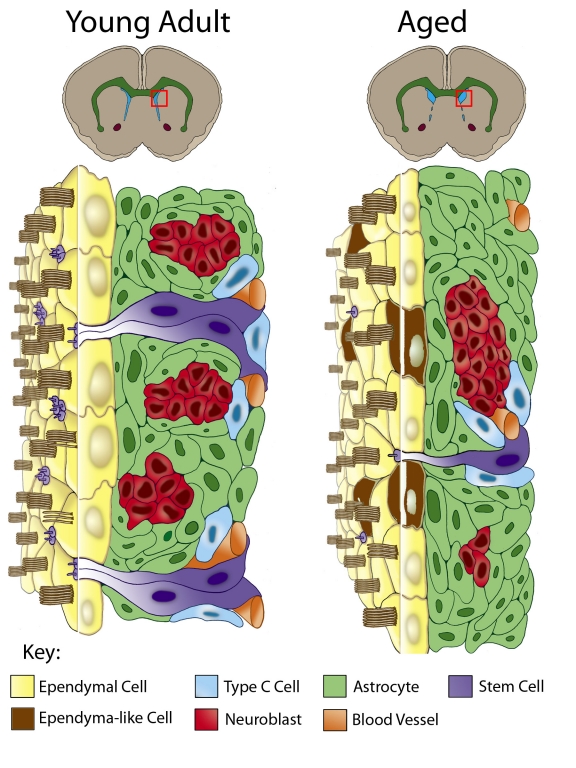
Figure 1.
Figure 1.
Comparative cytoarchitecture of the SVZ through aging. Due to age-related stenosis of the ventral lateral ventricle walls, only the dorsolateral SVZ remains proliferative and the dorsal ventricle (blue in upper coronal brain images) expands. The red box in each schematic represents the dorsolateral SVZ depicted in more detail below. The young adult SVZ is organized below an ependyma monolayer (yellow cells) and includes astrocytes (green cells), astrocytes with an apical and basal process spanning the SVZ (NSCs, purple cells), neuroblasts (red cells), Type C cells (blue cells) and basally located blood vessels (orange). In the aged SVZ there is a significant reduction of the SVZ, with fewer astrocytes possessing an apical process and fewer neuroblasts and Type C cells. Additionally, some SVZ astrocytes (brown cells) are found incorporated within the ependymal monolayer. These integrated astrocytes are derived from dividing astrocytes and take on ependyma-like characteristics.
Figure 2.
Figure 2.
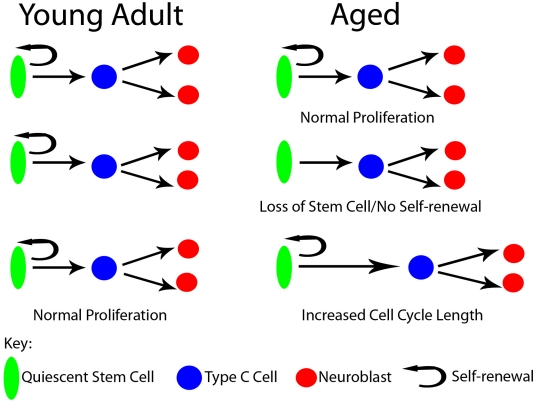
Proliferation in the young, adult SVZ via the stem cell generates another quiescent stem cell and neural progeny through a transitory amplifying cell. In the aged SVZ proliferation is reduced due to loss of stem cell numbers, inability to self-renew or increases in cell cycle length.
Figure 3.
Figure 3.
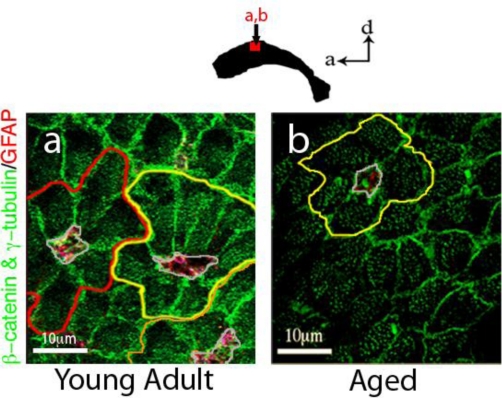
Apical processes of SVZ astrocytes that contact the ventricle decline with age. a, In young adult (3-month old) mice, many pinwheels (outlined in red, yellow and orange) and their core of astrocytic processes (outlined in grey) can be detected. b, In elderly (2-year old) mice, there are significantly fewer intact pinwheel structures (only one is found in this section). In addition, only one or two astrocytic processes are found at the core, versus 3–5 in young mice. Images were taken using a Leica TCS SP2 confocal microscope. β-catenin defines cell boundaries of astrocytes and ependymal cells, γ-tubulin labels basal bodies (multiple found in ependymal cells and a single basal body of the primary cilium found in astrocytes) and GFAP marks astrocytes.

References

    1. Aimone JB, Wiles J, Gage FH. Computational influence of adult neurogenesis on memory encoding. Neuron. 2009;61:187–202. - PMC - PubMed
    1. Clelland CD, Choi M, Romberg C, Clemenson GD, Jr, Fragniere A, Tyers P, Jessberger S, Saksida LM, Barker RA, Gage FH, Bussey TJ. A functional role for adult hippocampal neurogenesis in spatial pattern separation. Science. 2009;325:210–213. - PMC - PubMed
    1. Deng W, Saxe MD, Gallina IS, Gage FH. Adult-born hippocampal dentate granule cells undergoing maturation modulate learning and memory in the brain. J Neurosci. 2009;29:13532–13542. - PMC - PubMed
    1. Garthe A, Behr J, Kempermann G. Adult-generated hippocampal neurons allow the flexible use of spatially precise learning strategies. PLoS One. 2009;4:e5464. - PMC - PubMed
    1. Kriegstein A, Alvarez-Buylla A. The glial nature of embryonic and adult neural stem cells. Annu Rev Neurosci. 2009;32:149–184. - PMC - PubMed

LinkOut - more resources