. 2011 Apr;2(2):138-48.
Epub 2011 Feb 6.

Ischemic preconditioning in the younger and aged heart

Affiliations
Free PMC article

Ischemic preconditioning in the younger and aged heart

Pasquale Abete et al. Aging Dis. 2011 Apr.
Free PMC article

Abstract

Ischemic preconditioning is the effect of brief ischemic episodes which protect the heart from the following more prolonged ischemic episode. This mechanism is effective in younger but not in aged heart. The age-related reduction of ischemic preconditioning has been demonstrated in experimental models and in elderly patients. Preinfarction angina, a clinical equivalent of ischemic preconditioning, reduces mortality in adult but not in elderly patients with acute myocardial infarction. Physical activity or caloric restriction is partially capable to preserve the cardioprotective effect of ischemic preconditioning in the aging heart. More importantly, physical activity and caloric restriction in tandem action completely preserve the protective mechanism of ischemic preconditioning. Accordingly, the protective mechanism of preinfarction angina is preserved in elderly patients with a high grade of physical activity or a low body-mass index. Thus, both physical activity and caloric restriction are confirmed as powerful anti-aging interventions capable to restore age-dependent reduction of a critical endogenous protective mechanism such as ischemic preconditioning.

Keywords: Aged; caloric restriction; heart; ischemia; preconditioning; younger.


Figures
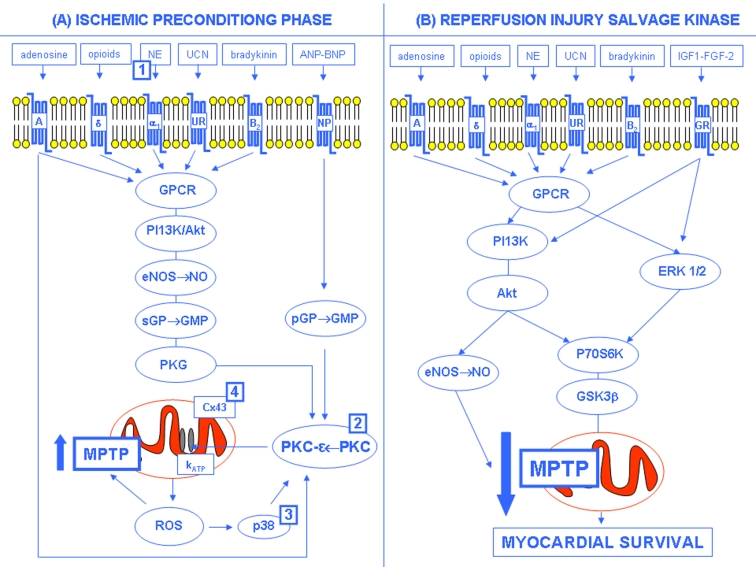
Fig. 1:
Fig. 1:
Hypothetical mechanism of IP-induced cardioprotection (see text for details). (A) Ischemic preconditioning phase: NE=Norepinephrine; UCN=Urocortins; ANP=Atrial Natriuretic Peptide; BNP=Brain Natriuretic Peptide; GPCR=G-protein coupled receptor; NPR, natriuretic peptide receptor; PI3K=Phosphatydil-inositol 3 kinase; Akt=serine/threonine kinase; serine/threonine kinase eNOS=endothelial Nitric Oxide Synthase; NO=Nitric Oxide; sGC=soluble Guanylate Cyclase; GMP=Guanosine MonoPhosphate; pGC=particulate Guanylate Cyclase; PKG=Protein Kinase G; PKC=Protein Kinase C; Cx43=Connexin 43; KATP=Mitochondrial potassium ATP-dependent channels; ROS=Reactive Oxygen Species; MPTP=Mitochondrial Permeability Transition Pore; p38=p38 mitogen-activated protein kinase. (B) Reperfusion Injury Salvage Kinase (RISK): IGF-1, insulin-like growth factor; FGF-2, fibroblast growth factor 2; GFR=Growth Factor Receptor; ERK=extracellular regulated kinase; P70S6K=p70 ribosomal S6 protein kinase; GSK3ß=glycogen synthase kinase 3beta. In (A), the numbers in squares indicate the age-related IP impairment sites: 1=Abete et al., 1996; 2=Tani et al., 2001; 3=Fenton et al., 2005; 4=Boengler et al., 2007 (with permission, Abete P et al., 2010) [56].
Fig. 2:
Fig. 2:
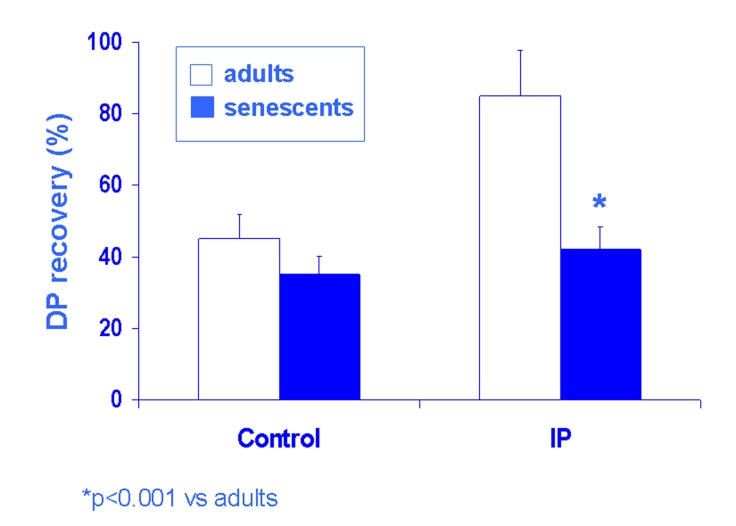
The age-related reduction of IP in the isolated and perfused rat heart is shown. In Langendorff experiments left ventricular developed pressure (DP) recovered ≈ 40–50% in controls (standard ischemia [20 min] – reperfusion [40 min] insult) of both adult and senescent rat hearts (A). In preconditioning experiments (ischemia 2 min followed by 10 min of reperfusion and then a standard ischemia – reperfusion insult) (IP), DP recovered ≈ 80% in adult but not in senescent hearts (*p<0.001 vs. adults).
Fig. 3:
Fig. 3:
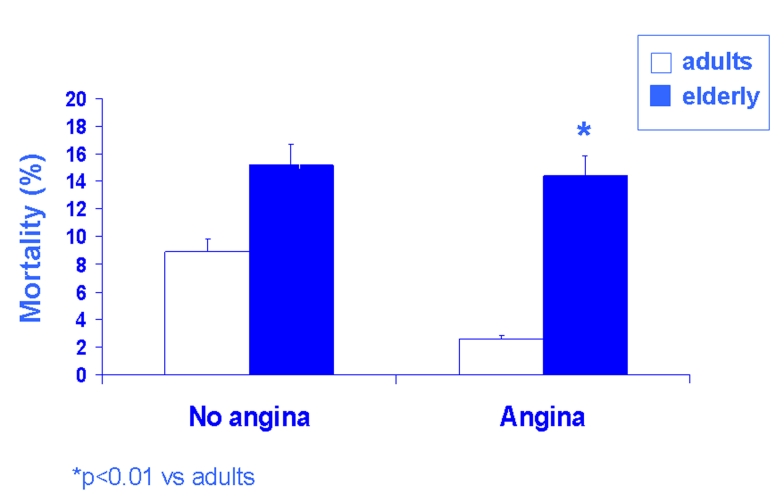
The age-related reduction of the cardioprotective effect of preinfarction angina, a clinical equivalent of IP, is shown. Bar graphs show that in-hospital mortality was similar in adults and elderly patients. In contrast, in the presence of angina, in-hospital mortality was lower in adults than in elderly patients. Thus, preinfarction angina is protective against in-hospital mortality in adults but not in elderly patients.
Fig. 4:
Fig. 4:
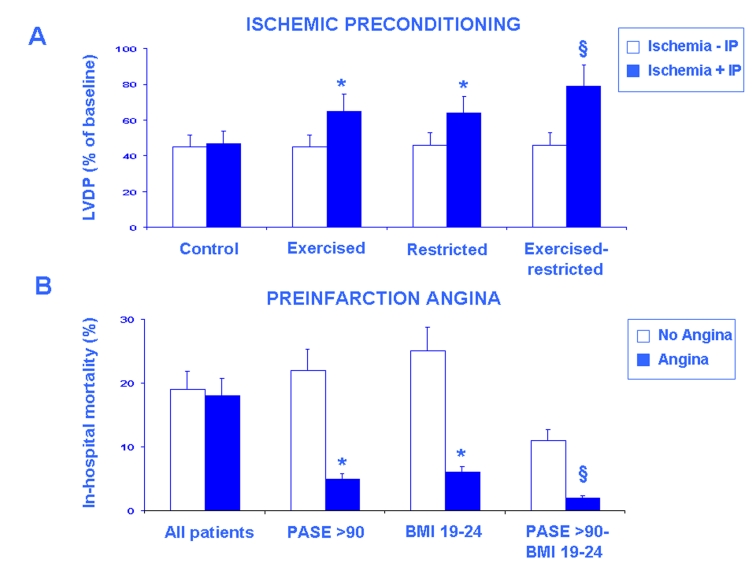
The restoration of the age-related of IP by exercise training and caloric restriction in the isolated and perfused rat heart is shown in panel A. Bar graphs show the recovery of left ventricular developed pressure (LVDP) (% of basal) at the end of reperfusion in sedentary ad libitum fed (control), trained ad libitum fed, sedentary food-restricted and trained- and food-restricted senescent hearts subjected to ischemia (20 min) and reperfusion (40 min) (Ischemia - IP) and pre-treated with preconditioning stimulus of 2 min followed by 10 min of reperfusion (Ischemia + IP). LVDP recovery was similar in the absence and the presence of IP. Exercise training and caloric restriction restored IP (p<0.01 vs. Control) and this effect was more evident in hearts from trained- and food-restricted rats (§p<0.001 vs. Control). The preservation of the age-related reduction of the cardio-protective effect of preinfarction angina, a clinical equivalent of IP, by physical activity evaluated by Physical Activity Scale for the Elderly (PASE) score and by a normal body-mass index (BMI) is shown in B. Bar graphs show that in-hospital mortality percentage was similar in elderly patients without and with preinfarction angina but it was lower in elderly patient with preinfarction angina with high PASE score (>90) and normal BMI (19–24) (§p<0.05 vs. all patients). This effect was more evident in elderly patients with the highest PASE (>90) and the normal BMI (19–24) (*p<0.01 vs. all patients) (with permission, Abete P et al., 2010) [56].
Figure 5:
Figure 5:
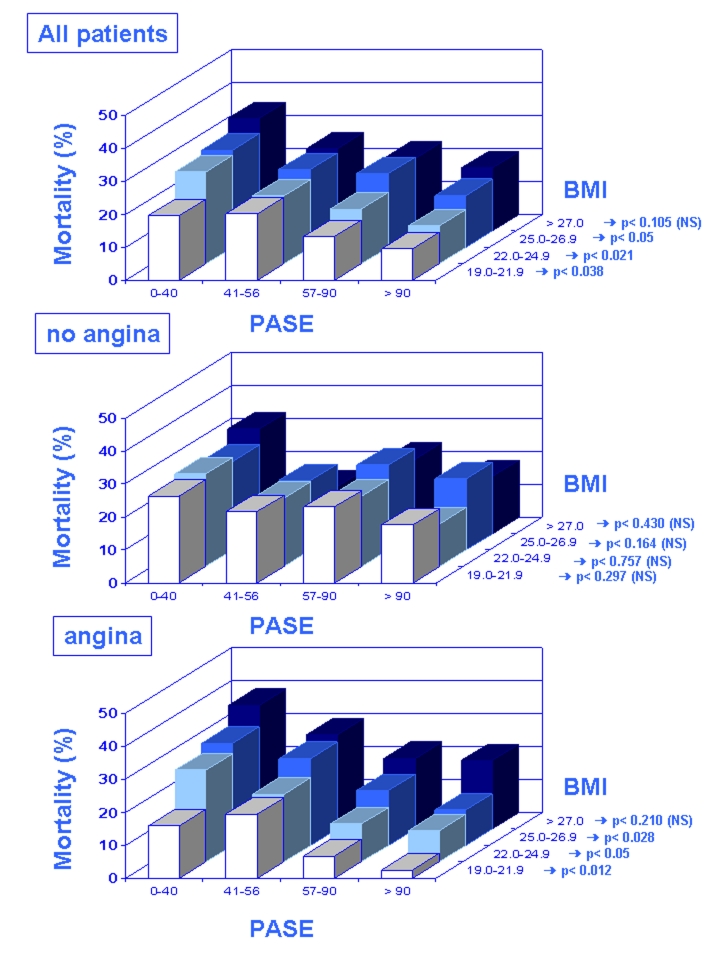
Mortality for acute myocardial infarction in all elderly patients (A), in those without (no angina, B) and in those with (angina, C) preinfarction angina according to quartiles of physical activity (PASE) combined with each body mass index (BMI) quartile is shown. In-hospital death was lowest in elderly patients “with preinfarction angina” in the highest PASE score and in the lowest BMI subgroups (with permission, Abete P et al., 2009) [55].

References

    1. Murry CE, Jennings RB, Reimer KA. Preconditioning with ischemia: a delay of lethal cell injury in ischemic myocardium. Circulation. 1986;74:1124–36. - PubMed
    1. Kloner RA, Bolli R, Marban E, Reinlib L, Braunwald E. Medical and cellular implications of stunning, hibernation and preconditioning. An NHLBI workshop. Circulation. 1998;97:1848–67. - PubMed
    1. Napoli C, Pinto A, Cirino G. Pharmacological modulation, preclinical studies, and new clinical features of myocardial ischemic preconditioning. Pharmacol Ther. 2000;88:311–31. - PubMed
    1. Yellon DM, Downey JM. Preconditioning the myocardium: from cellular physiology to clinical cardiology. Physiol Rev. 2003;83:1113–51. - PubMed
    1. Vinten-Johansen J, Zhao ZQ, Jiang R, Zatta AJ, Dobson GP. Preconditioning and postconditioning: innate cardioprotection from ischemia-reperfusion injury. J Appl Physiol. 2007;103:1441–8. - PubMed

LinkOut - more resources