


β,γ-CHF- and β,γ-CHCl-dGTP diastereomers: synthesis, discrete 31P NMR signatures, and absolute configurations of new stereochemical probes for DNA polymerases
- PMID: 22397499
- PMCID: PMC3595068
- DOI: 10.1021/ja300218x
β,γ-CHF- and β,γ-CHCl-dGTP diastereomers: synthesis, discrete 31P NMR signatures, and absolute configurations of new stereochemical probes for DNA polymerases
Abstract
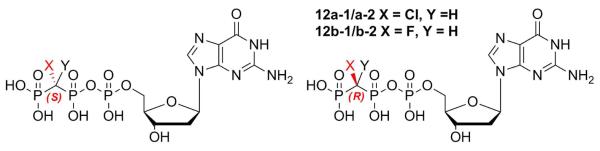
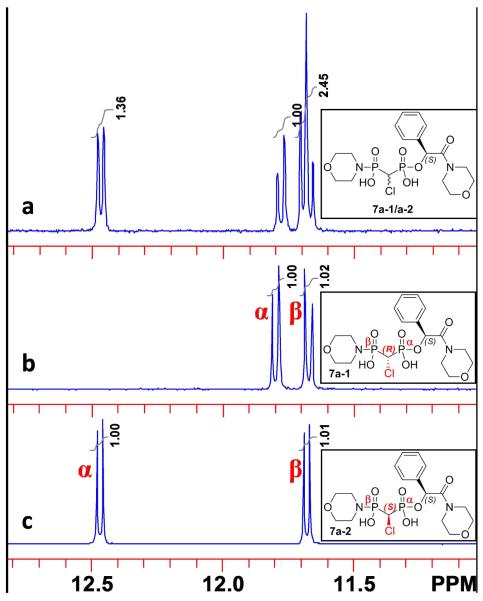
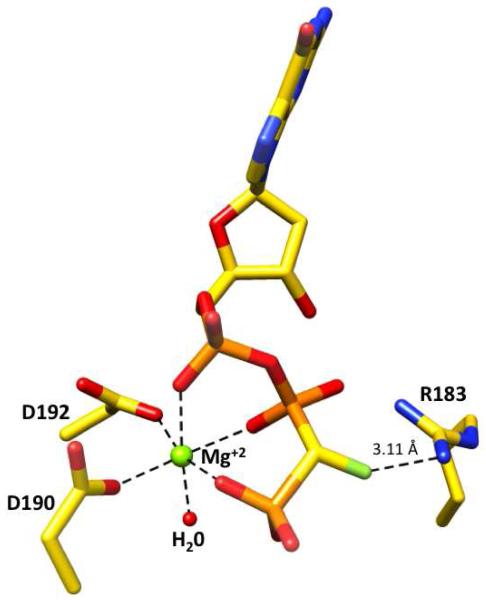
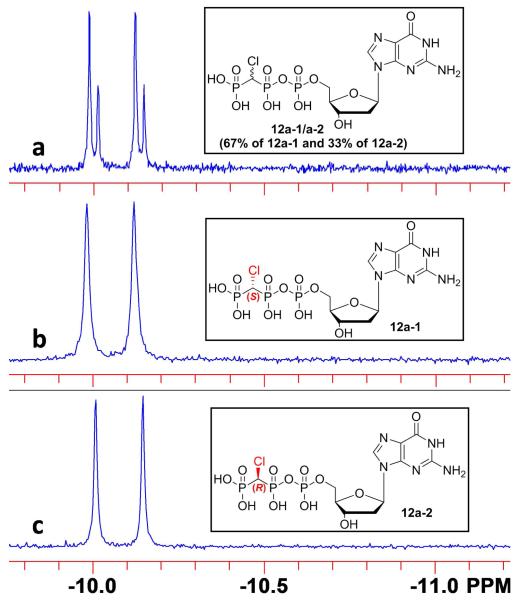
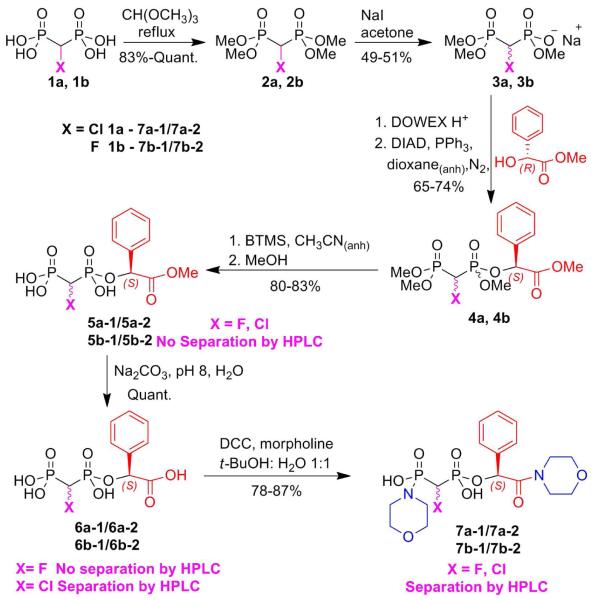
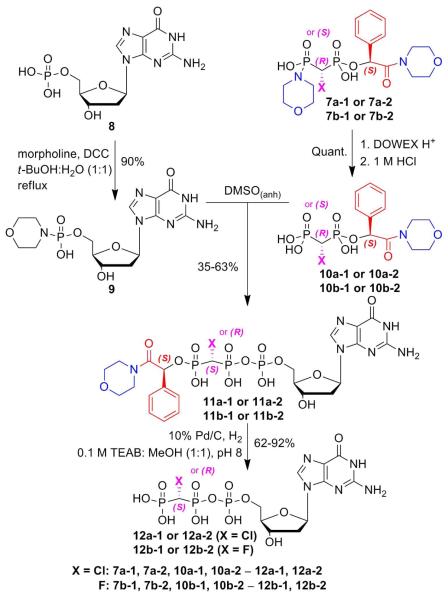
Deoxynucleoside 5'-triphosphate analogues in which the β,γ-bridging oxygen has been replaced with a CXY group are useful chemical probes to investigate DNA polymerase catalytic and base-selection mechanisms. A limitation of such probes has been that conventional synthetic methods generate a mixture of diastereomers when the bridging carbon substitution is nonequivalent (X ≠ Y). We report here a general solution to this long-standing problem with four examples of β,γ-CXY dNTP diastereomers: (S)- and (R)-β,γ-CHCl-dGTP (12a-1/12a-2) and (S)- and (R)-β,γ-CHF-dGTP (12b-1/12b-2). Central to their preparation was conversion of the prochiral parent bisphosphonic acids to the P,C-dimorpholinamide derivatives 7 of their (R)-mandelic acid monoesters, which provided access to the individual diastereomers 7a-1, 7a-2, 7b-1, and 7b-2 by preparative HPLC. Selective acidic hydrolysis of the P-N bond then afforded "portal" diastereomers, which were readily coupled to morpholine-activated dGMP. Removal of the chiral auxiliary by H(2) (Pd/C) gave the four individual diastereomeric nucleotides 12, which were characterized by (31)P, (1)H, and (19)F NMR spectroscopy and by mass spectrometry. After treatment with Chelex-100 to remove traces of paramagnetic ions, at pH ~10 the diastereomer pairs 12a,b exhibit discrete P(α) and P(β)(31)P resonances. The more upfield P(α) and more downfield P(β) resonances (and also the more upfield (19)F NMR resonance in 12b) are assigned to the R configuration at the P(β)-CHX-P(γ) carbons on the basis of the absolute configurations of the individual diastereomers as determined from the X-ray crystallographic structures of their ternary complexes with DNA and polymerase β.
Figures
References
-
- McKenna CE, Shen P-D. J. Org. Chem. 1981;46:4573.
- Berkowitz DB, Bose M. J. Fluorine Chem. 2001;112:13.
- Blackburn GM, Kent DE, Kolkmann F. J. Chem. Soc., Chem. Commun. 1981;1188
- Davisson VJ, Davis DR, Dixit VM, Poulter CD. J. Org. Chem. 1987;52:1794.
-
- Alexandrova LA, Skoblov AY, Jasko MV, Victorova LS, Krayevsky AA. Nuc. Acids Res. 1998;26:778. - PMC - PubMed
- Arabshahi L, Khan NN, Butler M, Noonan T, Brown NC, Wright GE. Biochemistry. 1990;29:6820. - PubMed
- Hamilton CJ, Roberts SM, Shipitsin A. Chem. Commun. 1998;1087
- Krayevsky A, Arzumanov A, Shirokova E, Dyatkina N, Victorova L, Jasko M, Alexandrova L. Nucleosides Nucleotides. 1998;17:681. - PubMed
- Martynov BI, Shirokova EA, Jasko MV, Victorova LS, Krayevsky AA. FEBS Lett. 1997;410:423. - PubMed
- Shipitsin AV, Victorova LS, Shirokova EA, Dyatkina NB, Goryunova LE, Beabealashvilli RS, Hamilton CJ, Roberts SM, Krayevsky A. J. Chem. Soc. Perkin Trans. 1. 1999;1039 - PubMed
- Spelta V, Mekhalfia A, Rejman D, Thompson M, Blackburn GM, North RA. Br. J. Pharmacol. 2003;140:1027. - PMC - PubMed
- Kashemirov BA, Roze CN, McKenna CE. Phosphorus Sulfur Silicon Relat. Elem. 2002;177:2275. - PMC - PubMed
- Boyle NA, Fagan P, Brooks JL, Prhavc M, Lambert J, Cook PD. Nucleosides Nucleotides Nucleic Acids. 2005;24:1651. - PubMed
-
-
This limitation as applied to β,γ-CHF ATP has long been recognized: Blackburn GM, Kent DE, Kolkmann F. J. Chem. Soc. Perkin Trans. 1. 1984;1119 These authors reported that the diastereomer resonances in this compound mixture could not be distinguished in 19F (94.08 MHz) and 31P (40.48 and 162 MHz) NMR.
-
Publication types
MeSH terms
Substances
Grants and funding
LinkOut - more resources
Full Text Sources
