. 2012 Mar 8;10(1):16.
doi: 10.1186/1477-5956-10-16.

Proteomic analysis of soybean defense response induced by cotton worm (prodenia litura, fabricius) feeding

Affiliations

Proteomic analysis of soybean defense response induced by cotton worm (prodenia litura, fabricius) feeding

Rui Fan et al. Proteome Sci. .

Abstract

Background: Cotton worm is one of the main insects of soybean in southern China. Plants may acquire defense mechanisms that confer protection from predation by herbivores. Induced responses can lead to increased resistance against herbivores in many species. This study focuses on searching changed proteins in soybean defense response induced by cotton worm feeding.

Results: Ten protein spots that are changed in abundance in response to cotton worm feeding were identified by Two-dimensional gel electrophoresis (2-DE). A total of 11 unique proteins from these spots were identified by MALDI-TOF MS. The mRNA and protein relative expression levels of most changed proteins were up-regulated. These proteins were mainly involved in physiological processes, including active oxygen removal, defense signal transduction, and metabolism regulation.

Conclusion: This is the first proteomic analysis of the soybean defense response induced by cotton worm. The differentially expressed proteins could work together to play a major role in the induced defense response. PAL and SAMS were up-regulated at both the protein and mRNA levels. These genes can be strongest candidates for further functional research.


Figures
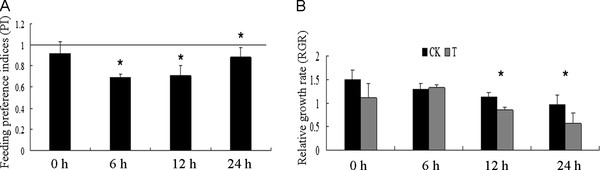
Figure 1
Figure 1
Identification of induced resistance. A, Feeding preference indices in dual-choice tests.B, Relative growth rate of cotton worms fed with control (CK) and treated (T) leaves. Error bars represent the standard deviation. * Significant (P < 0.05).
Figure 2
Figure 2
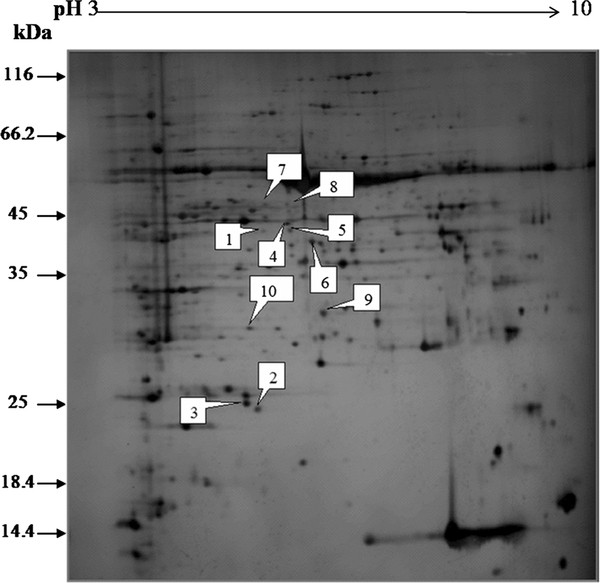
Representative silver-stained 2D-PAGE gel of separated soybean leaf proteins. Proteins were separated in the first dimension on a nonlinear IPG strip, pH 3.0-10.0, and in the second dimension on a 12% polyacrylamide SDS-gel. Quantitative image analysis revealed a total of 10 spots that changed in abundance.
Figure 3
Figure 3
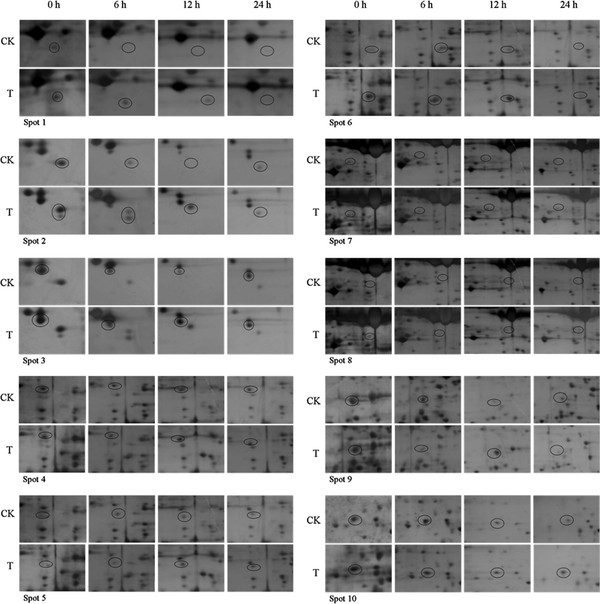
Enlarged maps of the 10 differentially expressed protein spots. CK: control; T: soybean leaves treated with cotton worm feeding.
Figure 4
Figure 4
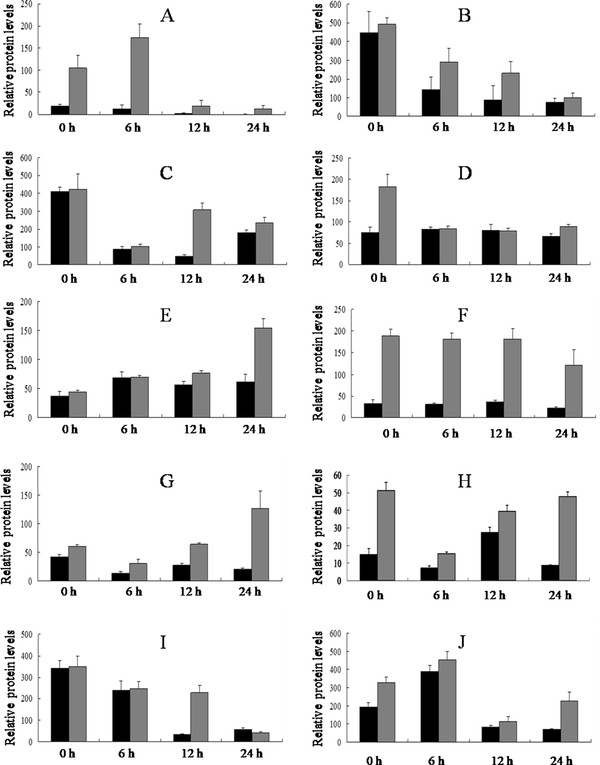
The volume changes of 10 differentially expressed spots. Control (black) and treated (gray). A - Jrepresent spot 1 - 10 respectively. Error bars represent the SD. The scales are different for the different proteins.
Figure 5
Figure 5
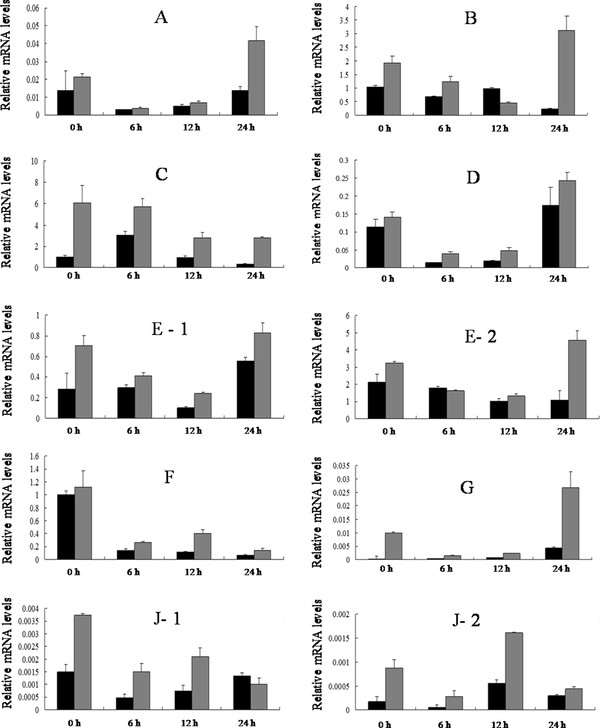
The expression of 10 differentially expressed spots at the corresponding mRNA level. A represents spot 1.B represents spot 2 and 9. C - Grepresent spot 3 - 7 respectively. J represents spot 10. A, serine/threonine kinase-related protein.B, ribulose-1,5- bisphosphate carboxylase/oxygenase large subunit. C, Vegetative storage protein A. D, cytosolic phosphoglycerate kinase.E- 1, ATP synthase beta subunit. E- 2, malate dehydrogenase. F, phenylalanine ammonia-lyase.G, S-adenosylmethionine synthetase.J- 1, ascorbate peroxidase. J- 2, 20S proteasome alpha subunit. Error bars represent the SD. The scales are different for the different genes.

References

    1. Krishnan HB. Biochemistry and molecular biology of soybean seed storage proteins. New Seeds. 2000;2:1–25. doi: 10.1300/J153v02n04_01. - DOI
    1. Thelen JJ, Ohlrogge JB. Metabolic engineering of fatty acid biosynthesis in plants. Metab Eng. 2002;4:12–21. doi: 10.1006/mben.2001.0204. - DOI - PubMed
    1. Cui ZL, Gai JY. A study of leaf--feeding insect species on soybeans in Nanjing area. Soybean Science. 1997;16:12–20.
    1. Zhan QW, Gai JY, Zhang YM, Sun ZD. Development and expression process of inheritance of resistance to cotton worm (prodinia litura) in soybeans. Acta Genetica Sinica. 2001;28:956–963. - PubMed
    1. Zhang PJ, Shu JP, Fu CX, Zhou Y, Hu Y, Zalucki MP, Liu SS. Trade-offs between constitutive and induced resistance in wild crucifers shown by a natural, but not an artificial, elicitor. Oecologia. 2008;157:83–92. doi: 10.1007/s00442-008-1060-8. - DOI - PubMed

LinkOut - more resources