Review
. 2012 Mar;10(3):391-400.
doi: 10.1586/eri.11.176.

Immunomodulation for gastrointestinal infections

Affiliations
Review

Immunomodulation for gastrointestinal infections

Roberto J Cieza et al. Expert Rev Anti Infect Ther. 2012 Mar.

Abstract

The intestinal epithelium provides a barrier between a variety of luminal antigens and provides the components of intestinal innate and adaptive immunity. It is crucial that at this interface, the epithelial cell layer and the components of the intestinal immunity interact with dietary and bacterial antigens in a regulated way to maintain homeostasis. Failure to tightly control immune reactions can be detrimental and result in inflammation. In the current review, we described the regulatory mechanisms controlling host-immune homeostasis and the role of regulatory CD4(+) T cells, with a special emphasis in the regulatory T-cell subsets (Tregs). Furthermore, the participation of innate cell cross-talk in the polarization of intestinal immune responses is also evaluated. Finally, the recent characterization of host responses to normal commensal flora, the role of bacteria and bacterial factors in the maintenance of immunomodulation, and the disruption of this balance by bacterial enteric pathogens is also summarized.


Figures
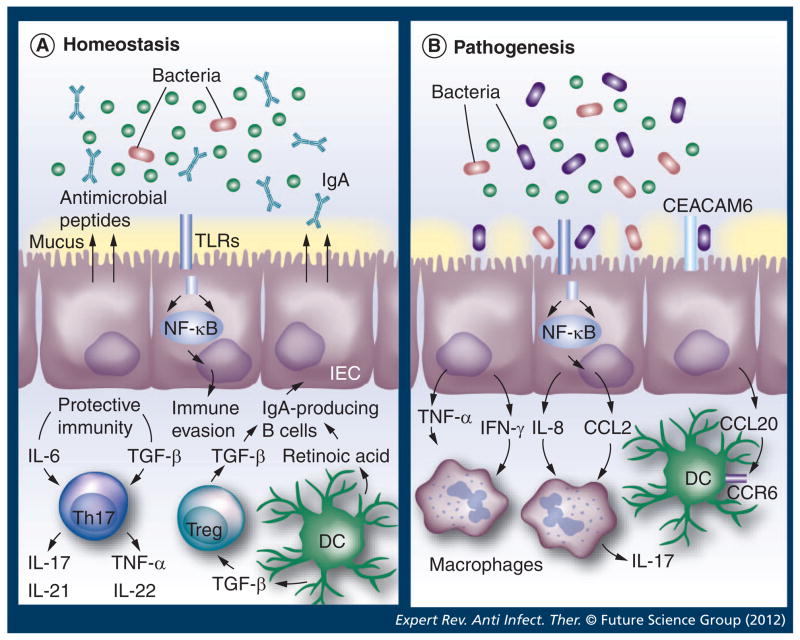
Figure 1
Figure 1. Intestinal homeostasis and its breakdown during pathogenic processes
(A) Intestinal homeostasis requires the establishment of a balance between the microbiota, the intestinal epithelium and the host immune system. Diverse regulatory mechanisms and cross-talk between intestinal and immune cells help to maintain intestinal homeostasis, and a breakdown in these pathways may precipitate the inflammatory pathology observed during pathogenic processes (B). IECs and intestinal DCs sense distinct infectious agents, leading to the production of factors that direct different immune responses (black arrows). Regulatory T cell (Treg; blue) can suppress all types of inflammatory responses and enhance the production of protective secretory IgA antibodies. Th17 type (purple), together with other Th cell types, participate in the maintenance of the protective immunity. CD103+ DCs display the ability to drive the differentiation of Tregs and to inhibit Th1 and Th17 cell development. A bacterial pathogenic process causes the destruction of the intestinal epithelial integrity, resulting in the recruitment of immune cells to the site of infection. Inflammation may affect the differentiation of tolerogenic macrophages from recruited monocytes, leading to reduction in Treg differentiation and inability to control the activity of DCs. As a result, a pathogenic process is initiated. DC: Dendritic cell; IEC: Intestinal epithelial cell; TLR: Toll-like receptor.

References

    1. Maloy KJ, Powrie F. Intestinal homeostasis and its breakdown in inflammatory bowel disease. Nature. 2011;474:298–306. Excellent overview of the factors affecting the balance between homeostasis and intestinal inflammation. - PubMed
    1. Jarchum I, Pamer EG. Regulation of innate and adaptive immunity by the commensal microbiota. Curr Opin Immunol. 2011;23:353–360. - PMC - PubMed
    1. Kunisawa J, Kurashima Y, Kiyono H. Gut-associated lymphoid tissues for the development of oral vaccines. Adv Drug Deliv Rev. 2011 doi: 10.1016/j.addr.2011.07.003. (Epub ahead of print) - DOI - PubMed
    1. Peters BM, Shirtliff ME, Jabra-Rizk MA. Antimicrobial peptides: primeval molecules or future drugs? PLoS Pathog. 2010;6:e1001067. - PMC - PubMed
    1. Fagarasan S, Kawamoto S, Kanagawa O, Suzuki K. Adaptive immune regulation in the gut: T cell-dependent and T cell-independent IgA synthesis. Annu Rev Immunol. 2010;28:243–273. - PubMed

Publication types
