Intratumor heterogeneity and branched evolution revealed by multiregion sequencing
- PMID: 22397650
- PMCID: PMC4878653
- DOI: 10.1056/NEJMoa1113205
Intratumor heterogeneity and branched evolution revealed by multiregion sequencing
Erratum in
- N Engl J Med. 2012 Sep 6;367(10):976
Abstract
Background: Intratumor heterogeneity may foster tumor evolution and adaptation and hinder personalized-medicine strategies that depend on results from single tumor-biopsy samples.
Methods: To examine intratumor heterogeneity, we performed exome sequencing, chromosome aberration analysis, and ploidy profiling on multiple spatially separated samples obtained from primary renal carcinomas and associated metastatic sites. We characterized the consequences of intratumor heterogeneity using immunohistochemical analysis, mutation functional analysis, and profiling of messenger RNA expression.
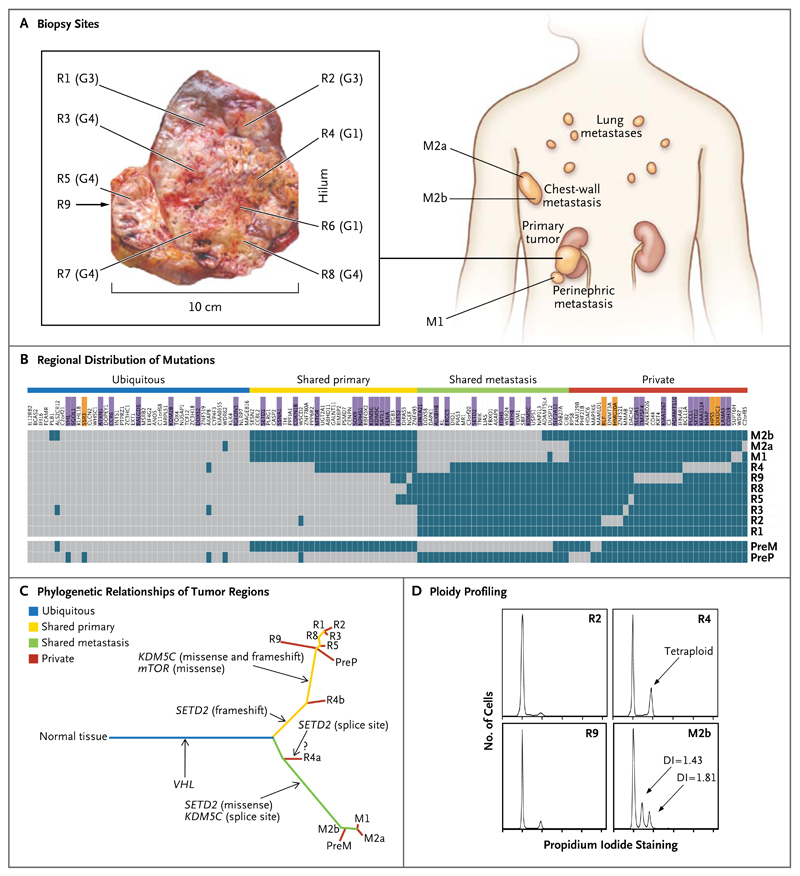
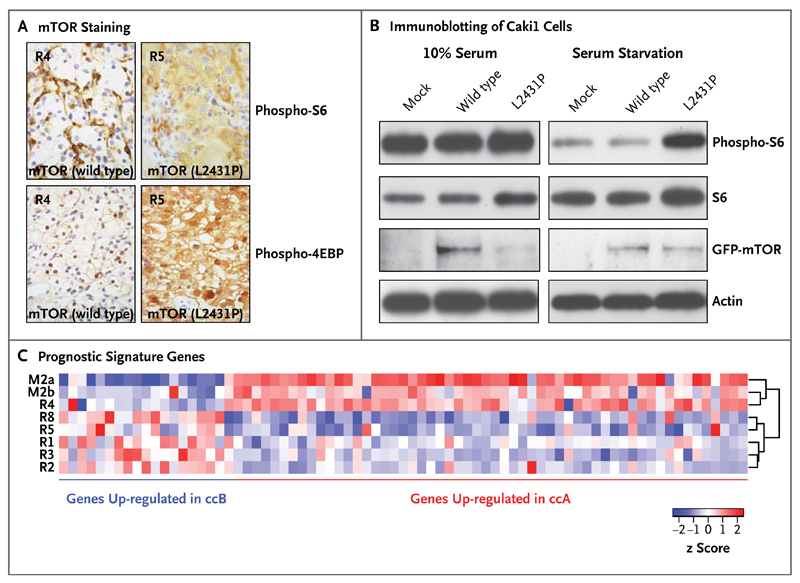
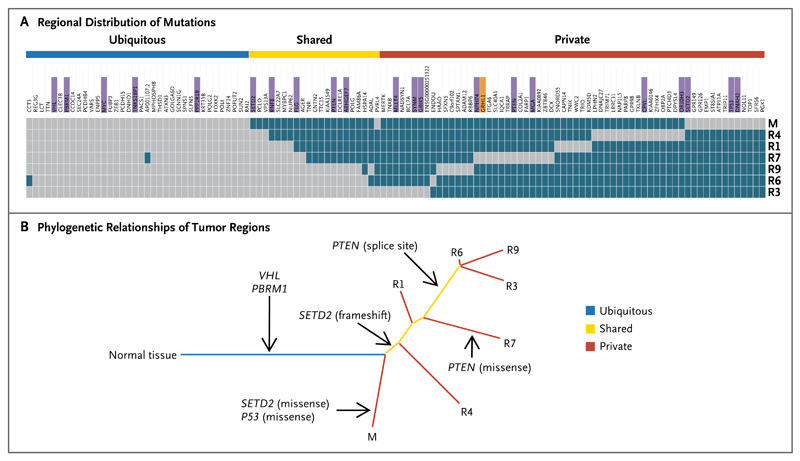
Results: Phylogenetic reconstruction revealed branched evolutionary tumor growth, with 63 to 69% of all somatic mutations not detectable across every tumor region. Intratumor heterogeneity was observed for a mutation within an autoinhibitory domain of the mammalian target of rapamycin (mTOR) kinase, correlating with S6 and 4EBP phosphorylation in vivo and constitutive activation of mTOR kinase activity in vitro. Mutational intratumor heterogeneity was seen for multiple tumor-suppressor genes converging on loss of function; SETD2, PTEN, and KDM5C underwent multiple distinct and spatially separated inactivating mutations within a single tumor, suggesting convergent phenotypic evolution. Gene-expression signatures of good and poor prognosis were detected in different regions of the same tumor. Allelic composition and ploidy profiling analysis revealed extensive intratumor heterogeneity, with 26 of 30 tumor samples from four tumors harboring divergent allelic-imbalance profiles and with ploidy heterogeneity in two of four tumors.
Conclusions: Intratumor heterogeneity can lead to underestimation of the tumor genomics landscape portrayed from single tumor-biopsy samples and may present major challenges to personalized-medicine and biomarker development. Intratumor heterogeneity, associated with heterogeneous protein function, may foster tumor adaptation and therapeutic failure through Darwinian selection. (Funded by the Medical Research Council and others.).
Conflict of interest statement
Disclosure forms provided by the authors are available with the full text of this article at NEJM.org.
Figures
Comment in
-
Tumor heterogeneity and personalized medicine.N Engl J Med. 2012 Mar 8;366(10):956-7. doi: 10.1056/NEJMe1200656. N Engl J Med. 2012. PMID: 22397658 No abstract available.
-
Genetics: Personalized medicine and tumour heterogeneity.Nat Rev Clin Oncol. 2012 Mar 20;9(5):250. doi: 10.1038/nrclinonc.2012.46. Nat Rev Clin Oncol. 2012. PMID: 22430855 No abstract available.
-
Kidney cancer: bad news for personalized therapy.Nat Rev Urol. 2012 Apr 11;9(4):179. doi: 10.1038/nrurol.2012.53. Nat Rev Urol. 2012. PMID: 22491390 No abstract available.
-
Tumour heterogeneity: Darwin's finches.Nat Rev Cancer. 2012 Apr 12;12(5):317. doi: 10.1038/nrc3269. Nat Rev Cancer. 2012. PMID: 22495322 No abstract available.
-
Intratumor heterogeneity and branched evolution.N Engl J Med. 2012 May 31;366(22):2132; author reply 2133. doi: 10.1056/NEJMc1204069. N Engl J Med. 2012. PMID: 22646642 No abstract available.
-
Intratumor heterogeneity and branched evolution.N Engl J Med. 2012 May 31;366(22):2132; author reply 2133. doi: 10.1056/NEJMc1204069. N Engl J Med. 2012. PMID: 22646643 No abstract available.
-
Impact of intra-individual molecular heterogeneity in personalized treatment of hepatocellular carcinoma.Hepatology. 2012 Dec;56(6):2416-9. doi: 10.1002/hep.26124. Hepatology. 2012. PMID: 23212778 No abstract available.
-
Re: intratumor heterogeneity and branched evolution revealed by multiregion sequencing.Eur Urol. 2013 Jul;64(1):170. doi: 10.1016/j.eururo.2013.04.025. Eur Urol. 2013. PMID: 23746321 No abstract available.
-
Words of wisdom. Re: Intratumor heterogeneity and branched evolution revealed by multiregion sequencing.Eur Urol. 2014 Apr;65(4):846-7. doi: 10.1016/j.eururo.2013.12.033. Eur Urol. 2014. PMID: 24559903 No abstract available.
-
Adapting the drivers to the road: a new strategy for cancer evolution?Ann Oncol. 2015 May;26(5):827-829. doi: 10.1093/annonc/mdv137. Epub 2015 Mar 6. Ann Oncol. 2015. PMID: 25748650 No abstract available.
References
-
- Sjöblom T, Jones S, Wood LD, et al. The consensus coding sequences of human breast and colorectal cancers. Science. 2006;314:268–74. - PubMed
Publication types
MeSH terms
Substances
Grants and funding
LinkOut - more resources
Full Text Sources
Other Literature Sources
Medical
Molecular Biology Databases
Research Materials
Miscellaneous