


Chronic postthoracotomy pain and health-related quality of life
- PMID: 22397986
- PMCID: PMC3442599
- DOI: 10.1016/j.athoracsur.2012.01.031
Chronic postthoracotomy pain and health-related quality of life
Abstract
Background: Pain after thoracotomy is common. The objective of this study was to assess whether pain 3 months postthoracotomy negatively impacts quality of life.
Methods: One hundred ten patients were prospectively assessed using the Medical Outcomes Study 36-Item Short Form Health Survey before and 3 months after elective thoracotomy. Pain and medication use were evaluated by questionnaire. Patients experiencing pain at 3 months were compared with patients who did not have postthoracotomy pain.
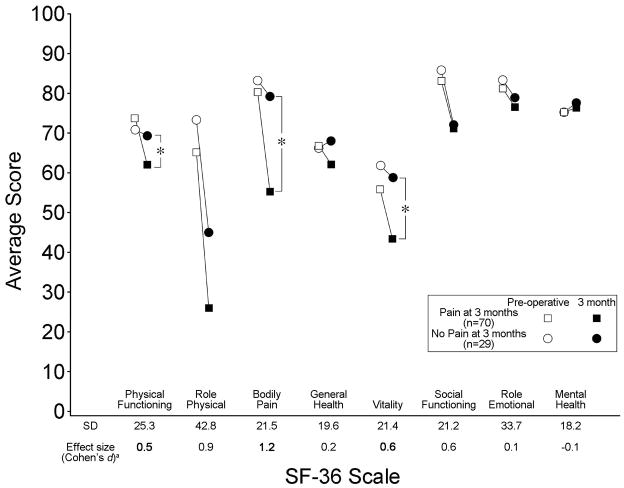
Results: Seventy-five patients (68%) had pain 3 months postthoracotomy; 12 patients (11%) rated their average pain greater than 3 (out of 10). Eighteen (16%) patients required opioid analgesics. The pain group reported lower SF-36 scores in physical functioning (p = 0.049), bodily pain (p = 0.0002), and vitality (p = 0.044). There were no other significant differences in any SF-36 scale between the pain and non-pain groups.
Conclusions: Pain is commonly reported at 3 months after elective thoracotomy but is generally mild, shows improvement with time, and does not usually require opioid analgesics. Patients who experience postthoracotomy pain at 3 months are at risk for significantly decreased physical functioning and vitality, but are not at risk for significantly decreased social, emotional, or mental health functioning compared with patients who do not experience postthoracotomy pain at 3 months.
Copyright © 2012 The Society of Thoracic Surgeons. Published by Elsevier Inc. All rights reserved.
Figures
References
-
- Brunelli A, Socci L, Refai M, Salati M, Xiume F, Sabbatini A. Quality of life before and after major lung resection for lung cancer: a prospective follow-up analysis. Ann Thorac Surg. 2007;84:410–416. - PubMed
-
- Schulte T, Schniewind B, Dohrmann P, Kuchler T, Kurdow R. The extent of lung parenchyma resection significantly impacts long-term quality of life in patients with non-small cell lung cancer. Chest. 2009;135:322–329. - PubMed
-
- McHorney CA, Ware JE, Jr, Lu JF, Sherbourne CD. The MOS 36-ltem Short-Form Health Survey (SF-36): III. Tests of data quality, scaling assumptions, and reliability across diverse patient groups. Med Care. 1994;32:40–66. - PubMed
Publication types
MeSH terms
Substances
Grants and funding
LinkOut - more resources
Full Text Sources
Medical
