Review
. 2012 Oct;22(5):837-43.
doi: 10.1016/j.conb.2012.02.006. Epub 2012 Mar 5.

Human disorders of axon guidance

Affiliations
Review

Human disorders of axon guidance

Alicia A Nugent et al. Curr Opin Neurobiol. 2012 Oct.

Abstract

Axon pathfinding is essential for the establishment of proper neuronal connections during development. Advances in neuroimaging and genomic technologies, coupled with animal modeling, are leading to the identification of an increasing number of human disorders that result from aberrant axonal wiring. In this review, we summarize the recent clinical, genetic and molecular advances with regard to three human disorders of axon guidance: Horizontal gaze palsy with progressive scoliosis, Congenital mirror movements, and Congenital fibrosis of the extraocular muscles, Type III.


Figures

Figure 1
Figure 1
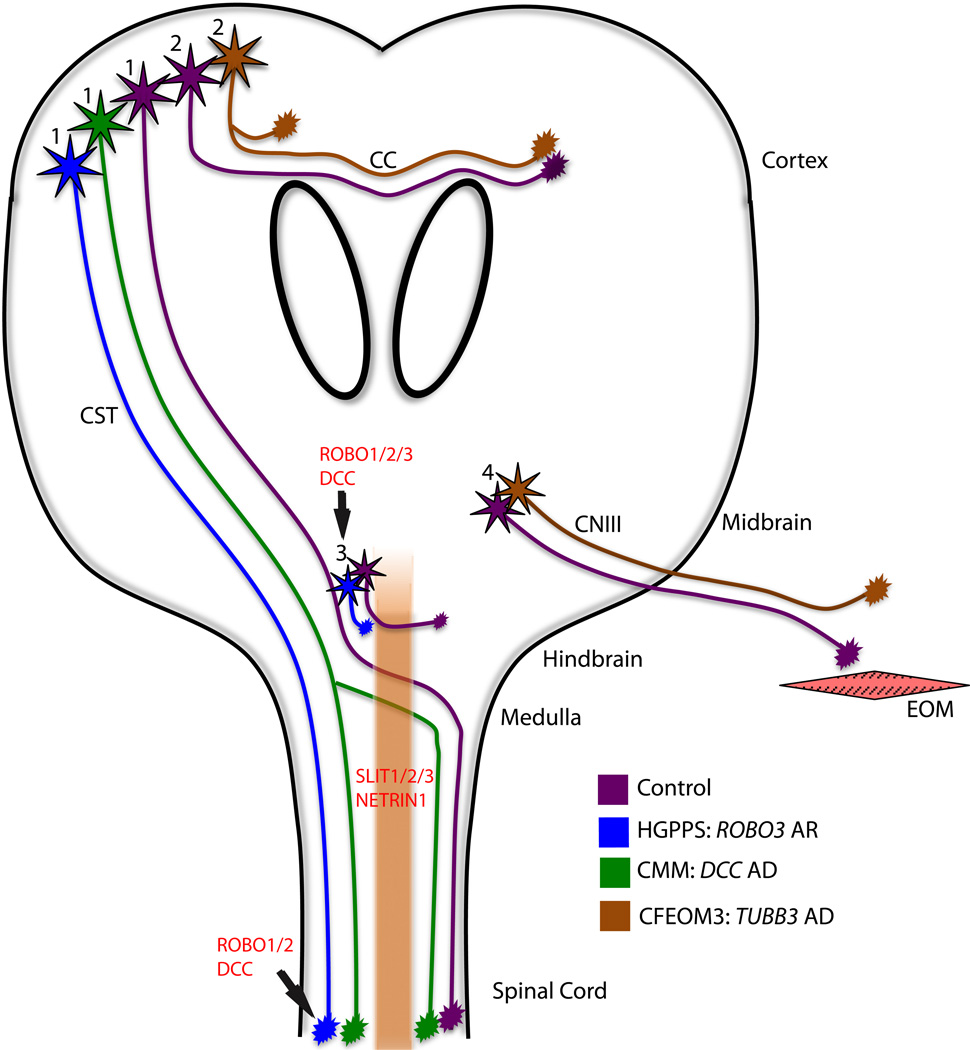
Schematic of axon guidance defects in HGPPS, CMM, and CFEOM3. With normal guidance (purple): corticospinal tract (CST) axons navigate from the motor cortex to the spinal cord, decussating in the medulla (cell bodies labeled ‘1’); corpus callosum (CC) and anterior commissure axons cross from one hemisphere to the other (cell bodies labeled ‘2’); interneuron populations decussate in the hindbrain (cell bodies labeled ‘3’); and oculomotor axons extend to their target extraocular muscles (EOM, cell bodies labeled ‘4’). In HGPPS (blue), CST and hindbrain interneuron axons fail to decussate, resulting in ipsilateral projections. In CMM (green), it is proposed but not proven that while some CST axons decussate appropriately, others fail to do so and project ipsilaterally. In CFEOM3 (brown), there is variable thinning of the CC and anterior commissure axons, supporting abnormal guidance of these axonal tracts and the oculomotor nerve (CNIII) has abnormal guidance, resulting in the dysinnervation of EOM. AR = autosomal recessive; AD = autosomal dominant.
Figure 2
Figure 2
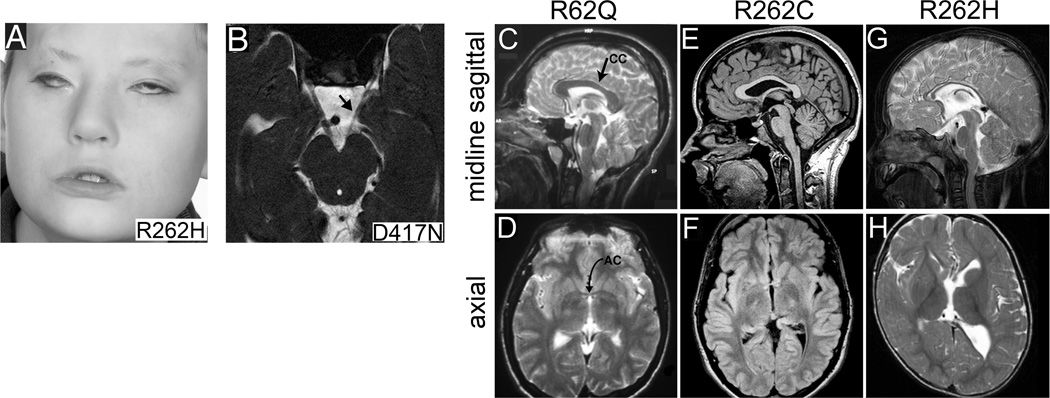
TUBB3 mutation-specific abnormalities in white matter tracts and basal ganglia. (A) Photograph of a child harboring a TUBB3 R262H amino acid substitution who exhibits severe CFEOM3 and facial weakness. (B) Brainstem MRI from a patient with predominantly left-sided CFEOM3 reveals unilateral hypoplasia of the left oculomotor nerve (arrow; D417N substitution). (C–H) Sagittal and axial MR images from individuals harboring R62Q, R262C, and R262H TUBB3 substitutions as indicated. (C,D) R62Q results in normal appearance of the corpus callosum (CC) and anterior commissure (AC); (E,F) R262C causes CC posterior thinning (E) and AC hypoplasia (F); (G,H) while R262H causes CC hypoplasia (G), AC agenesis and dysmorphic basal ganglia (H). (Reprinted, with permission, from [49]).

References

    1. Engle EC. Human genetic disorders of axon guidance. Cold Spring Harb Perspect Biol. 2010;2(3):a001784.. ** This is a comprehensive review of additional human genetic disorders of axon guidance. Our review builds upon this article.

    1. Izzi L, Charron F. Midline axon guidance and human genetic disorders. Clin Genet. 2011;80(3):226–234.. * This a comprehensive review of midline axon guidance, highlighting molecular mechanisms and human disorders.

    1. Chan W-M, Traboulsi E, Arthur B, Friedman N, Andrews C, Engle E. Horizontal gaze palsy with progressive scoliosis can result from compound heterozygous mutations in ROBO3. J Med Genet. 2006;43(3):e11. - PMC - PubMed
    1. Amoiridis G, Tzagournissakis M, Christodoulou P, Karampekios S, Latsoudis H, Panou T, Simos P, Plaitakis A. Patients with horizontal gaze palsy and progressive scoliosis due to ROBO3 E319K mutation have both uncrossed and crossed central nervous system pathways and perform normally on neuropsychological testing. J Neurol Neurosurg Psychiatry. 2006;77(9):1047–1053. - PMC - PubMed
    1. Dretakis E. Familial idiopathic scoliosis associated with encephalopathy in three children of the same family. Acta orthop Hell. 1970;22:51–55.

Publication types