


Review
doi: 10.1007/978-1-4614-1704-0_12.
Neurobiology of sociability
Affiliations
- PMID: 22399403
- PMCID: PMC4146394
- DOI: 10.1007/978-1-4614-1704-0_12
Item in Clipboard
Review
Neurobiology of sociability
Adv Exp Med Biol.
2012.
Abstract
Sociability consists of behaviors that bring animals together and those that keep animals apart. Remarkably, while the neural circuitry that regulates these two "faces" of sociability differ from one another, two neurohormones, oxytocin (Oxt) and vasopressin (Avp), have been consistently implicated in the regulation of both. In this chapter the the structure and function of the Oxt and Avp systems, the ways in which affiliative and aggressive behavior are studied and the roles of Oxt and Avp in the regulation of sociability will be briefly reviewed. Finally, work implicating Oxt and Avp in sociability in humans, with a focus on neuropsychiatric disorders will be highlighted.
Figures
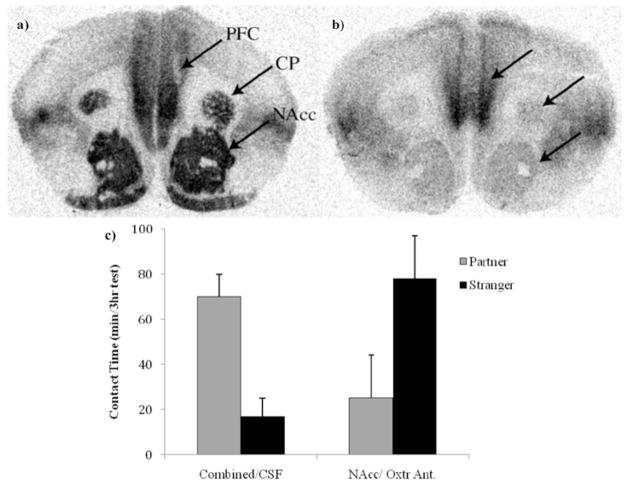
In female prairie voles, oxytocin receptors (Oxtr) in the nucleus acumbens (NAcc) are
thought be important for the formation of partner preference. Autoradiograms illustrating
Oxtr distribution between monogamous female prairie voles (A) and nonmonogamous female
meadow voles (B) demonstrate that female prairie voles have increased Oxtr binding in the
prefrontal cortex (PFC), the caudate putamen (CP) and the NAcc compared to female meadow
voles. Further, female prairie voles given a selective NAcc prior to and 12 hours into a
24 hour cohabitation period do not form a partner preference compared to females that
received cerebral spinal fluid (CSF) into the PFC, CP and NAcc at the same time points
(i.e., combined). (C). (A) and (B) were adapted from Hammock and Young. J Phil Trans R Soc
B 2006; 361:2187–2198,
©2006 with permission from The Royal Society. (C) was adapted from Young et al.
Horm Behav 2001; 40:133–138,
©2001 with permission from Elsevier.
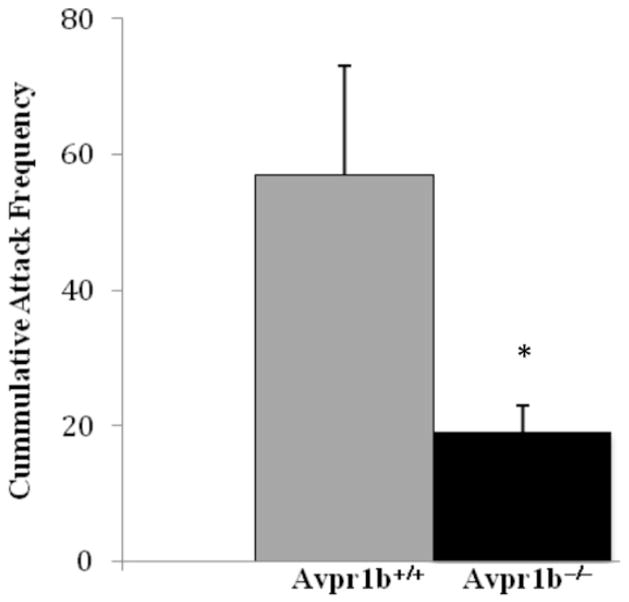
Even when crossed with Mus musculus cantaneus, male Avpr1b knockout mice
(Avpr1b−/−) have reduced aggression compared to wildtype
(Avpr1b+/+) controls; as measured by fewer attacks in a
resident intruder behavioral test. Adapted from Caldwell and Young. Physiol Behav 2009;
97:131–134,
©2009 with permission from Elsevier.)
References
-
- Pinkham AE, Penn DL, Perkins DO, et al. Implications for the neural basis of social cognition for the study of schizophrenia. Am J Psychiatry. 2003;160(5):815–824. - PubMed
-
- Lim MM, Young LJ. Neuropeptidergic regulation of affiliative behavior and social bonding in animals. Horm Behav. 2006;50(4):506–517. - PubMed
Publication types
MeSH terms
Substances
Grants and funding
LinkOut - more resources
Full Text Sources
Miscellaneous
