


Vitamin D levels predict all-cause and cardiovascular disease mortality in subjects with the metabolic syndrome: the Ludwigshafen Risk and Cardiovascular Health (LURIC) Study
- PMID: 22399697
- PMCID: PMC3329808
- DOI: 10.2337/dc11-1714
Vitamin D levels predict all-cause and cardiovascular disease mortality in subjects with the metabolic syndrome: the Ludwigshafen Risk and Cardiovascular Health (LURIC) Study
Abstract
Objective: Optimal vitamin D levels are associated with reduced cardiovascular and all-cause mortality. We investigated whether optimal 25-hydroxyvitamin D (25[OH]D) is protective in individuals with the metabolic syndrome.
Research design and methods: The Ludwigshafen Risk and Cardiovascular Health (LURIC) study is a cohort study of subjects referred for coronary angiography between 1997 and 2000, from which 1,801 with the metabolic syndrome were investigated. Mortality was tracked for a median of 7.7 years. Multivariable survival analysis was used to estimate the association between 25(OH)D levels and mortality.
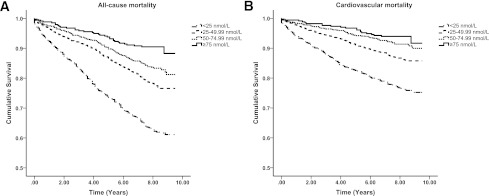
Results: Most subjects (92%) had suboptimal levels of 25(OH)D (<75 nmol/L), with 22.2% being severely deficient (<25 nmol/L). During follow-up, 462 deaths were recorded, 267 (57.8%) of which were cardiovascular in origin. After full adjustment, including the metabolic syndrome components, those with optimal 25(OH)D levels showed a substantial reduction in all-cause (hazard ratio [HR] 0.25 [95% CI 0.13-0.46]) and cardiovascular disease mortality (0.33 [0.16-0.66]) compared with those with severe vitamin D deficiency. For specific cardiovascular disease mortality, there was a strong reduction for sudden death (0.15 [0.04-0.63]) and congestive heart failure (0.24 [0.06-1.04]), but not for myocardial infarction. The reduction in mortality was dose-dependent for each of these causes.
Conclusions: Optimal 25(OH)D levels substantially lowered all-cause and cardiovascular disease mortality in subjects with the metabolic syndrome. These observations call for interventional studies that test whether vitamin D supplementation provides a useful adjunct in reducing mortality in these subjects.
Figures
References
-
- Thomas GN, Phillips AC, Carroll D, Gale CR, Batty GD. The metabolic syndrome adds utility to the prediction of mortality over its components: The Vietnam Experience Study. Atherosclerosis 2010;210:256–261 - PubMed
-
- Hunt KJ, Resendez RG, Williams K, Haffner SM, Stern MP, San Antonio Heart Study National Cholesterol Education Program versus World Health Organization metabolic syndrome in relation to all-cause and cardiovascular mortality in the San Antonio Heart Study. Circulation 2004;110:1251–1257 - PubMed
-
- Thomas GN, Schooling CM, McGhee SM, et al. Hong Kong Cardiovascular Risk Factor Prevalence Study Steering Committee Metabolic syndrome increases all-cause and vascular mortality: the Hong Kong Cardiovascular Risk Factor Study. Clin Endocrinol (Oxf) 2007;66:666–671 - PubMed
-
- Ford ES. Risks for all-cause mortality, cardiovascular disease, and diabetes associated with the metabolic syndrome: a summary of the evidence. Diabetes Care 2005;28:1769–1778 - PubMed
-
- Thomas GN, Jiang CQ, Taheri S, et al. A systematic review of lifestyle modification and glucose intolerance in the prevention of type 2 diabetes. Curr Diabetes Rev 2010;6:378–387 - PubMed
Publication types
MeSH terms
Substances
Grants and funding
LinkOut - more resources
Full Text Sources
Other Literature Sources
Medical
Miscellaneous
