


Rodents rely on Merkel cells for texture discrimination tasks
- PMID: 22399751
- PMCID: PMC3306053
- DOI: 10.1523/JNEUROSCI.5307-11.2012
Rodents rely on Merkel cells for texture discrimination tasks
Abstract
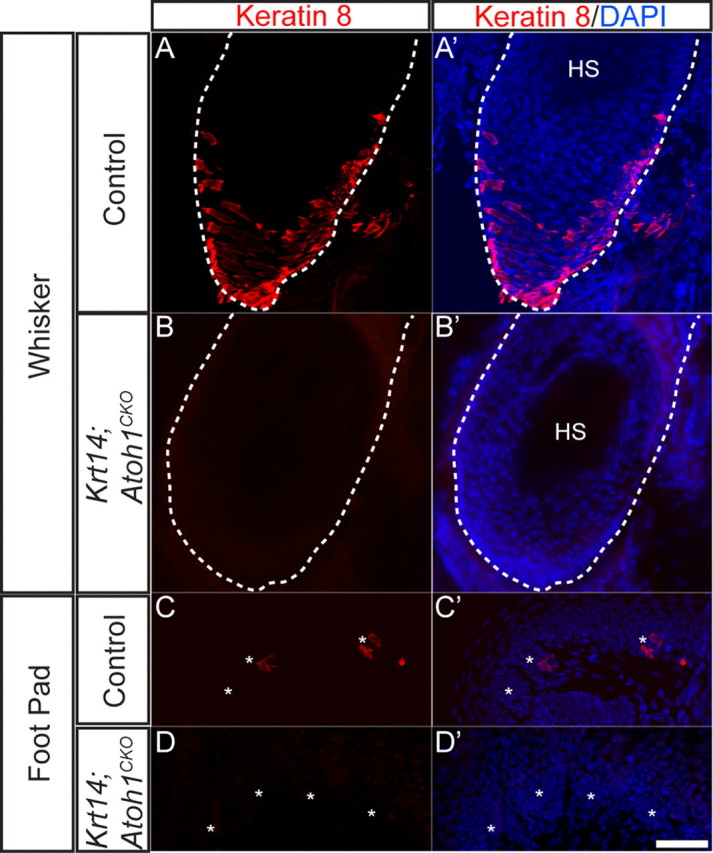
The cutaneous somatosensory system contains multiple types of mechanoreceptors that detect different mechanical stimuli (Johnson, 2001). These stimuli, either alone or in combination, are ultimately interpreted by the brain as different aspects of the sense of touch. Psychophysical and electrophysiological experiments in humans and other mammals implicate one of these mechanoreceptors, the Merkel cell/neurite complex, in two-point discrimination and the detection of curvature, shape, and texture (Johnson and Lamb, 1981; Johnson et al., 2000; Johnson, 2001). However, whether Merkel cell/neurite complex function is required for the detection of these stimuli is unknown. We genetically engineered mice that lack Merkel cells (Maricich et al., 2009; Morrison et al., 2009) to directly test the hypothesis that Merkel cell/neurite complexes are necessary to perform these types of sensory discrimination tasks. We found that mice devoid of Merkel cells could not detect textured surfaces with their feet while other measures of motor and sensory function were unaffected. Interestingly, these mice retained the ability to discriminate both texture and shape using their whiskers, suggesting that other somatosensory afferents can functionally substitute for Merkel cell/neurite complexes in this sensory organ. These findings suggest that Merkel cell/neurite complexes are essential for texture discrimination tasks involving glabrous skin but not whiskers.
Figures
References
-
- Aloisi AM, Albonetti ME, Carli G. Sex differences in the behavioural response to persistent pain in rats. Neurosci Lett. 1994;179:79–82. - PubMed
-
- Ben-Arie N, Bellen HJ, Armstrong DL, McCall AE, Gordadze PR, Guo Q, Matzuk MM, Zoghbi HY. Math1 is essential for genesis of cerebellar granule neurons. Nature. 1997;390:169–172. - PubMed
-
- Brecht M, Preilowski B, Merzenich MM. Functional architecture of the mystacial vibrissae. Behav Brain Res. 1997;84:81–97. - PubMed
Publication types
MeSH terms
Grants and funding
LinkOut - more resources
Full Text Sources
Other Literature Sources
Molecular Biology Databases
