


Microbial synthesis of core/shell gold/palladium nanoparticles for applications in green chemistry
- PMID: 22399790
- PMCID: PMC3367827
- DOI: 10.1098/rsif.2012.0003
Microbial synthesis of core/shell gold/palladium nanoparticles for applications in green chemistry
Abstract
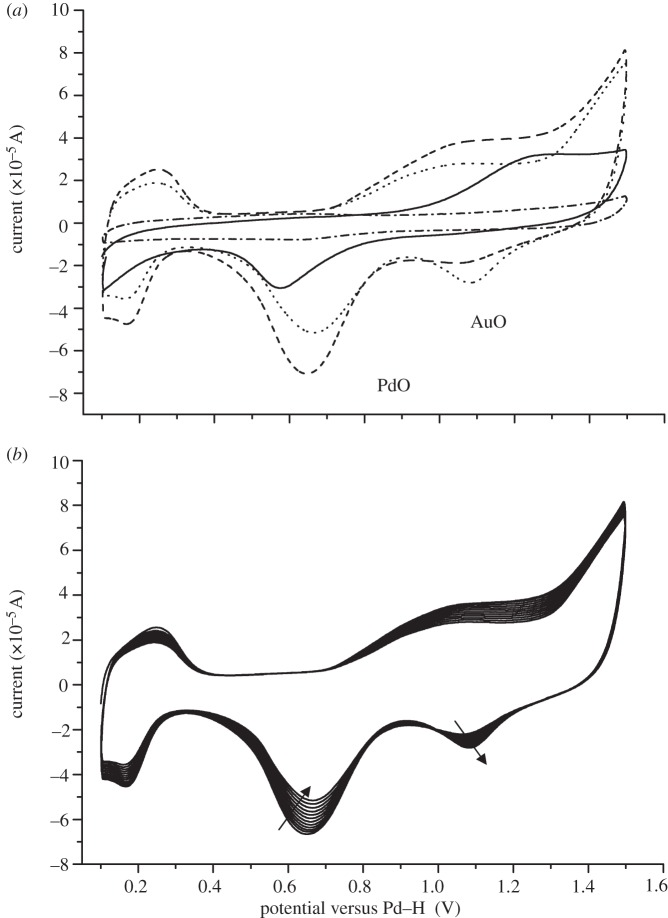
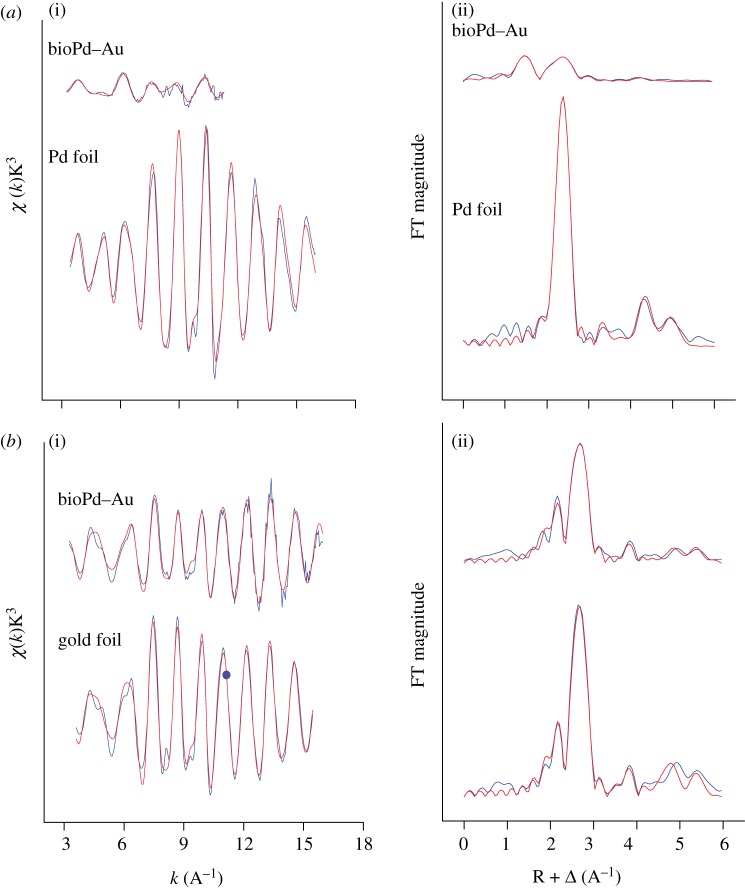
We report a novel biochemical method based on the sacrificial hydrogen strategy to synthesize bimetallic gold (Au)-palladium (Pd) nanoparticles (NPs) with a core/shell configuration. The ability of Escherichia coli cells supplied with H(2) as electron donor to rapidly precipitate Pd(II) ions from solution is used to promote the reduction of soluble Au(III). Pre-coating cells with Pd(0) (bioPd) dramatically accelerated Au(III) reduction, with the Au(III) reduction rate being dependent upon the initial Pd loading by mass on the cells. Following Au(III) addition, the bioPd-Au(III) mixture rapidly turned purple, indicating the formation of colloidal gold. Mapping of bio-NPs by energy dispersive X-ray microanalysis suggested Au-dense core regions and peripheral Pd but only Au was detected by X-ray diffraction (XRD) analysis. However, surface analysis of cleaned NPs by cyclic voltammetry revealed large Pd surface sites, suggesting, since XRD shows no crystalline Pd component, that layers of Pd atoms surround Au NPs. Characterization of the bimetallic particles using X-ray absorption spectroscopy confirmed the existence of Au-rich core and Pd-rich shell type bimetallic biogenic NPs. These showed comparable catalytic activity to chemical counterparts with respect to the oxidation of benzyl alcohol, in air, and at a low temperature (90°C).
Figures

References
-
- Mabbett A. N., Sanyahumbi D., Yong P., Macaskie L. E. 2006. Biorecovered precious metals from industrial wastes: single-step conversion of a mixed metal liquid waste to inorganic catalysts with environmental application. Environ. Sci. Technol 40, 1015–1021 10.1021/es0509836 (doi:10.1021/es0509836) - DOI - PubMed
-
- Hall S. R., Shenton W., Engelhardt H., Mann S. 2001. Site-specific organization of gold nanoparticles by biomolecular templating. Chem. Phys. Chem. 3, 184–186 10.1002/1439-7641(20010316)2:3<184::AID-CPHc184>3.0.CO;2-J (doi:10.1002/1439-7641(20010316)2:3<184::AID-CPHc184>3.0.CO;2-J) - DOI - PubMed
-
- McMillan R. A. 2003. Biomolecular templates: nanoparticles align. Nat. Mater. 2, 214–215 10.1038/nmat866 (doi:10.1038/nmat866) - DOI - PubMed
-
- Ma N., Tikhomirov G., Kelley S. O. 2010. Nucleic acid-passivated semiconductor nanocrystals: biomolecular templating of form and function. Acc. Chem. Res. 43, 173–180 10.1021/ar900046n (doi:10.1021/ar900046n) - DOI - PMC - PubMed
-
- Lovely D. R. 1993. Dissimilatory metal reduction. Annu. Rev. Microbiol. 4, 263–290 - PubMed
Publication types
MeSH terms
Substances
Grants and funding
LinkOut - more resources
Full Text Sources
