


Adoption of new drugs by physicians: a survival analysis
- PMID: 22401169
- PMCID: PMC3353238
- DOI: 10.1186/1472-6963-12-56
Adoption of new drugs by physicians: a survival analysis
Abstract
Background: New drugs often substitute others cheaper and with a risk-benefit balance better established. Our aim was to analyse the diffusion of new drugs during the first months of use, examining the differences between family physicians and specialists.
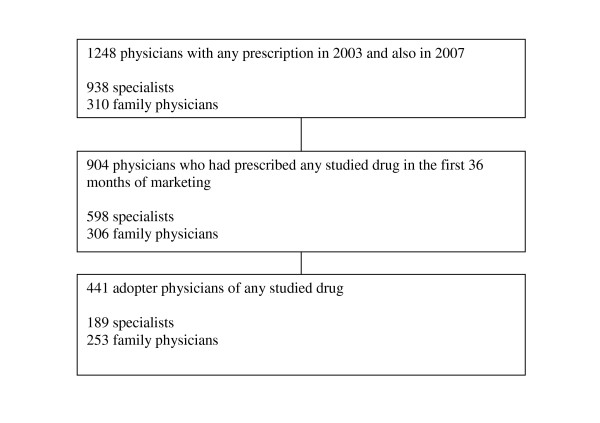
Methods: Prescription data were obtained of cefditoren, duloxetine, etoricoxib, ezetimibe, levocetirizine, olmesartan, pregabalin and tiotropium 36 months after their launching. We obtained the monthly number of prescriptions per doctor and the number prescribers of each drug by specialty. After discarding those with less than 10 prescriptions during this period, physicians were defined as adopters if the number of prescriptions was over the 25th percentile for each drug and level (primary or secondary care). The diffusion of each drug was studied by determining the number of adopter family physicians throughout the study period. Among the group of adopters, we compared the month of the first prescription by family physicians to that of other specialists using the Kaplan-Meier method.
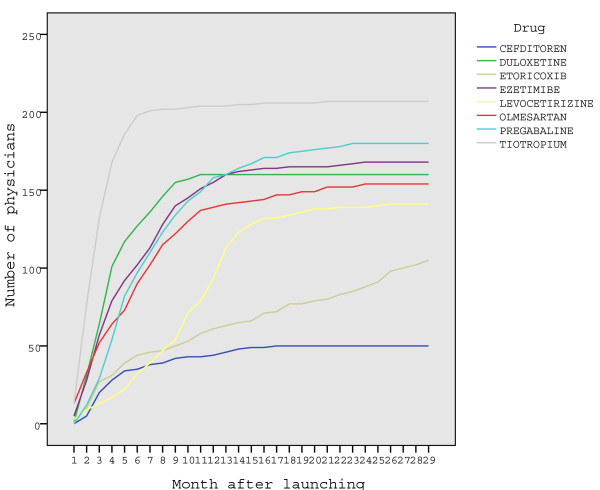
Results: The adoption of the drugs in primary care follows an exponential diffusion curve that reaches a plateau at month 6 to 23. Tiotropium was the most rapidly and widely adopted drug. Cefditoren spread at a slower rate and was the least adopted. The diffusion of etoricoxib was initially slowed down due to administrative requirements for its prescription. The median time of adoption in the case of family physicians was 4-6 months. For each of the drugs, physicians of a specialty other than family physicians adopted it first.
Conclusions: The number of adopters of a new drug increases quickly in the first months and reaches a plateau. The number of adopter family physicians varies considerably for different drugs. The adoption of new drugs is faster in specialists. The time of adoption should be considered to promote rational prescribing by providing timely information about new drugs and independent medical education.
Figures
References
Publication types
MeSH terms
Substances
LinkOut - more resources
Full Text Sources
