


Review
doi: 10.1016/j.coph.2012.02.003.
Epub 2012 Mar 7.
Ras family of small GTPases in immunity and inflammation
Affiliations
- PMID: 22401931
- PMCID: PMC3374043
- DOI: 10.1016/j.coph.2012.02.003
Item in Clipboard
Review
Ras family of small GTPases in immunity and inflammation
Curr Opin Pharmacol.
2012 Aug.
Abstract
The Ras superfamily of small GTPases is a group of more than 150 small G proteins, all of which share some degree of homology to the founding member Ras. These small GTPases function as molecular switches within cells, impacting nearly all cellular processes. The Ras superfamily can be further divided into several smaller subfamilies, with those proteins that most closely resemble Ras belonging to the Ras subfamily. While heavily studied within the field of cancer biology, the Ras family of proteins also plays cardinal roles in immunity and inflammation. Here we review the roles of these molecular switches in regulating immune cell homeostasis and functions.
Copyright © 2012 Elsevier Ltd. All rights reserved.
Figures
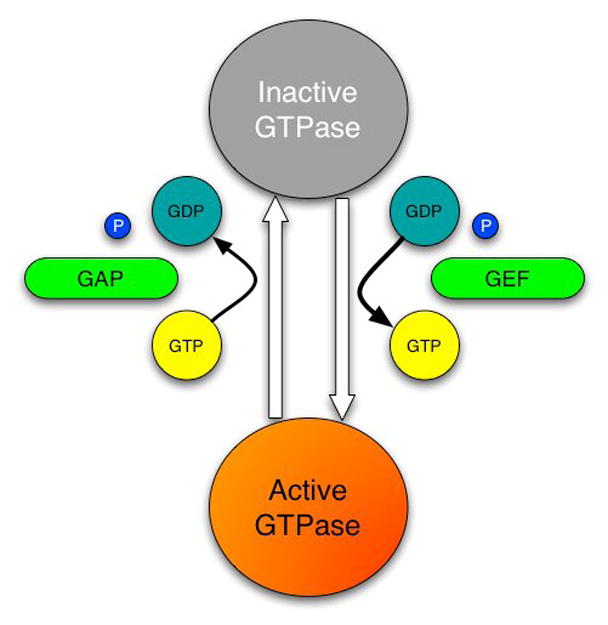
Small GTPase is “off” when bound to GDP; a GEF then removes GDP and allows GTP to bind to the GTPase, turning it “on”. All GTPases can eventually hydrolyze GTP to GDP and turn themselves off, though GAPs rapidly accelerate this process.
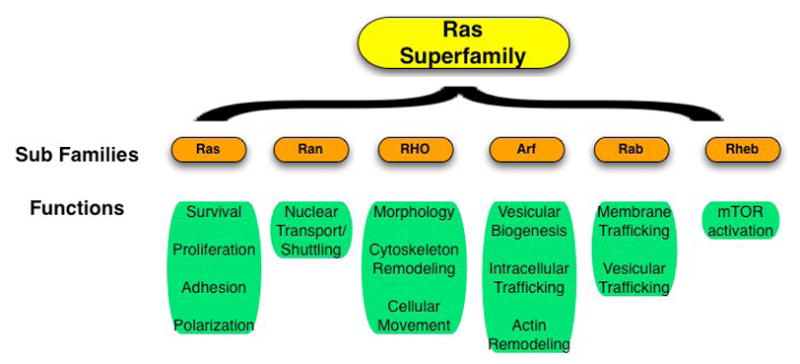
The Ras superfamily is broken down into 6 families, each listed with their primary functions.
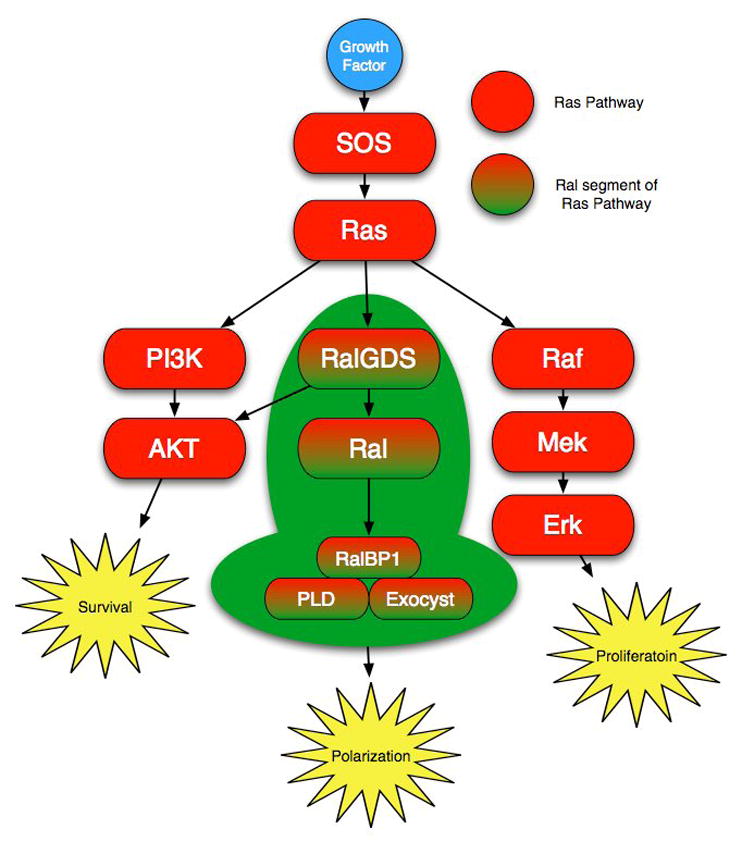
Ras signaling pathway is highlighted in Red. The Ral signaling segment of the Ras pathway is additionally marked in Green.
References
-
- Donahue AC, Fruman DA. Leukocyte signaling Distinct signaling mechanisms activate the target of rapamycin in response to different B-cell stimuli. Euroean Journal of Immunology. 2007;37:2923–2936. - PubMed
-
- Tsukamoto N, Hattori M, Yang H, Bos JL, Minato N. Rap1 GTPase-activating Protein SPA-1 Negatively Regulates Cell Adhesion. The Journal of biological chemistry. 1999;274:18463–18469. - PubMed
-
- Koike T, Yamagishi H, Hatanaka Y, Fukushima A, Chang J-wen, Xia Y, Fields M, Chandler P, Iwashima M. A Novel ERK-dependent Signaling Process That Regulates Interleukin-2 Expression in a Late Phase of T Cell Activation. The Journal of biological chemistry. 2003;278:15685–15692. - PubMed
-
- Marko AJ, Miller RA, Kelman A, Frauwirth KA. Induction of Glucose Metabolism in Stimulated T Lymphocytes Is Regulated by Mitogen-Activated Protein Kinase Signaling. PloS one. 2010;5:e15425. Identifies ERK as a key component required for glucose metabolism in T Cells. Provides insight into the role played by both CD28 and TCR in important metabolic events within T cells, and how they cooperate to allow a T cell to become fully active. - PMC - PubMed
Publication types
MeSH terms
Substances
Grants and funding
LinkOut - more resources
Full Text Sources
Other Literature Sources
