Comparison of reliability and responsiveness of patient-reported clinical outcome measures in knee osteoarthritis rehabilitation
- PMID: 22402677
- PMCID: PMC3435439
- DOI: 10.2519/jospt.2012.4038
Comparison of reliability and responsiveness of patient-reported clinical outcome measures in knee osteoarthritis rehabilitation
Abstract
Study design: Secondary analysis, pretreatment-posttreatment observational study.
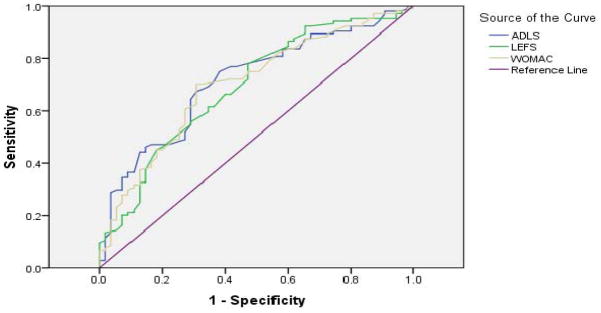
Objective: To compare the reliability and responsiveness of the Western Ontario and McMaster Universities Osteoarthritis Index (WOMAC), the Knee Outcome Survey activities of daily living subscale (KOS-ADL), and the Lower Extremity Functional Scale (LEFS) in individuals with knee osteoarthritis (OA).
Background: The WOMAC is the current standard in patient-reported measures of function in patients with knee OA. The KOS-ADL and LEFS were designed for potential use in patients with knee OA. If the KOS-ADL and LEFS are to be considered viable alternatives to the WOMAC for measuring patient-reported function in individuals with knee OA, they should have measurement properties comparable to the WOMAC. It would also be important to determine whether either of these instruments may be superior to the WOMAC in terms of reliability or responsiveness in this population.
Methods: Data from 168 subjects with knee OA, who participated in a rehabilitation program, were used in the analyses. Reliability and responsiveness of each outcome measure were estimated at follow-ups of 2, 6, and 12 months. Reliability was estimated by calculating the intraclass correlation coefficient (ICC2,1) for subjects who were unchanged in status from baseline at each follow-up time, based on a global rating of change score. To examine responsiveness, the standard error of the measurement, minimal detectable change, minimal clinically important difference, and the Guyatt responsiveness index were calculated for each outcome measure at each follow-up time.
Results: All 3 outcome measures demonstrated reasonable reliability and responsiveness to change. Reliability and responsiveness tended to decrease somewhat with increasing follow-up time. There were no substantial differences between outcome measures for reliability or any of the 3 measures of responsiveness at any follow-up time.
Conclusion: The results do not indicate that one outcome measure is more reliable or responsive than another when applied to subjects with knee OA. We believe that all 3 instruments are appropriate outcome measures to examine change in functional status of patients with knee OA.
Figures
References
-
- Altman R, Asch E, Bloch D, et al. Development of criteria for the classification and reporting of osteoarthritis. Arthritis Rheum. 1986;29:1039–1049. - PubMed
-
- Angst F, Aeschlimann A, Beat MA, et al. Minimal clinically important rehabilitation effects in patients with osteoarthritis of the lower extremities. J Rheumatol. 2002;29:131–138. - PubMed
-
- Beaton DE. Understanding the relevance of measured change through studies of responsiveness. Spine. 2000;25:3192–3199. - PubMed
-
- Bellamy N, Watson-Buchanan W, Goldsmith CH, et al. Validation study of WOMAC: A health status instrument for measuring clincically important patient relevant outcomes to antirheumatic drug therapy in patients with osteoarthritis of the hip or knee. J Rheumatol. 1988;15:1833–1840. - PubMed
-
- Binkley JM, Stratford PW, Lott SA, et al. The Lower Extremity Functional Scale (LEFS): Scale development, measurement properties, and clinical application. Phys Ther. 1999;79:371–383. - PubMed
Publication types
MeSH terms
Grants and funding
LinkOut - more resources
Full Text Sources
Medical