


Effect of an environmental school-based obesity prevention program on changes in body fat and body weight: a randomized trial
- PMID: 22402733
- PMCID: PMC3374922
- DOI: 10.1038/oby.2012.60
Effect of an environmental school-based obesity prevention program on changes in body fat and body weight: a randomized trial
Abstract
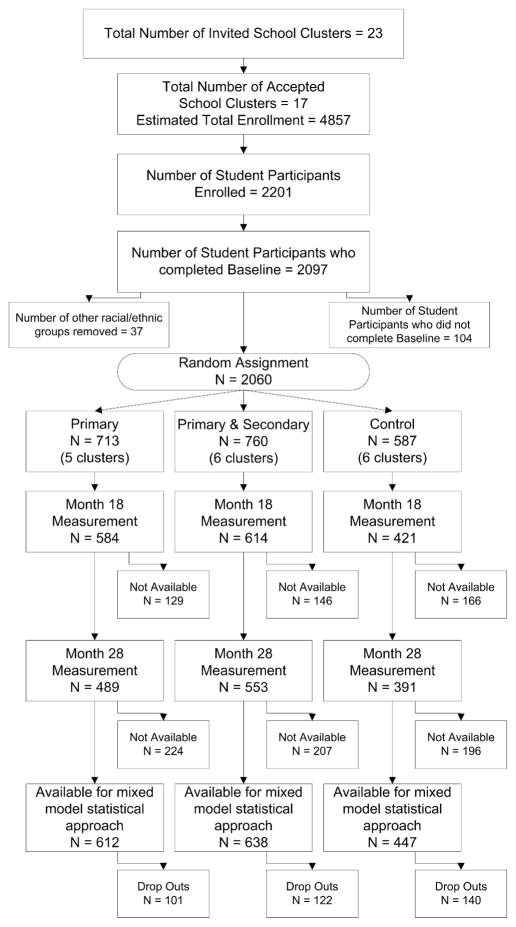
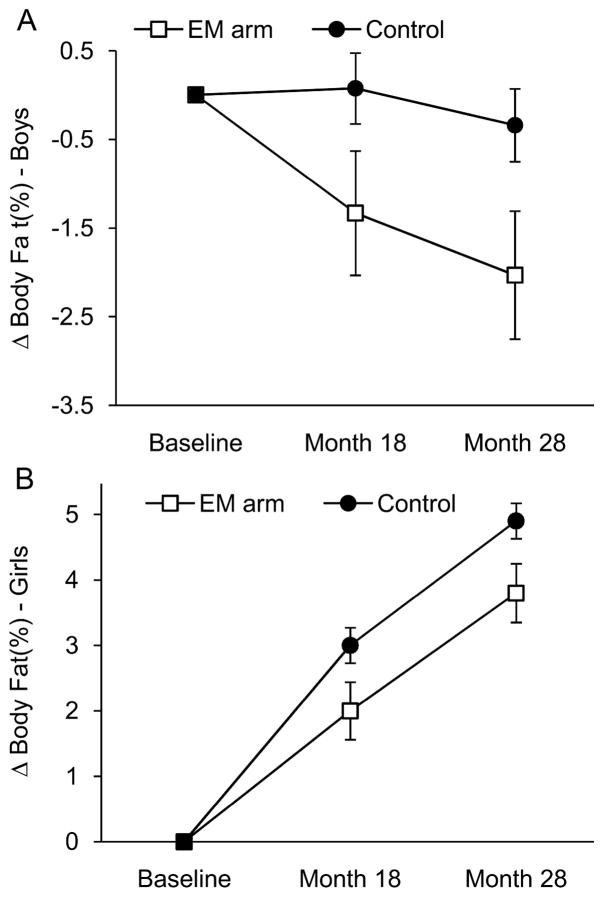
This study tested the efficacy of two school-based programs for prevention of body weight/fat gain in comparison to a control group, in all participants and in overweight children. The Louisiana (LA) Health study utilized a longitudinal, cluster randomized three-arm controlled design, with 28 months of follow-up. Children (N = 2,060; mean age = 10.5 years, SD = 1.2) from rural communities in grades 4-6 participated in the study. Seventeen school clusters (mean = 123 children/cluster) were randomly assigned to one of three prevention arms: (i) primary prevention (PP), an environmental modification (EM) program, (ii) primary + secondary prevention (PP+SP), the environmental program with an added classroom and internet education component, or (iii) control (C). Primary outcomes were changes in percent body fat and BMI z scores. Secondary outcomes were changes in behaviors related to energy balance. Comparisons of PP, PP+SP, and C on changes in body fat and BMI z scores found no differences. PP and PP+SP study arms were combined to create an EM arm. Relative to C, EM decreased body fat for boys (-1.7 ± 0.38% vs. -0.14 ± 0.69%) and attenuated fat gain for girls (2.9 ± 0.22% vs. 3.93 ± 0.37%), but standardized effect sizes were relatively small (<0.30). In conclusion, this school-based EM programs had modest beneficial effects on changes in percent body fat. Addition of a classroom/internet program to the environmental program did not enhance weight/fat gain prevention, but did impact physical activity and social support in overweight children.
Trial registration: ClinicalTrials.gov NCT00289315.
Conflict of interest statement
The authors disclose no conflicts of interest.
Figures

References
-
- Flegal KM, Carroll MD, Ogden CL, Johnson CL. Prevalence and trends in obesity among US adults, 1999–2000. JAMA. 2002;288:1723–1727. - PubMed
-
- Ogden CL, Carroll MD, Curtin LR, Lamb MM, Flegal KM. Prevalence of high body mass index in US children and adolescents, 2007–2008. JAMA. 2010;303:242–249. - PubMed
-
- Rashid MN, Fuentes F, Touchon RC, Wehner PS. Obesity and the risk for cardiovascular disease. Prev Cardiol. 2003;6:42–47. - PubMed
-
- Wadden TA, Osei S. The treatment of obesity: An overview. In: Wadden TA, Stunkard AJ, editors. Handbook of obesity treatment. Vol. 2002. New York: New York: 2002. pp. 229–248.
-
- National Task Force on the Prevention and Treatment of Obesity. Overweight, obesity, and health risk. Arch Intern Med. 2000;160:898–904. - PubMed
Publication types
MeSH terms
Associated data
Grants and funding
LinkOut - more resources
Full Text Sources
Medical
Miscellaneous
