Determinants of Anopheles seasonal distribution patterns across a forest to periurban gradient near Iquitos, Peru
- PMID: 22403317
- PMCID: PMC3284362
- DOI: 10.4269/ajtmh.2012.11-0547
Determinants of Anopheles seasonal distribution patterns across a forest to periurban gradient near Iquitos, Peru
Abstract
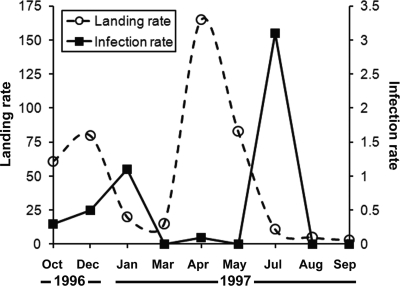
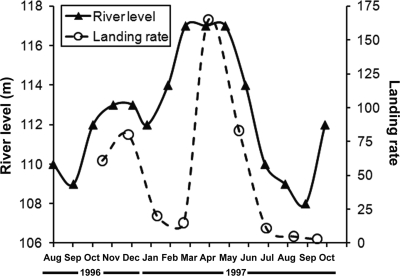
As part of a field ecology study of arbovirus and malaria activity in the Amazon Basin, Loreto Department, Peru, we collected mosquitoes landing on humans at a forest site and inside and outside of residences and military barracks at periurban, rural, and village sites. We collected 11 Anopheles spp. from these four sites. An. darlingi, the principal malaria vector in the region, accounted for 98.7% of all Anopheles spp. collected at Puerto Almendra. Peaks in landing activity occurred during the December and April collection periods. However, the percent of sporozoite-positive Anopheles spp. was highest 1-2 months later, when landing activity decreased to approximately 10% of the peak activity periods. At all sites, peak landing activity occurred about 2 hours after sunset. These data provide a better understanding of the taxonomy, population density, and seasonal and habitat distribution of potential malaria vectors within the Amazon Basin region.
Figures
References
-
- Roper MH, Torres RS, Goicochea CG, Andersen EM, Guarda JS, Calampa C, Hightower AW, Magill AJ. The epidemiology of malaria in an epidemic area of the Peruvian Amazon. Am J Trop Med Hyg. 2000;62:247–256. - PubMed
-
- Need JT, Rogers EJ, Phillips IA, Falcon R, Fernandez R, Carbajal F, Quintana J. Mosquitoes (Diptera: Culicidae) captured in the Iquitos area of Peru. J Med Entomol. 1993;30:634–638. - PubMed
Publication types
MeSH terms
LinkOut - more resources
Full Text Sources
Medical
Research Materials
Miscellaneous