. 2012 Mar 5:5:21.
doi: 10.3389/fnmol.2012.00021. eCollection 2012.

A Role for K2P Channels in the Operation of Somatosensory Nociceptors

Affiliations

A Role for K2P Channels in the Operation of Somatosensory Nociceptors

Leigh D Plant. Front Mol Neurosci. .

Abstract

The ability to sense mechanical, thermal, and chemical stimuli is critical to normal physiology and the perception of pain. Contact with noxious stimuli triggers a complex series of events that initiate innate protective mechanisms designed to minimize or avoid injury. Extreme temperatures, mechanical stress, and chemical irritants are detected by specific ion channels and receptors clustered on the terminals of nociceptive sensory nerve fibers and transduced into electrical information. Propagation of these signals, from distant sites in the body to the spinal cord and the higher processing centers of the brain, is also orchestrated by distinct groups of ion channels. Since their identification in 1995, evidence has emerged to support roles for K2P channels at each step along this pathway, as receptors for physiological and noxious stimuli, and as determinants of nociceptor excitability and conductivity. In addition, the many subtypes of K2P channels expressed in somatosensory neurons are also implicated in mediating the effects of volatile, general anesthetics on the central and peripheral nervous systems. Here, I offer a critical review of the existing data supporting these attributes of K2P channel function and discuss how diverse regulatory mechanisms that control the activity of K2P channels act to govern the operation of nociceptors.

Keywords: K1P18; K2P1; K2P10; K2P2; K2P3; K2P4; K2P9; nociceptor.


Figures
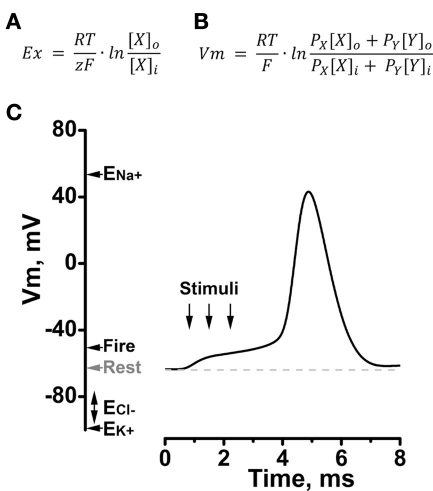
Figure 1
Figure 1
The neuronal membrane potential during rest and excitation. Cellular membrane potential (Vm) is determined by the internal and external ionic compositions and the relative permeability of the membrane to each ion species. Under quasi-physiological conditions, resting Vm for a neuron falls between ∼−60 and −75 mV and is determined in large part by the magnitude of the K+ leak current. (A) The Nernst equilibrium potential for cation X (Ex) is calculated using the Nernst equation, where R is the Gas constant (1.987 cal K−1 mol−1), T is the temperature in Kelvin, z is the charge of the ion and F is Faraday’s constant (9.648 × 104 C mol−1) and [X]o and [X]i are the external and internal concentrations of X, respectively. (B) The Goldman–Hodgkin–Katz equation shows that Vm is determined by the relative concentrations and permeabilities (P) of cations X and Y. (C) An exemplar action potential evoked in a neuron by depolarizing stimuli. Values for Vm corresponding to rest, the firing threshold for the action potential (Fire) and the Nernst potentials for Na+ (ENa), K+ (EK), and Cl (ECl) are indicated.
Figure 2
Figure 2
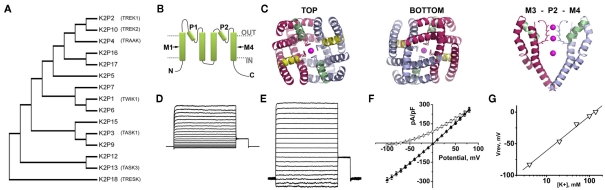
The structure and function of K2P channels. Fifteen K2P channel subunits have been identified in humans. Two subunits come together to form a K+ selective permeation pathway that opens and closes with little or no voltage or time-dependence. (A) A phylogenetic tree calculated from the alignment of the 15 K2P proteins expressed in humans shows the relatedness of subunits. Functional expression has not been observed for K2P7, 12, and 15. The descriptive names of the K2P channels discussed in this review are also given. (B) A cartoon showing that K2P subunits are integral membrane proteins with internal amino (N) and carboxy (C) termini, four transmembrane domains, M1–M4 and two re-entrant pore forming loops, P1 and P2. (C) A structural model of the Drosophila K2PØ channel based on experimental constrains and homology to the crystal structure of the voltage-dependent channel, Kv1.2. The top and bottom of the model are shown, as well as a side view showing the arrangement of transmembrane M3, P2, and M4. Occupation of the pore by K+ is denoted in each case. From above or below, the model shows twofold symmetry, with conservation of the fourfold symmetry required to form a K+ selective pore. Adapted from Kollewe et al. (2009). (D) A K+ leak current recorded from a Chinese Hamster Ovary cell transfected to express active human K2P1 channels. The inside of the cell is perfused with 140 mM K+ and the outside of the cell is perfused with 4 mM K+. (E) The same cell recorded in (D) with 140 mM K+ on the inside and the outside of the cell. (F) The current–voltage relationships for the cell recorded in (D) ○, and (E) (▲). (G) The same cell recorded in (D) studied in various concentrations of external K+. The voltage where zero-current was passed for each condition is plotted against the log10 of the external K+ concentration. The data are fit to a linear regression and show a shift of ∼54 mV per 10-fold change in K+. This relationship is predicted by the Nernst equation and confirms the K+ selective nature of the channel (see also Figure 1A). Elements D to F are adapted from Plant et al. (2010).
Figure 3
Figure 3
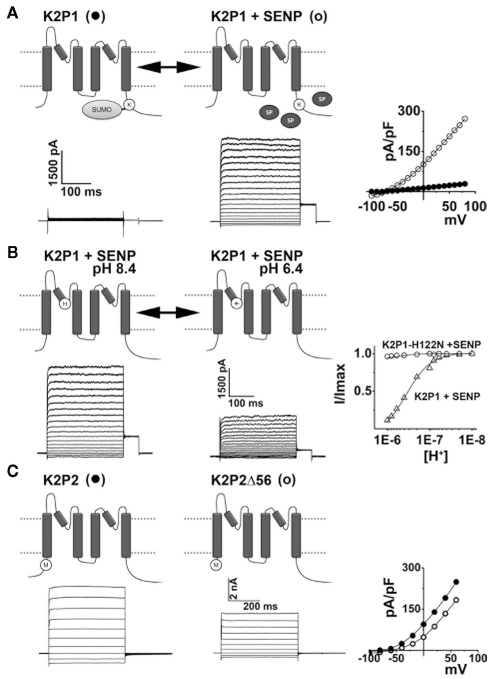
K2P channels are subject to regulation by diverse mechanisms. The operation of K2P channels is tightly controlled, both acutely and in the long-term, by a plethora of stimuli and regulatory pathways. (A) K2P1 channels are constitutively covalently modified at lysine residue 274 (K) by the small ubiquitin-like modifier protein, SUMO. Sumoylation silences K2P1 but is reversed by the action of SUMO-specific proteases (SENP, SP) to reveal active channels that mediate K+ selective leak currents in excitable cells such as neurons and cardiac myocytes. Example current-families and current–voltage relationships for K2P1 alone (●) and K2P1 in the presence of SENP (○) are shown; adapted from Plant et al. (2010). (B) Acid-sensitive K2P (TASK) channels have a histidine (H) adjacent to the K+ selectivity filter in the first P-loop. Thus, K2P3, K2P9, and active K2P1 channels pass currents that are reversibly blocked by protonation of this residue during acidification. Example currents-families for active K2P1 channels (in the presence of SENP) are shown at external pH 8.4 and 6.4. The proton-dependent block of active K2P1 channels is plotted (Δ) and shows that half-block occurs at pH 6.7. Active K2P1 channels in which the protonatable histidine is substituted for an asparagine residue are not sensitive to external acidification (○); adapted from Plant et al. (2010). K2P18 channels from rodents and other mammals are also acid-sensitive however, primate clones have a tyrosine rather than a histidine in the first P-loop and thus, human K2P18 channels are insensitive to acidification. (C) Full-length K2P2 channels mediate K+ selective leak currents. Alternative translation initiation of KCNK2 mRNA transcripts results in K2P2Δ, a subunits that lack the first 56 residues of the intracellular N-terminus. K2P2Δ is expressed throughout the brain and spinal cord at levels that change throughout development and pass smaller currents than full-length channels because of an increased permeability to Na+under physiological conditions. Example current-families and current–voltage relationships for full-length (●) and Δ56 variants of K2P2 (○) are shown; adapted from Thomas et al. (2008).

References

    1. Alloui A., Zimmermann K., Mamet J., Duprat F., Noel J., Chemin J., Guy N., Blondeau N., Voilley N., Rubat-Coudert C., Borsotto M., Romey G., Heurteaux C., Reeh P., Eschalier A., Lazdunski M. (2006). TREK-1, a K+ channel involved in polymodal pain perception. EMBO J. 25, 2368–2376 10.1038/sj.emboj.7601116 - DOI - PMC - PubMed
    1. Baccaglini P. I. (1978). Action potentials of embryonic dorsal root ganglion neurones in Xenopus tadpoles. J. Physiol. (Lond.) 283, 585–604 - PMC - PubMed
    1. Bang H., Kim Y., Kim D. (2000). TREK-2, a new member of the mechanosensitive tandem-pore K+ channel family. J. Biol. Chem. 275, 17412–17419 10.1074/jbc.M006620200 - DOI - PubMed
    1. Basbaum A. I., Bautista D. M., Scherrer G., Julius D. (2009). Cellular and molecular mechanisms of pain. Cell 139, 267–284 10.1016/j.cell.2009.09.028 - DOI - PMC - PubMed
    1. Baumann T. K., Burchiel K. J., Ingram S. L., Martenson M. E. (1996). Responses of adult human dorsal root ganglion neurons in culture to capsaicin and low pH. Pain 65, 31–38 10.1016/0304-3959(95)00145-X - DOI - PubMed

LinkOut - more resources