. 2012 Mar 2:3:60.
doi: 10.3389/fpsyg.2012.00060. eCollection 2012.

Mapping symbols to sounds: electrophysiological correlates of the impaired reading process in dyslexia

Affiliations

Mapping symbols to sounds: electrophysiological correlates of the impaired reading process in dyslexia

Andreas Widmann et al. Front Psychol. .

Abstract

Dyslexic and control first-grade school children were compared in a Symbol-to-Sound matching test based on a non-linguistic audiovisual training which is known to have a remediating effect on dyslexia. Visual symbol patterns had to be matched with predicted sound patterns. Sounds incongruent with the corresponding visual symbol (thus not matching the prediction) elicited the N2b and P3a event-related potential (ERP) components relative to congruent sounds in control children. Their ERPs resembled the ERP effects previously reported for healthy adults with this paradigm. In dyslexic children, N2b onset latency was delayed and its amplitude significantly reduced over left hemisphere whereas P3a was absent. Moreover, N2b amplitudes significantly correlated with the reading skills. ERPs to sound changes in a control condition were unaffected. In addition, correctly predicted sounds, that is, sounds that are congruent with the visual symbol, elicited an early induced auditory gamma band response (GBR) reflecting synchronization of brain activity in normal-reading children as previously observed in healthy adults. However, dyslexic children showed no GBR. This indicates that visual symbolic and auditory sensory information are not integrated into a unitary audiovisual object representation in them. Finally, incongruent sounds were followed by a later desynchronization of brain activity in the gamma band in both groups. This desynchronization was significantly larger in dyslexic children. Although both groups accomplished the task successfully remarkable group differences in brain responses suggest that normal-reading children and dyslexic children recruit (partly) different brain mechanisms when solving the task. We propose that abnormal ERPs and GBRs in dyslexic readers indicate a deficit resulting in a widespread impairment in processing and integrating auditory and visual information and contributing to the reading impairment in dyslexia.

Keywords: ERPs; audiovisual; dyslexia; gamma band; integration; mismatch; oscillatory activity; reading.


Figures
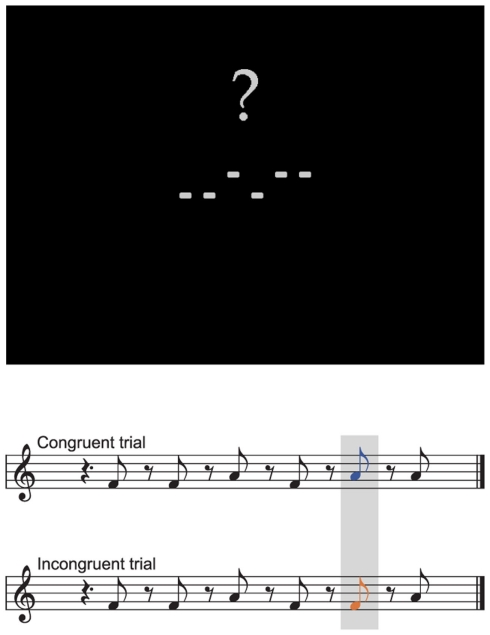
Figure 1
Figure 1
Prototypical visual display and corresponding auditory stimulation. Each trial started with the display of a visual pattern. After 1 s a corresponding sound pattern was presented either congruent to the visual pattern in all elements (congruent trial) or deviating in a single element (incongruent trial). Sound duration was 300 ms. Stimulus onset asynchrony was 600 ms. Three hundred milliseconds after the offset of the last sound a question mark was overlayed indicating the subject to discriminate congruent and incongruent trials by button press.
Figure 2
Figure 2
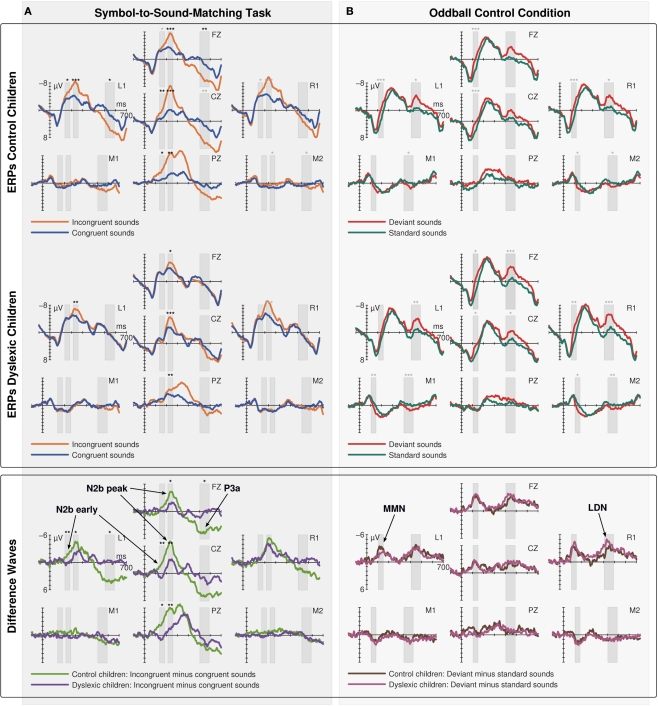
Event-related potentials (ERPs) to congruent and incongruent events in the Symbol-to-Sound matching condition (A) and to standard and deviant sounds in the passive oddball control condition (B) for control (first row) and dyslexic children (second row) and the corresponding incongruent minus congruent and deviant minus standard subtraction waves (third row). Bars indicate the time windows used for statistical analysis. Black asterisks indicate statistical significance of results in the respective time windows as described in Section “Results” (interaction of condition and group for difference waves; follow-up test of within group difference between incongruent and congruent trials for ERPs on electrode locations with significant interactions; gray asterisks indicate statistical significance of additional within group contrasts not motivated by significant interactions).
Figure 3
Figure 3
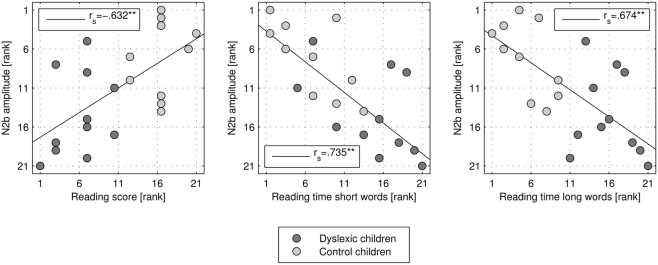
Scatter plot and correlation of N2b amplitude rank (negative up) at electrode location Cz and rank of reading score, and reading time of short and long words, respectively.
Figure 4
Figure 4
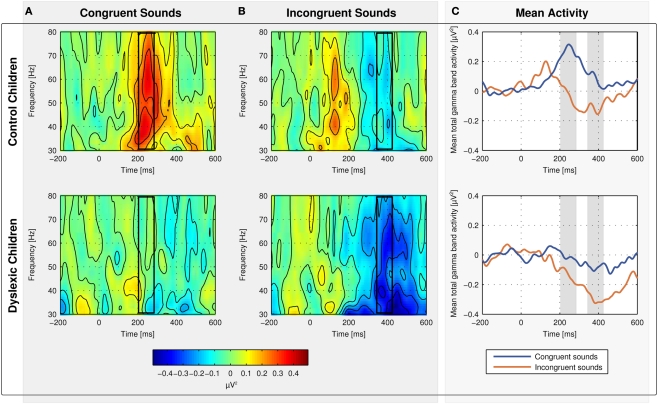
Spectrograms for mean total gamma band activity at electrodes Fz, Cz, and Pz in response to congruent (A) and incongruent sounds (B) for normal-reading (first row) and dyslexic children (second row). The mean of total gamma band activity is shown on (C).
Figure 5
Figure 5
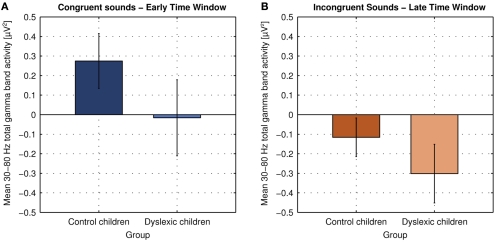
Mean 30–80 Hz total gamma band activity at electrodes Fz, Cz, and Pz in response to congruent sounds in the early analysis time window [204–284 ms; (A)] and to incongruent sounds in the late analysis time window in both groups [344–424 ms; (B); error bars indicate the 95% confidence intervals].

References

    1. Ahissar M., Lubin Y., Putter-Katz H., Banai K. (2006). Dyslexia and the failure to form a perceptual anchor. Nat. Neurosci. 9, 1558–1564 10.1038/nn1800 - DOI - PubMed
    1. Baldeweg T., Richardson A., Watkins S., Foale C., Gruzelier J. (1999). Impaired auditory frequency discrimination in dyslexia detected with mismatch evoked potentials. Ann. Neurol. 45, 495–503 10.1002/1531-8249(199904)45:4<495::AID-ANA11>3.0.CO;2-M - DOI - PubMed
    1. Blau V., Reithler J., Van Atteveldt N., Seitz J., Gerretsen P., Goebel R., Blomert L. (2010). Deviant processing of letters and speech sounds as proximate cause of reading failure: a functional magnetic resonance imaging study of dyslexic children. Brain 133, 868–879 10.1093/brain/awp308 - DOI - PubMed
    1. Blau V., Van Atteveldt N., Ekkebus M., Goebel R., Blomert L. (2009). Reduced neural integration of letters and speech sounds links phonological and reading deficits in adult dyslexia. Curr. Biol. 19, 503–508 10.1016/j.cub.2009.06.008 - DOI - PubMed
    1. Blomert L. (2011). The neural signature of orthographic-phonological binding in successful and failing reading development. Neuroimage 57, 695–703 10.1016/j.neuroimage.2010.11.003 - DOI - PubMed

LinkOut - more resources