. 2012 Feb 28:3:3.
doi: 10.3389/fgene.2012.00003. eCollection 2012.

The Presence of the DNA Repair Genes mutM, mutY, mutL, and mutS is Related to Proteome Size in Bacterial Genomes

Affiliations

The Presence of the DNA Repair Genes mutM, mutY, mutL, and mutS is Related to Proteome Size in Bacterial Genomes

Aurian Garcia-Gonzalez et al. Front Genet. .

Abstract

DNA repair is expected to be a modulator of underlying mutation rates, however the major factors affecting the distribution of DNA repair pathways have not been determined. The Proteomic Constraint theory proposes that mutation rates are inversely proportional to the amount of heredity information contained in a genome, which is effectively the proteome. Thus, organisms with larger proteomes are expected to possess more efficient DNA repair. We show that an important factor influencing the presence or absence of four DNA repair genes mutM, mutY, mutL, and mutS is indeed the size of the bacterial proteome. This is true both of intracellular and other bacteria. In addition, the relationship of DNA repair to genome GC content was examined. In principle, if a DNA repair pathway is biased in the types of mutations it corrects, this may alter the genome GC content. The presence of the mismatch repair genes mutL and mutS was not correlated with genome GC content, consistent with their involvement in an unbiased DNA repair pathway. In contrast, the presence of the base excision repair genes mutM and mutY, whose products both correct GC → AT mutations, was positively correlated with genome GC content, consistent with their biased repair mechanism. Phylogenetic analysis however indicates that the relationship between the presence of mutM and mutY genes and genome GC content is not a simple one.

Keywords: AT bias; DNA repair; bacterial genome; proteome size.


Figures
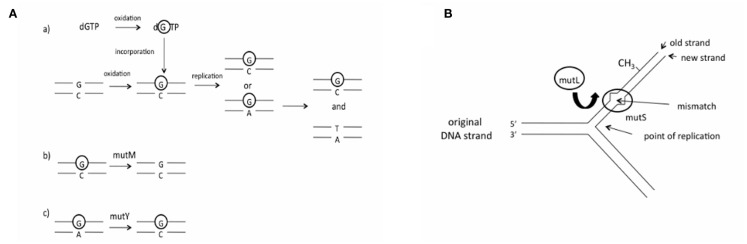
Figure 1
Figure 1
The BER and MMR pathways (A) The role of the products of the mutM and mutY genes in the BER pathway. (a) Oxidation of guanine to 8-oxoguanine (circled G) occurs either before or after incorporation of dGTP into the DNA strand; (b) mutM removes 8-oxoguanine that is present in double-stranded DNA; (c) mutY removes a mismatched adenine that is incorporated opposite 8-oxoguanine. (B) The role of the products of the mutL and mutS genes in the MMR pathway. The mutS gene product recognizes a mismatched basepair in the DNA strand after replication. The mutL gene product is recruited to the complex, while the mutH gene product is used to identify the original DNA strand, which is methylated, from the newly replicated DNA strand.
Figure 2
Figure 2
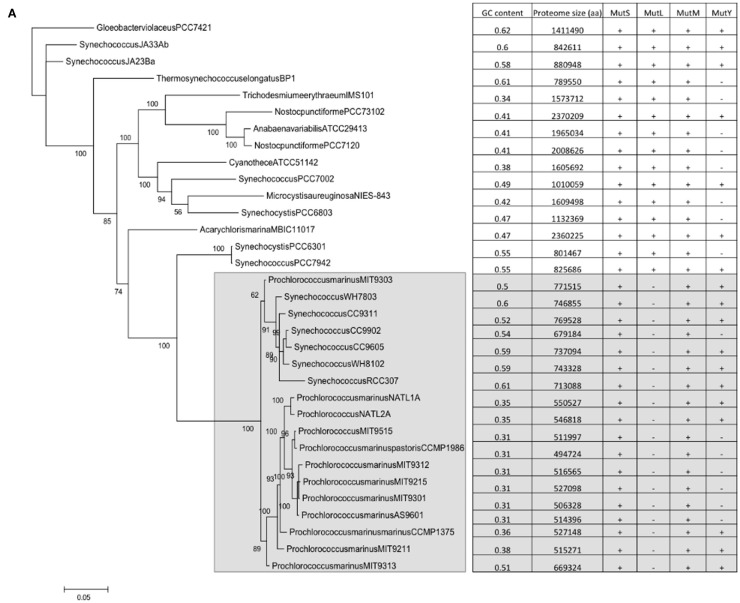
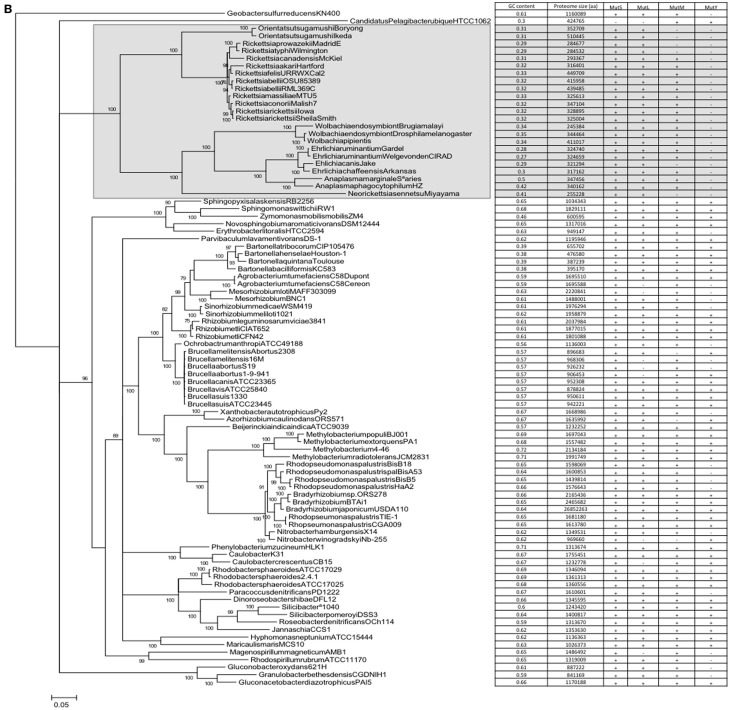
Phylogenetic trees of the cyanobacteria and alphaproteobacteria, with genome GC contents and presence of DNA repair genes (A) Cyanobacteria; (B) Alphaproteobacteria. Trees were constructed as described in Section “Materials and Methods.” Numerals refer to posterior probability.
Figure 2
Figure 2
Phylogenetic trees of the cyanobacteria and alphaproteobacteria, with genome GC contents and presence of DNA repair genes (A) Cyanobacteria; (B) Alphaproteobacteria. Trees were constructed as described in Section “Materials and Methods.” Numerals refer to posterior probability.
Figure A1
Figure A1
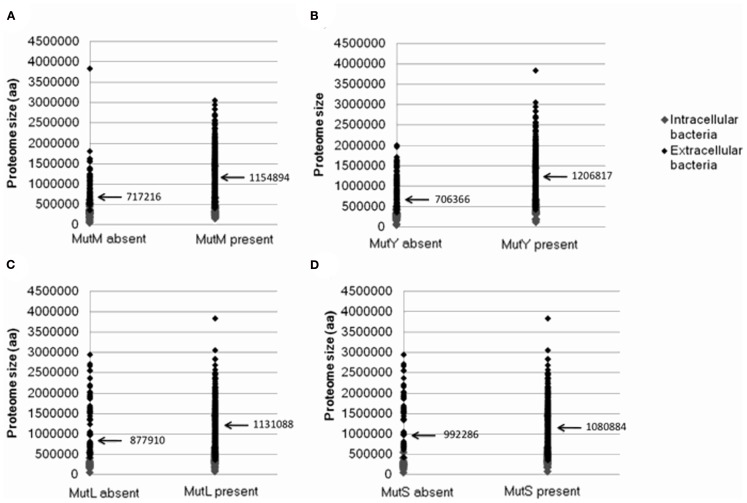
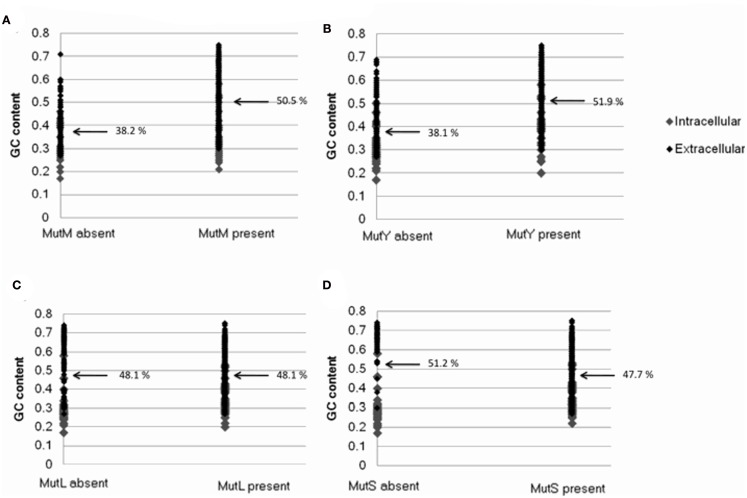
The relationship between the presence or absence of genes involved in DNA repair and proteome size. Plots show presence or absence of (A) mutM (B) mutY (C) mutL (D) mutS. Data was generated from 699 complete eubacterial genomes. Intracellular and extracellular bacteria are indicated.
Figure A2
Figure A2
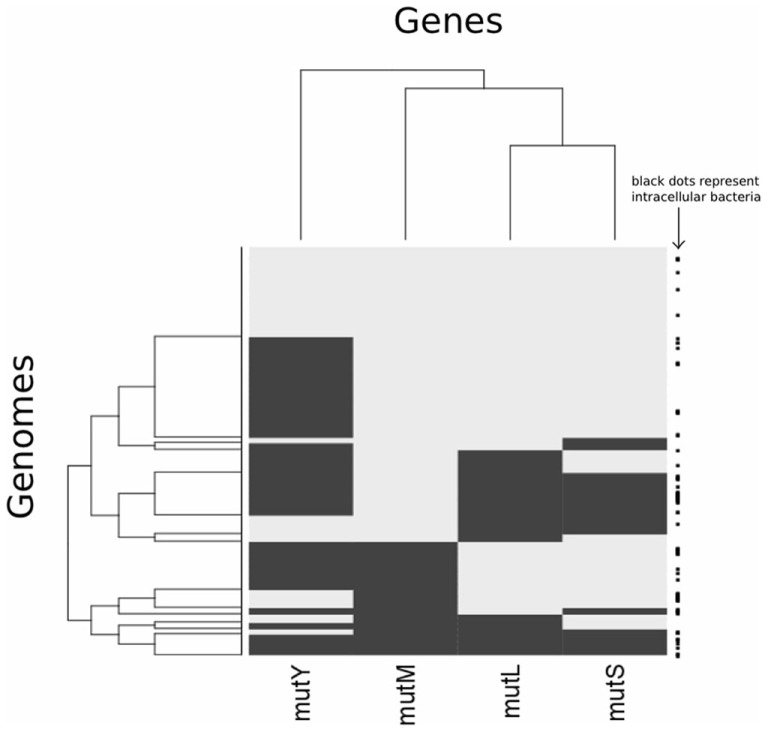
Heatmap clustering analysis showing presence/absence of mutM, mutY, mutL and mutS across genomes. Rows represent genomes and columns represent genes. Black denotes absence of a gene in a particular genome, while gray indicates presence. The clustering of columns follows the complete linkage method, as implemented in the R statistical package. The right hand side of the plot displays whether a genome belongs to a bacterium that is intracellular (black square).
Figure A3
Figure A3
The relationship between the presence/absence of genes involved in DNA repair and bacterial genome GC content. Plots show presence or absence of (A) mutM (B) mutY (C) mutL (D) mutS. Data was generated from 699 complete eubacterial genomes. Intracellular and extracellular bacteria are indicated.

References

    1. Akman L., Yamashita A., Watanabe H., Oshima K., Shiba T., Hattori M., Aksoy S. (2002). Genome sequence of the endocellular obligate symbiont of tsetse flies, Wigglesworthia glossinidia. Nat. Genet. 32, 402–407 10.1038/ng986 - DOI - PubMed
    1. Bernardi G., Mouchiroud D., Gautier C., Bernardi G. (1988). Compositional patterns in vertebrate genomes: conservation and change in evolution. J. Mol. Evol. 28, 7–18 10.1007/BF02143493 - DOI - PubMed
    1. Bridge P. D., Sawilowsky S. S. (1999). Increasing physicians’ awareness of the impact of statistics on research outcomes: comparative power of the t-test and Wilcoxon Rank-Sum test in small samples applied research. J. Clin. Epidemiol. 52, 229–235 10.1016/S0895-4356(98)00168-1 - DOI - PubMed
    1. Brynnel E. U., Kurland C. G., Moran N. A., Andersson S. G. (1998). Evolutionary rates for tuf genes in endosymbionts of aphids. Mol. Biol. Evol. 15, 574–582 - PubMed
    1. Cabrera M., Nghiem Y., Miller J. H. (1988). MutM, a second mutator locus in Escherichia coli that generates G.C-T.A transversions. J. Bacteriol. 170, 5405–5407 - PMC - PubMed