Physician empathy: definition, outcome-relevance and its measurement in patient care and medical education
- PMID: 22403596
- PMCID: PMC3296095
- DOI: 10.3205/zma000781
Physician empathy: definition, outcome-relevance and its measurement in patient care and medical education
Abstract
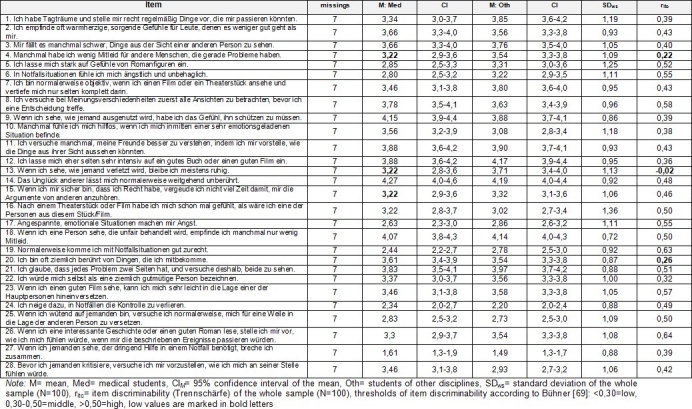
Objective: The present study gives a brief introduction into 1. the definition of physician empathy (PE) and 2. its influence on patients' health outcomes. Furthermore 3. we present assessment instruments to measure PE from the perspective of the patient and medical student. The latter topic will be explored in detail as we conducted a pilot study on the German versions of two self-assessment instruments of empathy, which are mostly used in medical education research, namely the "Jefferson Scale of Physician Empathy, Student Version" (JSPE-S) and the "Interpersonal Reactivity Index" (IRI).
Methods: We first present an overview of the current empirical and theoretical literature on the definition and outcome-relevance of PE. Additionally, we conducted basic psychometric analyses of the German versions of the JSPE-S and the IRI. Data for this analyses is based on a cross-sectional pilot-survey in N=44 medical students and N=63 students of other disciplines from the University of Cologne.
Results: PE includes the understanding of the patient as well as verbal and non-verbal communication, which should result in a helpful therapeutic action of the physician. Patients' health outcomes in different healthcare settings can be improved considerably from a high quality empathic encounter with their clinician. Basic psychometric results of the German JSPE-S and IRI measures show first promising results.
Conclusion: PE as an essential and outcome-relevant element in the patient-physician relationship requires more consideration in the education of medical students and, thus, in medical education research. The German versions of the JSPE-S and IRI measures seem to be promising means to evaluate these education aims and to conduct medical education research on empathy.
Ziel: Die vorliegende Studie gibt einen kurzen Überblick
zur Definition und
zum Einfluss ärztlicher Empathie auf die Gesundheit der Patienten.
Des Weiteren werden
Messinstrumente zur Erfassung ärztlicher Empathie aus der Sicht von Patienten und Medizinstudenten vorgestellt.
Letzteres Thema wird ausführlich behandelt, da eine Pilotstudie zur Testung zwei deutscher Versionen von Selbsteinschätzungsinstrumenten durchgeführt wurde, die derzeit am häufigsten in der internationalen Medizinischen Ausbildungsforschung genutzt werden. Dazu gehören die “Jefferson Scale of Physician Empathy, Student Version” (JSPE-S) sowie der “Interpersonal Reactivity Index” (IRI).
Methoden: Zunächst wird eine aktuelle empirische und theoretische Übersicht zur Definition und Outcome-Relevanz ärztlicher Empathie vorgestellt. Darüber hinaus werden erste Analysen zur Psychometrie der deutschen Versionen des JSPE-S und IRI durchgeführt. Die Daten für diese Analysen stammen aus einer Querschnittstudie mit N=44 Medizinstudenten und N=63 Studenten anderer Disziplinen der Universität zu Köln.
Ergebnisse: Ärztliche Empathie beinhaltet das Verstehen des Patienten sowie die verbale und non-verbale Kommunikation, wobei beides in ein unterstützendes, therapeutisches Verhalten des Arztes resultieren sollte. Die Gesundheit der Patienten kann in vielerlei Hinsicht und in unterschiedlichsten Versorgungsbereichen positiv durch eine empathische Konsultation mit dem Arzt beeinflusst werden. Die psychometrischen Kennwerte der deutschen Versionen des JSPE-S und IRI zeigen erste vielversprechende Ergebnisse.
Schlussfolgerung: Da ärztliche Empathie ein essenzielles und outcome-relevantes Element der Arzt-Patient-Beziehung ist, sollte sie mehr Beachtung in der medizinischen Ausbildung und daher auch in der Ausbildungsforschung finden. Die deutschen Versionen der JSPE-S und IRI Skalen scheinen vielversprechende Messinstrumente zu sein um solche Ausbildungsdesiderate zu evaluieren und Ausbildungsforschungsprojekte im Bereich der Empathie durchzuführen.
Keywords: CARE; IRI; JSPE-S; definition; patient-outcomes; physician empathy.
Figures

References
-
- Kappauf HW. Kommunikation in der Onkologie. Hautarzt. 2004;55:709–714. doi: 10.1007/s00105-004-0767-7. Available from: http://dx.doi.org/10.1007/s00105-004-0767-7. - DOI - PubMed
-
- Usherwood T. Understanding the consultation: evidence, theory and practice. Oxford: Oxford University Press; 1999.
-
- Rees-Lewis JC. Patients views on quality of care in general practice: literature review. Soc Sci Med. 1994;39:655-671.DOI:10. doi: 10.1016/0277-9536(94)90022-1. Available from: http://dx.doi.org/10.1016/0277-9536(94)90022-1. - DOI - PubMed
Publication types
MeSH terms
LinkOut - more resources
Full Text Sources
Other Literature Sources
Medical