


Selective loss of chemokine receptor expression on leukocytes after cell isolation
- PMID: 22403612
- PMCID: PMC3293867
- DOI: 10.1371/journal.pone.0031297
Selective loss of chemokine receptor expression on leukocytes after cell isolation
Abstract
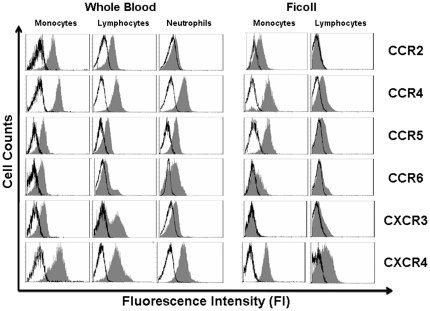
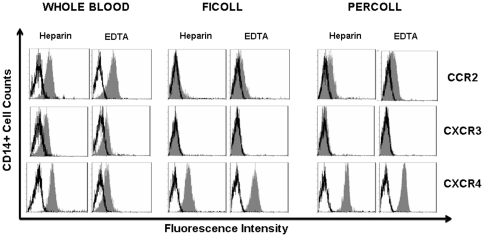
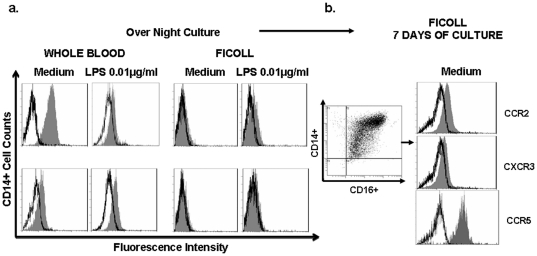
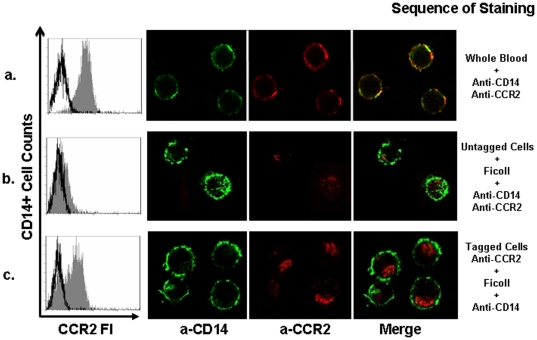
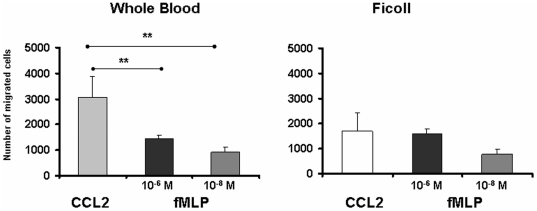
Chemokine receptors are distinctively exposed on cells to characterize their migration pattern. However, little is known about factors that may regulate their expression. To determine the optimal conditions for an accurate analysis of chemokine receptors, we compared the expression of CCR2, CCR4, CCR5, CCR6, CXCR3 and CXCR4 on different leukocyte subsets using whole blood (WB) plus erythrocyte lysis and density gradient isolation (Ficoll). Most WB monocytes were CCR2+ (93.5 ± 2.9%) whereas 32.8 ± 6.0% of monocytes from Ficoll-PBMC expressed CCR2 (p<0.001). Significant reductions of CCR6 and CXCR3 on monocytes were also observed after Ficoll isolation (WB: 46.4 ± 7.5% and 57.1 ± 5.5%; Ficoll: 29.5 ± 2.2% and 5.4 ± 4.3% respectively) (p<0.01). Although comparable percentages of WB and Ficoll-PBMC monocytes expressed CCR4, CCR5 and CXCR4, Ficoll isolation significantly reduced the levels of CXCR4 (WB: MFI 5 ± 0.4 and Ficoll: MFI 3.3 ± 0.1) (p<0.05). Similarly to monocytes, CCR2, CXCR3 and CXCR4 were also reduced on lymphocytes. In addition, Ficoll isolation significantly reduced the percentage of CCR4 positive lymphocytes (WB: 90.2 ± 4.5% and Ficoll: 55 ± 4.1%) (p<0.01). The loss of expression of chemokine receptors after isolation of monocytes was not dependent on either the anticoagulant or the density gradient method. It was irreversible and could not be restored by LPS activation or in vitro macrophage differentiation. Experiments tagged with anti-CCR2 antibodies prior to density gradient isolation demonstrated that Ficoll internalized chemokine receptors. The method for cell isolation may alter not only the expression of certain chemokine receptors but also the respective functional migration assay. The final choice to analyze their expression should therefore depend on the receptor to be measured.
Conflict of interest statement
Figures
References
-
- Murphy PM. International Union of Pharmacology. XXX. Update on chemokine receptor nomenclature. Pharmacol Rev. 2002;54:227–229. - PubMed
-
- Zou YR, Kottmann AH, Kuroda M, Taniuchi I, Littman DR. Function of the chemokine receptor CXCR4 in haematopoiesis and in cerebellar development. Nature. 1998;393:595–599. - PubMed
-
- Ebert LM, Schaerli P, Moser B. Chemokine-mediated control of T cell traffic in lymphoid and peripheral tissues. Mol Immunol. 2005;42:799–809. - PubMed
-
- D'Amico G, Frascaroli G, Bianchi G, Transidico P, Doni A, et al. Uncoupling of inflammatory chemokine receptors by IL-10: generation of functional decoys. Nat Immunol. 2000;1:387–391. - PubMed
Publication types
MeSH terms
Substances
LinkOut - more resources
Full Text Sources
