


Irritable bowel syndrome: methods, mechanisms, and pathophysiology. Genetic epidemiology and pharmacogenetics in irritable bowel syndrome
- PMID: 22403795
- PMCID: PMC3362100
- DOI: 10.1152/ajpgi.00537.2011
Irritable bowel syndrome: methods, mechanisms, and pathophysiology. Genetic epidemiology and pharmacogenetics in irritable bowel syndrome
Abstract
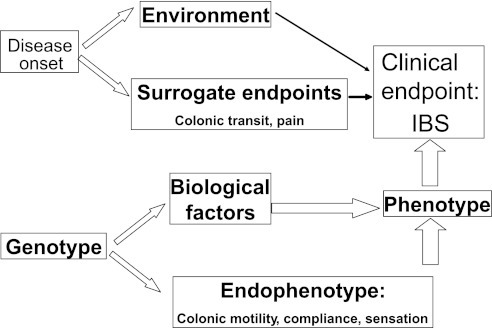
The objectives of this review are twofold. Our first objective is to evaluate the evidence supporting a role for genetics in irritable bowel syndrome (IBS). Specific examples of the associations of genetic variation and symptoms, syndromes, and intermediate phenotypes, including neurotransmitter (serotonergic, α(2)-adrenergic, and cannabinoid) mechanisms, inflammatory pathways (IL-10, TNFα, GNβ3, and susceptibility loci involved in Crohn's disease), and bile acid metabolism, are explored. The second objective is to review pharmacogenetics in IBS, with the focus on cytochrome P-450 metabolism of drugs used in IBS, modulation of motor and sensory responses to serotonergic agents based on the 5-hydroxytryptamine (5-HT) transporter-linked polymorphic region (5-HTTLPR) and 5-HT(3) genetic variants, responses to a nonselective cannabinoid agonist (dronabinol) based on cannabinoid receptor (CNR1) and fatty acid amide hydrolase (FAAH) variation, and responses to a bile acid (sodium chenodeoxycholate) and bile acid binding (colesevelam) based on klothoβ (KLB) and fibroblast growth factor receptor 4 (FGFR4) variation. Overall, there is limited evidence of a genetic association with IBS; the most frequently studied association is with 5-HTTLPR, and the most replicated association is with TNF superfamily member 15. Most of the pharmacogenetic associations are reported with intermediate phenotypes in relatively small trials, and confirmation in large clinical trials using validated clinical end points is still required. No published genome-wide association studies in functional gastrointestinal or motility disorders have been published.
Figures
References
-
- Abrahamsson H, Ostlund-Lindqvist AM, Nilsson R, Simrén M, Gillberg PG. Altered bile acid metabolism in patients with constipation-predominant irritable bowel syndrome and functional constipation. Scand J Gastroenterol 43: 1483–1488, 2008 - PubMed
-
- Aklillu E, Persson I, Bertilsson L, Johansson I, Rodrigues F, Ingelman-Sundberg M. Frequent distribution of ultrarapid metabolizers of debrisoquine in an Ethiopian population carrying duplicated and multiduplicated functional CYP 2D6 alleles. J Pharmacol Exp Ther 278: 441–446, 1996 - PubMed
-
- Andresen V, Camilleri M, Kim HJ, Stephens DA, Carlson PJ, Talley NJ, Saito YA, Urrutia R, Zinsmeister AR. Is there an association between GNβ3-C825T genotype and lower functional gastrointestinal disorders? Gastroenterology 130: 1985–1994, 2006 - PubMed
-
- Atkinson W, Lockhart S, Whorwell PJ, Keevil B, Houghton LA. Altered 5-hydroxytryptamine signaling in patients with constipation- and diarrhea-predominant irritable bowel syndrome. Gastroenterology 130: 34–43, 2006 - PubMed
-
- Bampton PA, Dinning PG, Kennedy ML, Lubowski DZ, Cook IJ. The proximal colonic motor response to rectal mechanical and chemical stimulation. Am J Physiol Gastrointest Liver Physiol 282: G443–G449, 2002 - PubMed
Publication types
MeSH terms
Substances
Grants and funding
LinkOut - more resources
Full Text Sources
Miscellaneous
