. 2012 Mar 7;102(5):1154-62.
doi: 10.1016/j.bpj.2012.01.041. Epub 2012 Mar 6.

Enrichment of amyloidogenesis at an air-water interface

Affiliations

Enrichment of amyloidogenesis at an air-water interface

Létitia Jean et al. Biophys J. .

Abstract

The aggregation of proteins or peptides into amyloid fibrils is a hallmark of protein misfolding diseases (e.g., Alzheimer's disease) and is under intense investigation. Many of the experiments performed are in vitro in nature and the samples under study are ordinarily exposed to diverse interfaces, e.g., the container wall and air. This naturally raises the question of how important interfacial effects are to amyloidogenesis. Indeed, it has already been recognized that many amyloid-forming peptides are surface-active. Moreover, it has recently been demonstrated that the presence of a hydrophobic interface can promote amyloid fibrillization, although the underlying mechanism is still unclear. Here, we combine theory, surface property measurements, and amyloid fibrillogenesis assays on islet amyloid polypeptide and amyloid-β peptide to demonstrate why, at experimentally relevant concentrations, the surface activity of the amyloid-forming peptides leads to enriched fibrillization at an air-water interface. Our findings indicate that the key that links these two seemingly different phenomena is the surface-active nature of the amyloid-forming species, which renders the surface concentration much higher than the corresponding critical fibrillar concentration. This subsequently leads to a substantial increase in fibrillization.


Figures

Figure 1
Figure 1
Height of IAPP plateau depends on the presence of the AWI. A quantity of 10 μM IAPP was incubated with 32 μM ThT with or without AWI removal at the start of the reaction. ThT fluorescence changes were monitored with the plateau heights depicted (inset). The term a.u. is “arbitrary units”. The mean of at least three independent assays is shown. Error bars represent mean ± SE.
Figure 2
Figure 2
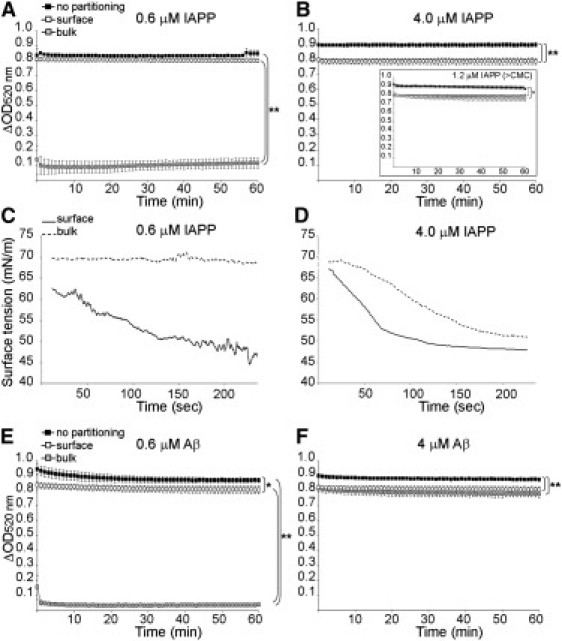
Amyloid assembly requires recruitment and adsorption of monomers at the AWI. Dynamic measurement of the surface activity for a whole reaction (nonpartitioned) and for the bulk and surface fractions of IAPP at 0.6 (A), 1.2 (inset in B), and 4 μM (B). The surface tension for the bulk and surface fractions of IAPP at 0.6 (C) and 4 μM (D) was also monitored over time (the graphs show 18-point moving averages of the raw data). Dynamic measurement of the surface activity for a whole reaction and for the bulk and surface fractions of Aβ1-40 at 0.6 (E) and 4 μM (F). ΔOD calculations were as described in Materials and Methods. a.u.: arbitrary units. The mean of at least three independent assays is shown. Error bars represent mean ± SE. Asterisk indicates p < 0.05 and double-asterisk indicates p < 0.02 for all time points of the time course.
Figure 3
Figure 3
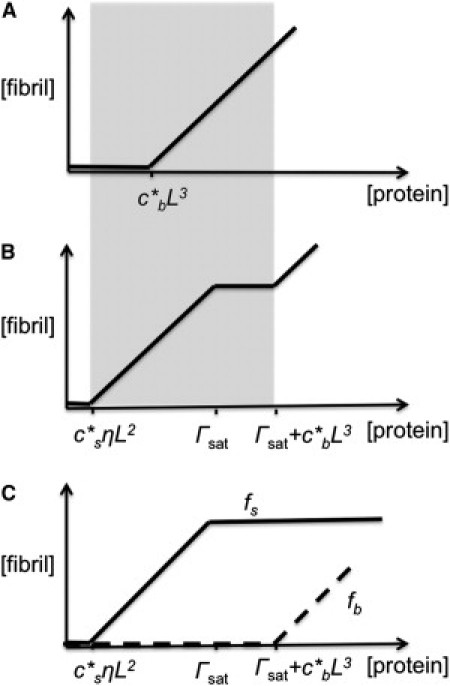
Fibrillization amounts in the absence and presence of the AWI according to the model in the limit of high adsorption. (A) In the absence of AWI, fibrillization occurs when the total number of monomeric peptides surpasses L3cb, where cb is the bulk CFC. (B) At the AWI, fibrillization occurs first due to the higher concentration of peptides at the AWI. After the surface is saturated with peptide (when the amount of peptides at the AWI is Γsat), the fibrillization amount remains constant until the total number of monomeric peptides in the bulk goes beyond L3cb, and then the fibrillization in the bulk starts and so the growth of fibrils continues. (Shaded area) Regime in which the fibrillization amount at the AWI is higher than the amount in the absence of the AWI. (C) The amount of fibrils at the surface (fs) and in the bulk (fb).
Figure 4
Figure 4
Amyloid fibrils are surface-active. Dynamic measurement of the surface activity of a fibrillized IAPP reaction at 4 (A) and 40 μM (B) were measured before and after partitioning of the bulk fraction from the surface. (Inset, B) ThT fluorescence changes monitored over time of the bulk fraction after partitioning of a 40 μM IAPP fibrillized reaction. (C) The surface activity of a fibrillized IAPP reaction at several concentrations was measured before and after partitioning of the bulk fraction from the surface. (D) The ThT fluorescence of a fibrillized IAPP reaction at several concentrations was measured before and after partitioning of the bulk fraction from the surface. ΔOD calculations were as described in Materials and Methods. The term a.u. is “arbitrary units”. The mean of at least three independent assays is shown. Error bars represent mean ± SE. (Asterisk) p < 0.05 and (double-asterisk) p < 0.02 for all time points of the time course.

References

    1. Chiti F., Dobson C.M. Protein misfolding, functional amyloid, and human disease. Annu. Rev. Biochem. 2006;75:333–366. - PubMed
    1. Harper J.D., Lansbury P.T., Jr. Models of amyloid seeding in Alzheimer's disease and scrapie: mechanistic truths and physiological consequences of the time-dependent solubility of amyloid proteins. Annu. Rev. Biochem. 1997;66:385–407. - PubMed
    1. Soreghan B., Kosmoski J., Glabe C. Surfactant properties of Alzheimer's Aβ peptides and the mechanism of amyloid aggregation. J. Biol. Chem. 1994;269:28551–28554. - PubMed
    1. Cottingham M.G., Bain C.D., Vaux D.J. Rapid method for measurement of surface tension in multiwell plates. Lab. Invest. 2004;84:523–529. - PubMed
    1. Lopes D.H., Meister A., Winter R. Mechanism of islet amyloid polypeptide fibrillation at lipid interfaces studied by infrared reflection absorption spectroscopy. Biophys. J. 2007;93:3132–3141. - PMC - PubMed

Publication types