


Associations between perceived neighborhood environmental attributes and adults' sedentary behavior: findings from the U.S.A., Australia and Belgium
- PMID: 22405686
- PMCID: PMC3321105
- DOI: 10.1016/j.socscimed.2012.01.018
Associations between perceived neighborhood environmental attributes and adults' sedentary behavior: findings from the U.S.A., Australia and Belgium
Abstract
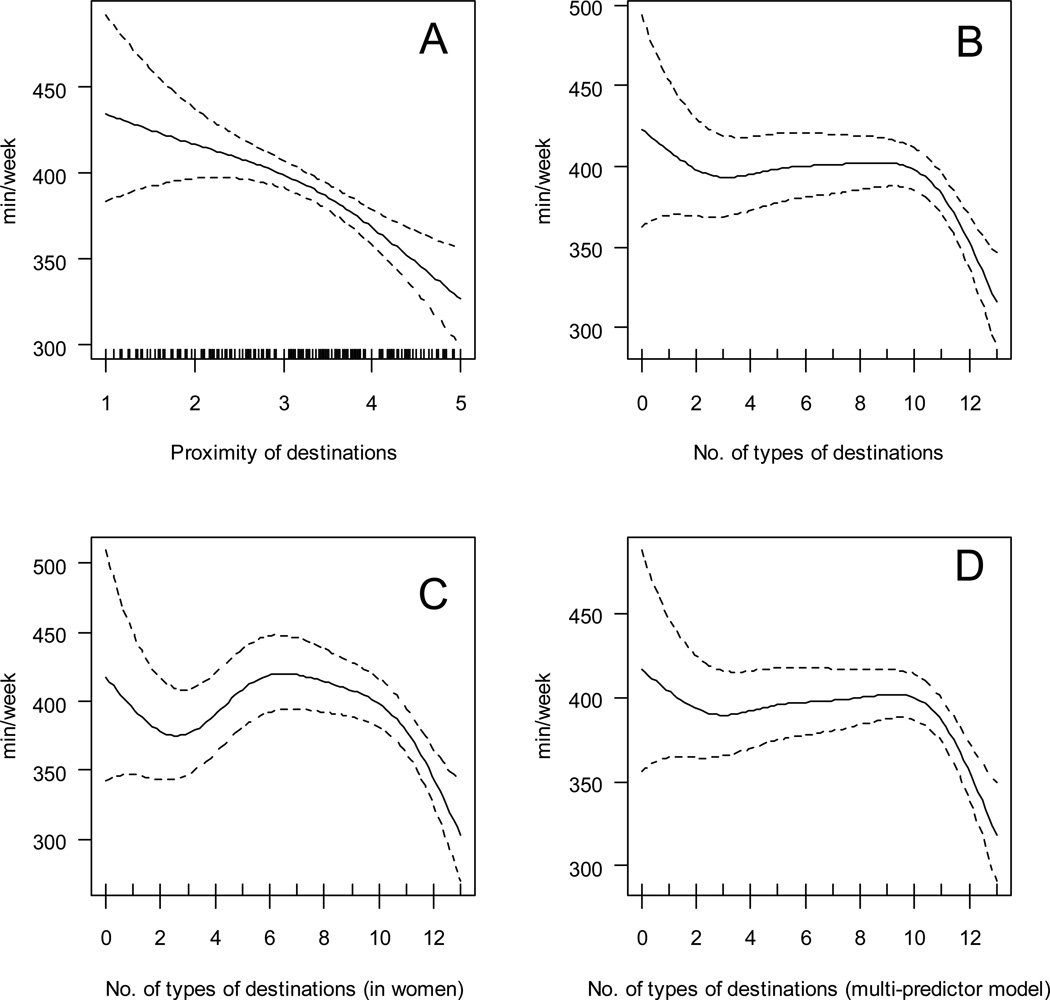
Sedentary behaviors are associated with multiple health problems, independently of physical activity. Neighborhood environment attributes might influence sedentary behaviors, but few studies have investigated these relationships. Moreover, all previous studies have been conducted within single countries, limiting environmental variability. We investigated the shape of associations between perceived neighborhood environment attributes and sedentary behavior in three countries; and whether these associations differed by country and gender. Data from U.S.A. (Seattle and Baltimore regions), Australia (Adelaide) and Belgium (Ghent) were pooled. Data collection took place between 2002 and 2008. In total, 6014 adults (20-65 years, 55.7% women) were recruited in high-/low-walkability and high-/low-income neighborhoods. All participants completed the International Physical Activity Questionnaire (domain-specific physical activity, transport-related sitting and overall time spent sitting) and the Neighborhood Environmental Walkability Scale (environmental perceptions). The number of destinations within a 20 min walk from home, perceiving few cul-de-sacs, good walking and cycling facilities, and traffic safety were included in an index of motorized transport correlates. This index was linearly negatively associated with motorized transport time, so the higher the scores on the index (more activity-friendliness), the lower the amount of motorized transport. No gender- or country-differences were identified. Perceived aesthetics and proximity of destinations were included in an index of overall sitting time correlates. A linear negative relationship with overall sitting time was found, but associations were stronger for men and not significant in Belgian adults. In conclusion, consistent and expected correlates were found for motorized transport in the three countries, but results were less clear for overall sitting time. Future studies should include even more countries to maximize environmental variability, but present findings suggest that neighborhoods may be designed to improve health through supporting more active and less sedentary transportation, which can be expected to have health benefits.
Copyright © 2012 Elsevier Ltd. All rights reserved.
Figures
References
-
- Australian Bureau of Statistics. [access verified on December 7, 2011];Census of Population and Housing: CDATA 2001, CD-ROM, Final Release. ABS. Available online at: www.abs.gov.au.
-
- Bauman AE, Bull FC. Environmental correlates of physical activity and walking in adults and children: a review of reviews. [access verified on December 7, 2011];Review undertaken for National Institute Health and Clinical Excellence. 2007 Available on: www.nice.org.uk/nicemedia/live/11679/34741/34741.doc.
-
- Cerin E, Saelens B, Sallis JF, Frank LD. Neighborhood environment walkability scale: validity and development of a short form. Medicine & Science in Sports & Exercise. 2006;38:1682–1691. - PubMed
-
- Clark BK, Sugiyama T, Healy GN, Salmon J, Dunstan DW, Shaw JE, et al. Socio-demographic correlates of prolonged television viewing time in Australian men and women: the AusDiab study. Journal of Physical Activity & Health. 2010;7:595–601. - PubMed
Publication types
MeSH terms
Grants and funding
LinkOut - more resources
Full Text Sources
Medical
