. 2012 May 3:209:128-35.
doi: 10.1016/j.neuroscience.2012.02.030. Epub 2012 Feb 24.

Relation between changes in neural responsivity and reductions in desire to eat high-calorie foods following gastric bypass surgery

Affiliations

Relation between changes in neural responsivity and reductions in desire to eat high-calorie foods following gastric bypass surgery

C N Ochner et al. Neuroscience. .

Abstract

Reductions in reward-related (e.g. striatal) neural activation have been noted following obesity surgery. It has been speculated that these postoperative neural changes may be related to documented postoperative changes in food preferences; however, this relation has not been previously established. In this study, functional magnetic resonance imaging and rating scales were used to assess neural responsivity, desire to eat (i.e. wanting), and liking for high- and low-calorie food cues in 14 females one month pre- and one month post-Roux-en-Y gastric bypass (RYGB) surgery. Pre- to post-RYGB changes in all variables were assessed, and postoperative changes in neural responsivity were regressed on postoperative changes in desire to eat and liking of foods. Results revealed significant postoperative reductions in mesolimbic (e.g. striatal) neural responsivity, desire to eat (wanting), and liking for high- relative to low-calorie food cues. Postoperative reductions in mesolimbic responsivity were associated with postoperative reductions in wanting, but not liking, for high- versus low-calorie foods. Interestingly, reductions in food wanting were also related to reductions in inhibitory (e.g. dorsolateral prefrontal cortex) activation following RYGB. Results are consistent with the hypothesized delineation between wanting and liking, supporting the notion that wanting, but not liking, is processed through the dopaminergic reward pathway. Concurrent reductions in both reward-related and inhibitory activation-predicted reductions in desire to eat might suggest that less dietary inhibition was elicited to resist potential overconsumption as the anticipated reward value of high-calorie foods decreased following RYGB.


Figures

Fig. 1
Fig. 1
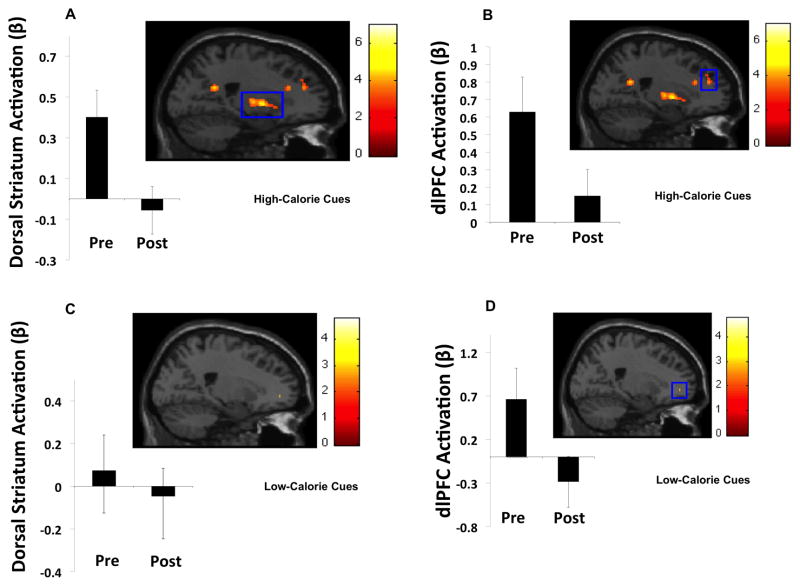
Pre > Post Contrast. Slices depicting postoperative decreases in neural responsivity to high-calorie (top) and low-calorie (bottom) food cues. All slices are derived from MNI coordinates 22, −2, 2 (x, y, z). Bar graphs display β values depicting blood oxygen level dependent signaling, with error bars showing 90% confidence intervals. The color bar represents t values. For display purposes, activation maps are shown without a cluster extent threshold. Significant clusters are presented in Table 2. Highlighted in blue are postoperative decreases in neural responsivity in the dorsal striatum (lentiform nucleus/putamen; Fig. 1A & C) and dlPFC (middle/superior frontal gyrus; Fig. 1B & D).
Fig. 2
Fig. 2
Desire to Eat in Response to High- and Low- Calorie Food Cues. Preoperatively, the difference (13.7 ± 12) between the desire to eat for high- vs. low- calorie foods (high-calorie – low-calorie) was greater than the nonsignificant postoperative difference (0.4 ± 3.5) in desire to eat for high- vs. low- calorie foods, F(1,13) = 16.7, p = 0.001. The postoperative reduction in desire to eat was greater for high- vs. low- calorie cues (p = 0.001), indicating a preferential reduction in desire to eat for high-, relative to low-, calorie foods. ** p < 0.01 *** p < 0.001
Fig. 3
Fig. 3
Postoperative Changes in Relative Desire to Eat (DTE) Regressed on Postoperative Reductions in Relative Neural Responsivity. Slices depicting areas in which significant postoperative reductions in neural responsivity to high- vs. low- calorie food cues predicted reductions in desire to eat for high- vs. low- calorie foods. All slices are derived from MNI coordinates 14, −10, 2 (x, y, z). The color bar represents t values. Results shown at p < 0.005 uncorrected for display purposes. Significant clusters are presented in Table 4. Highlighted in blue are associations in the dorsal striatum (caudate & lentiform nucleus; Fig. 3A) and dlPFC (superior frontal gyrus; Fig. 3B).

References

    1. Berridge KC. Wanting and Liking: Observations from the Neuroscience and Psychology Laboratory. Inquiry (Oslo) 2009;52:378. - PMC - PubMed
    1. Berridge KC. The tempted brain eats: pleasure and desire circuits in obesity and eating disorders. Brain research. 2010;1350:43–64. - PMC - PubMed
    1. Berridge KC, Robinson T. Parsing reward. Trends in neurosciences (Regular ed) 2003;26:507–513. - PubMed
    1. Berthoud H-R, Morrison C. The brain, appetite, and obesity. Annual review of psychology. 2008;59:55–92. - PubMed
    1. Bose M, Machineni S, Oliván B, Teixeira J, McGinty JJ, Bawa B, Koshy N, Colarusso A, Laferrère B. Superior appetite hormone profile after equivalent weight loss by gastric bypass compared to gastric banding. Obesity (Silver Spring) 2010;18:1085–1091. - PMC - PubMed

Publication types