


A two-year follow-up of cognitive deficits and brain perfusion in mild cognitive impairment and mild Alzheimer's disease
- PMID: 22406443
- PMCID: PMC3589736
- DOI: 10.3233/JAD-2012-111850
A two-year follow-up of cognitive deficits and brain perfusion in mild cognitive impairment and mild Alzheimer's disease
Abstract
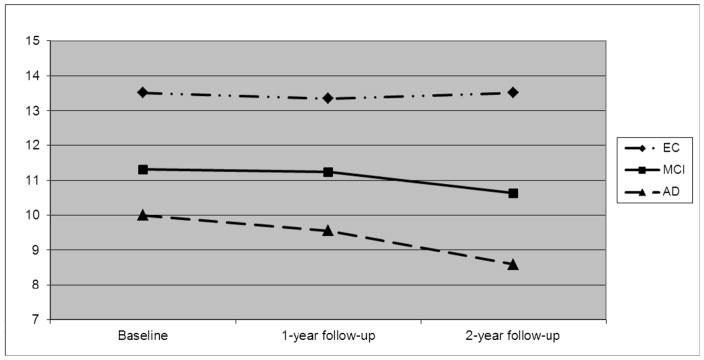
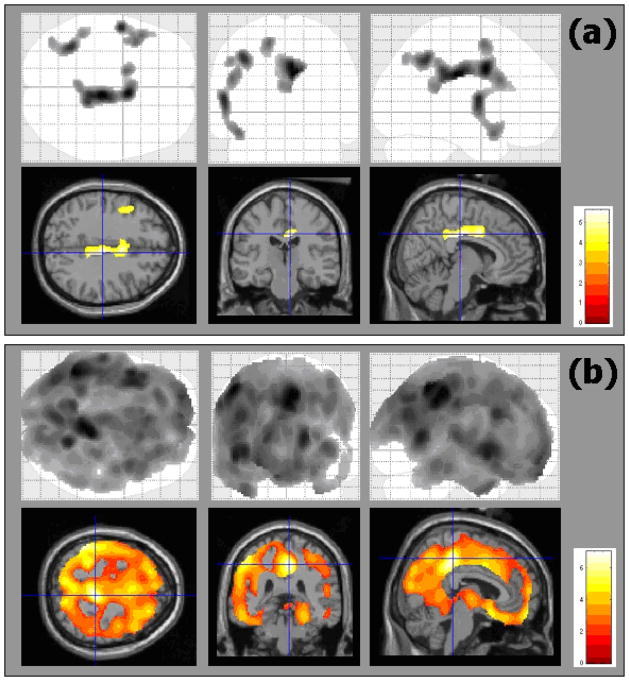
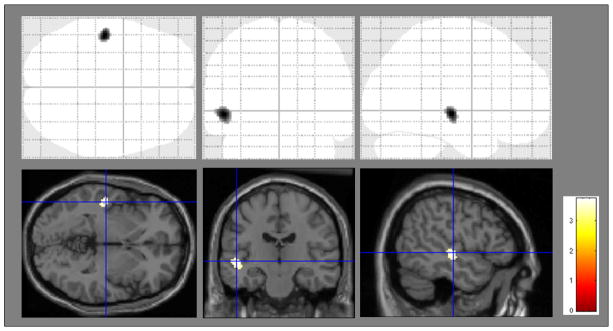
The 15-Objects Test (15-OT) provides useful gradation of visuoperceptual impairment from normal aging through Alzheimer's disease (AD) and correlates with temporo-parietal perfusion. The objectives of this study were to analyze progression of 15-OT performance in mild cognitive impairment (MCI) and AD, and its correlates with cognition and single photon emission computerized tomography (SPECT), as well as to examine neuropsychological and SPECT differences between the MCI patients who developed AD and those who did not. From the initial 126 participants (42/group), 38 AD, 39 MCI, and 38 elderly controls (EC) were reassessed (SPECT: 35 AD, 33 MCI, 35 EC) after two years. The progression of cognitive and SPECT scores during this period was compared between groups, and baseline data between converters and non-converters. The 15-OT was the only measure of progression that differed between the three groups; worsening scores on 15-OT were associated with worsening in verbal and visual retention, and decreased perfusion on left postsubicular area. In the MCI patients, cerebral perfusion fell over the two years in medial-posterior cingulate and fronto-temporo-parietal regions; AD showed extensive changes involving almost all cerebral regions. No SPECT changes were detected in controls. At baseline, the MCI patients who developed AD differed from non-converters in verbal recognition memory, but not in SPECT perfusion. In conclusion, SPECT and 15-OT appear to provide a potential measure to differentiate between normal aging, MCI, and AD. Worsening on 15-OT was related to decreased perfusion in postsubicular area; but further longitudinal studies are needed to determine the contribution of 15-OT as a predictor of AD from MCI.
Figures
References
-
- Small BJ, Gagnon E, Robinson B. Early identification of cognitive deficits: preclinical Alzheimer’s disease and mild cognitive impairment. Geriatrics. 2007;62:19–23. - PubMed
-
- Bäckman L, Small BJ, Fratiglioni L. Stability of the preclinical episodic memory deficit in Alzheimer’s disease. Brain. 2001;124:96–102. - PubMed
-
- Amieva H, Jacqmin-Gadda H, Orgogozo JM, Le Carret N, Helmer C, Letenneur L, Barberger-Gateau P, Fabrigoule C, Dartigues JF. The 9 year cognitive decline before dementia of the Alzheimer type: a prospective population-based study. Brain. 2005;128:1093–1101. - PubMed
-
- Levinoff EJ, Saumier D, Chertkov H. Focused attention deficits in partients with Alzheimer’s disease and mild cognitive impaiment. Brain Cogn. 2005;57:127–130. - PubMed
-
- Tales A, Haworth J, Nelson S, Snowden RM, Wilcock G. Abnormal visual search in mild cognitive impairment and Alzheimer’s disease. Neurocase. 2005;11:80–84. - PubMed
Publication types
MeSH terms
Grants and funding
LinkOut - more resources
Full Text Sources
Medical
