


Metabolism and neurotoxicity of homocysteine thiolactone in mice: evidence for a protective role of paraoxonase 1
- PMID: 22406444
- PMCID: PMC3544478
- DOI: 10.3233/JAD-2012-111940
Metabolism and neurotoxicity of homocysteine thiolactone in mice: evidence for a protective role of paraoxonase 1
Abstract
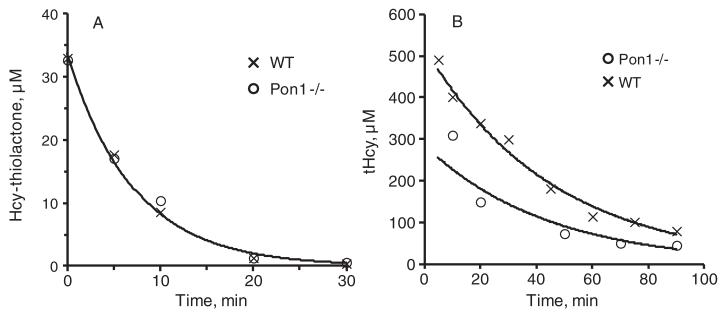
Homocysteine (Hcy)-thiolactone is toxic, induces epileptic seizures in rodents, and has been implicated in Alzheimer's disease. Paraoxonase 1 (Pon1), a component of high-density lipoprotein, hydrolyzes Hcy-thiolactone in vitro. Whether this reflects a physiological function and whether Pon1 can protect against Hcy-thiolactone toxicity was unknown. Here we show that Hcy-thiolactone was elevated in brains of Pon1-/- mice (1.5-fold, p = 0.047) and that Pon1-/- mice excrete more Hcy-thiolactone than wild type animals (2.4-fold, p = 0.047). The frequency of seizures induced by intraperitoneal injections of L-Hcy-thiolactone was significantly higher in Pon1-/- mice compared with wild type animals (52.8% versus 29.5%, p = 0.042); the latency of seizures was lower in Pon1-/- mice than in wild type animals (31.8 min versus 41.2 min, p = 0.019). Using the Pon1 null mice, we provide the first direct evidence that a specific Hcy metabolite, Hcy-thiolactone, rather than Hcy itself is neurotoxic in vivo. Our findings indicate that Pon1 protects mice against Hcy-thiolactone neurotoxicity by hydrolyzing it in the brain, and suggest a mechanism by which Pon1 can protect against neurodegeneration associated with hyperhomocysteinemia and Alzheimer's disease.
Figures
References
-
- Mudd SH, Levy HL, Krauss JP. Disorders of transsulfuration. In: Scriver CR, Beaudet AL, Sly WS, Valle D, Childs B, Kinzler KW, Vogelstein B, editors. The metabolic and molecular bases of inherited disease. Mc Graw-Hill; New York: 2001. pp. 2007–2056.
-
- Jakubowski H, Goldman E. Synthesis of homocysteine thiolactone by methionyl-tRNA synthetase in cultured mammalian cells. FEBS Lett. 1993;317:237–240. - PubMed
-
- Jakubowski H. Protein homocysteinylation: Possible mechanism underlying pathological consequences of elevated homocysteine levels. FASEB J. 1999;13:2277–2283. - PubMed
-
- Chwatko G, Boers GH, Strauss KA, Shih DM, Jakubowski H. Mutations in methylenetetrahydrofolate reductase or cystathionine beta-synthase gene, or a high-methionine diet, increase homocysteine thiolactone levels in humans and mice. FASEB J. 2007;21:1707–1713. - PubMed
-
- Jakubowski H, Boers GH, Strauss KA. Mutations in cystathionine beta-synthase or methylenetetrahydrofolate reductase gene increase N-homocysteinylated protein levels in humans. FASEB J. 2008;22:4071–4076. - PubMed
Publication types
MeSH terms
Substances
Grants and funding
LinkOut - more resources
Full Text Sources
Other Literature Sources
Medical
Miscellaneous
