Mineralocorticoid receptor Iso/Val (rs5522) genotype moderates the association between previous childhood emotional neglect and amygdala reactivity
- PMID: 22407082
- PMCID: PMC4700829
- DOI: 10.1176/appi.ajp.2011.11060855
Mineralocorticoid receptor Iso/Val (rs5522) genotype moderates the association between previous childhood emotional neglect and amygdala reactivity
Abstract
Objective: The amygdala is especially reactive to threatening stimuli, and the degree of reactivity predicts individual differences in the expression of depression and anxiety. Emerging research suggests that emotional neglect during childhood as well as hypercortisolemia may lead to heightened threat-related amygdala reactivity. This raises the possibility that genetic variation affecting hypothalamic-pituitary-adrenal (HPA) axis function contributes to individual differences in amygdala reactivity, both independently and as a function of childhood emotional neglect.
Method: This study assessed whether the mineralocorticoid receptor iso/val polymorphism (rs5522), a functional genetic variant affecting HPA axis function, influenced threat-related amygdala reactivity in 279 individuals in late childhood and early adolescence. The study also explored the extent to which any effects of the genotype on amygdala reactivity were contingent upon previous childhood emotional neglect.
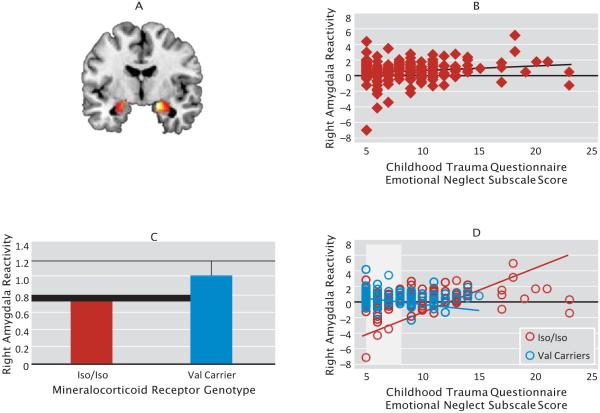
Results: Prior childhood emotional neglect and the val allele were associated with greater amygdala reactivity. Moreover, a significant genotype-by-emotional neglect interaction was observed whereby greater amygdala reactivity in val allele carriers was independent of previous childhood emotional neglect, while greater reactivity in iso homozygotes was revealed only in the context of a history of elevated emotional neglect. At relatively low levels of previous emotional neglect, val carriers had heightened amygdala reactivity relative to iso homozygotes.
Conclusions: These results suggest that relatively greater amygdala reactivity may represent a biological mechanism through which childhood adversity and functional genetic variation in HPA axis responsiveness to stress may mediate risk for psychopathology.
Figures
References
-
- Whalen PJ, Phelps EA, editors. The Human Amygdala. Guilford; New York: 2009.
-
- Hariri AR. The neurobiology of individual differences in complex behavioral traits. Annu Rev Neurosci. 2009;32:225–247. - PMC - PubMed
- Lupien SJ, McEwen BS, Gunnar MR, Heim C. Effects of stress throughout the lifespan on the brain, behaviour and cognition. Nat Rev Neurosci. 2009;10:434–445. - PubMed
-
- Mehta MA, Golembo NI, Nosarti C, Colvert E, Mota A, Williams SCR, Rutter M, Sonuga-Barke EJS. Amygdala, hippocampal and corpus callosum size following severe early institutional deprivation: the English and Romanian Adoptees study pilot. J Child Psychol Psychiatry. 2009;50:943–951. - PubMed
Publication types
MeSH terms
Substances
Grants and funding
LinkOut - more resources
Full Text Sources
Medical