


Identifying individual, cultural and asthma-related risk and protective factors associated with resilient asthma outcomes in urban children and families
- PMID: 22408053
- PMCID: PMC3415979
- DOI: 10.1093/jpepsy/jss002
Identifying individual, cultural and asthma-related risk and protective factors associated with resilient asthma outcomes in urban children and families
Abstract
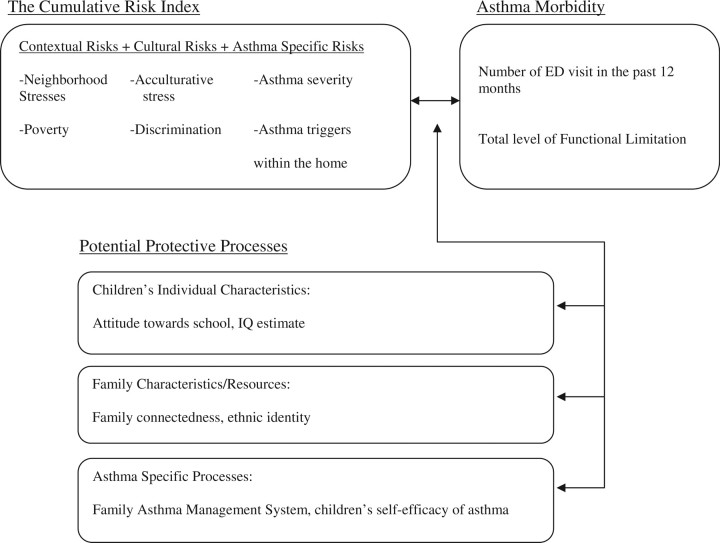
Objective: The goal of this study is to identify individual, family/cultural, and illness-related protective factors that may minimize asthma morbidity in the context of multiple urban risks in a sample of inner-city children and families.
Methods: Participating families are from African-American (33), Latino (51) and non-Latino white (47) backgrounds. A total of 131 children with asthma (56% male), ages 6-13 years and their primary caregivers were included.
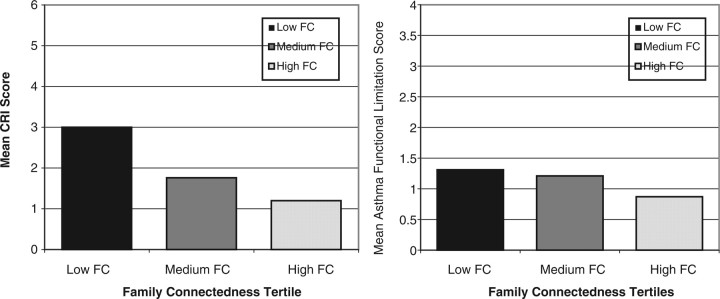
Results: Analyses supported the relationship between cumulative risks and asthma morbidity across children of the sample. Protective processes functioned differently by ethnic group. For example, Latino families exhibited higher levels of family connectedness, and this was associated with lower levels of functional limitation due to asthma, in the context of risks.
Conclusions: This study demonstrates the utility of examining multilevel protective processes that may guard against urban risks factors to decrease morbidity. Intervention programs for families from specific ethnic groups can be tailored to consider individual, family-based/cultural and illness-related supports that decrease stress and enhance aspects of asthma treatment.
Figures
References
-
- Alegria M, Vila D, Woo M, Canino G, Takeuchi D, Vera M, Febo V, Guarnaccia P, Aguilar-Gaxiola S, Shrout P. Cultural relevance and equivalence in the NLAAS instrument: Integrating etic and emic in the development of cross-cultural measures for a psychiatric epidemiology and services study of Latinos. International Journal of Methods in Psychiatric Research. 2004;13(4):270–288. - PMC - PubMed
-
- Barocas R, Seifer R, Sameroff A J. Defining environmental risk: Multiple dimensions of pscyhological vulnerability. American Journal of Community Psychology. 1985;13(4):433–447. - PubMed
-
- Bursch B, Schwankovsky L, Gilbert J, Zeiger R. Construction and validation of four childhood asthma self-management scales: Parent barriers, child and parent self-efficacy, and parent belief in treatment efficacy. Journal of Asthma. 1999;36(1):115–128. - PubMed
-
- Canino G, Bravo M. The adaptation and testing of diagnostic and outcome measures for cross-cultural research. International Review of Psychiatry. 1994;6:281–286.
-
- Canino G, Koinis-Mitchell D, Ortega A, McQuaid E, Fritz G, Alegria M. Asthma disparities in the prevalence, morbidity and treatment of Latino children. Social Science and Medicine. 2006;63(11):2926–2937. - PubMed
