


Psychometric evaluation of the HIV symptom distress scale
- PMID: 22409246
- PMCID: PMC3436989
- DOI: 10.1080/09540121.2012.656567
Psychometric evaluation of the HIV symptom distress scale
Abstract
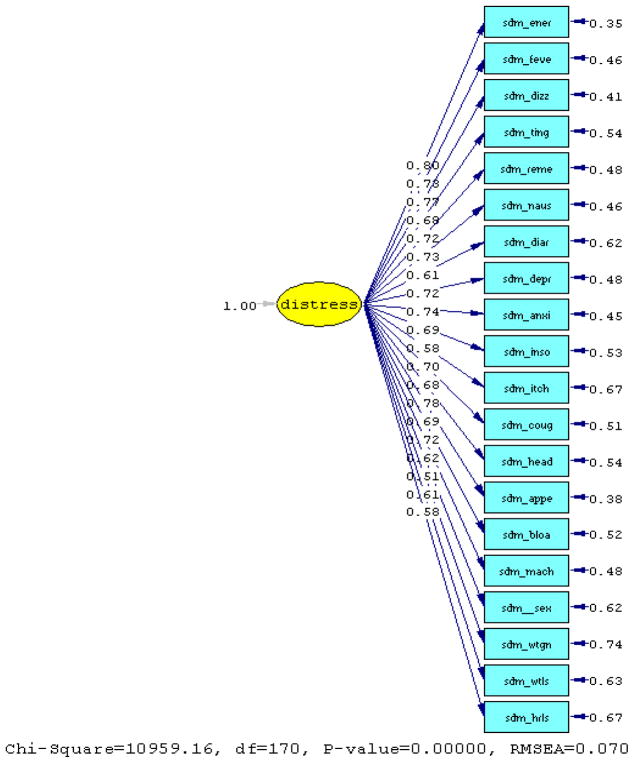
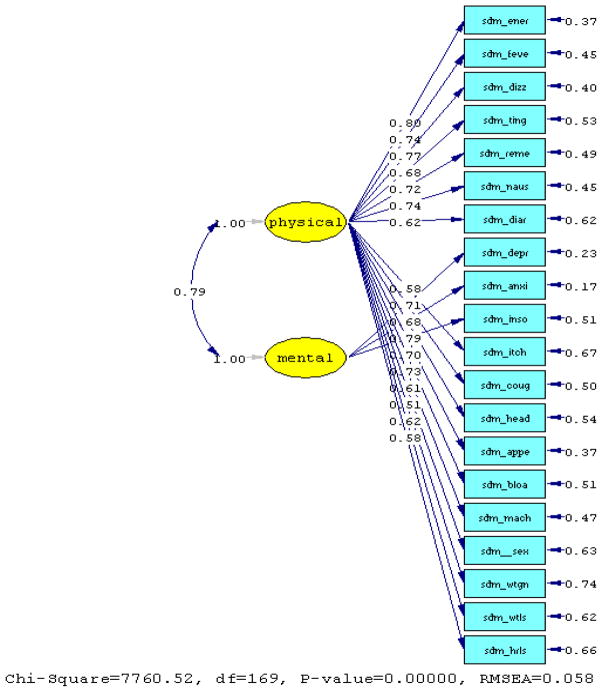
The objective of this article is to psychometrically validate the HIV symptom distress scale (SDS), an instrument that can be used to measure overall HIV symptom distress or clinically relevant groups of HIV symptoms. A secondary data analysis was conducted using the Collaborations in HIV Outcomes Research US Cohort (CHORUS). Inclusion criteria required study participants (N=5521) to have a valid baseline measure of the AIDS Clinical Trial Group Symptom Distress Module, with an SF-12 or SF-36 completed on the same day. Psychometric testing assessed unidimensionality, internal consistency, and factor structure using exploratory and confirmatory factor analysis, and structural equation modeling (SEM). Construct validity examined whether the new measure discriminates across clinical significance (CD4 and HIV viral load). Findings show that the SDS has high reliability (α=0.92), and SEM supports a correlated second-order factor model (physical and mental distress) with acceptable fit (GFI=0.88, AGFI=0.85, NFI=0.99, NNFI=0.99; RMSEA=0.06, [90% CI 0.06 - 0.06]; Satorra Bentler scaled, C (2) =3274.20; p=0.0). Construct validity shows significant differences across categories for HIV-1 viral load (p<0.001) and CD4 (p<0.001). Differences in mean SDS scores exist across gender (p<0.001), race/ethnicity (p<0.05), and educational attainment (p<0.001). Hence, the HIV SDS is a reliable and valid instrument, which measures overall HIV symptoms or clinically relevant groups of symptoms.
Figures
References
-
- SPSS for Windows 10.0 [computer program] Chicago, Ill: SPSS Inc;
-
- Becker SL, Raffanti SR, et al. Zidovudine and stavudine sequencing in HIV treatment planning: findings from the CHORUS HIV cohort. J Acquir Immune Defic Syndr. 2001;26(1):72–81. - PubMed
-
- Bentler PM, Bonnet DG. Significance Tests and Goodness of Fit in the Analysis of Covariance Structures. Psychological Bulletin. 1980 Nov;88:588–606.
-
- Bozzette SA, Hays RD, et al. A Perceived Health Index for use in persons with advanced HIV disease: derivation, reliability, and validity. Med Care. 1994;32(7):716–731. - PubMed
-
- Browne MW, Cudeck R. In: Testing Structural Equation Models. Bollen KA, Long JS, editors. Beverley Hills, CA: Sage; 1993. pp. 136–162.
Publication types
MeSH terms
Substances
Grants and funding
LinkOut - more resources
Full Text Sources
Medical
Research Materials
