. 2012 Mar 12:12:34.
doi: 10.1186/1471-2229-12-34.

Betalain production is possible in anthocyanin-producing plant species given the presence of DOPA-dioxygenase and L-DOPA

Affiliations

Betalain production is possible in anthocyanin-producing plant species given the presence of DOPA-dioxygenase and L-DOPA

Nilangani N Harris et al. BMC Plant Biol. .

Abstract

Background: Carotenoids and anthocyanins are the predominant non-chlorophyll pigments in plants. However, certain families within the order Caryophyllales produce another class of pigments, the betalains, instead of anthocyanins. The occurrence of betalains and anthocyanins is mutually exclusive. Betalains are divided into two classes, the betaxanthins and betacyanins, which produce yellow to orange or violet colours, respectively. In this article we show betalain production in species that normally produce anthocyanins, through a combination of genetic modification and substrate feeding.

Results: The biolistic introduction of DNA constructs for transient overexpression of two different dihydroxyphenylalanine (DOPA) dioxygenases (DODs), and feeding of DOD substrate (L-DOPA), was sufficient to induce betalain production in cell cultures of Solanum tuberosum (potato) and petals of Antirrhinum majus. HPLC analysis showed both betaxanthins and betacyanins were produced. Multi-cell foci with yellow, orange and/or red colours occurred, with either a fungal DOD (from Amanita muscaria) or a plant DOD (from Portulaca grandiflora), and the yellow/orange foci showed green autofluorescence characteristic of betaxanthins. Stably transformed Arabidopsis thaliana (arabidopsis) lines containing 35S: AmDOD produced yellow colouration in flowers and orange-red colouration in seedlings when fed L-DOPA. These tissues also showed green autofluorescence. HPLC analysis of the transgenic seedlings fed L-DOPA confirmed betaxanthin production.

Conclusions: The fact that the introduction of DOD along with a supply of its substrate (L-DOPA) was sufficient to induce betacyanin production reveals the presence of a background enzyme, possibly a tyrosinase, that can convert L-DOPA to cyclo-DOPA (or dopaxanthin to betacyanin) in at least some anthocyanin-producing plants. The plants also demonstrate that betalains can accumulate in anthocyanin-producing species. Thus, introduction of a DOD and an enzyme capable of converting tyrosine to L-DOPA should be sufficient to confer both betaxanthin and betacyanin production to anthocyanin-producing species. The requirement for few novel biosynthetic steps may have assisted in the evolution of the betalain biosynthetic pathway in the Caryophyllales, and facilitated multiple origins of the pathway in this order and in fungi. The stably transformed 35S: AmDOD arabidopsis plants provide material to study, for the first time, the physiological effects of having both betalains and anthocyanins in the same plant tissues.


Figures
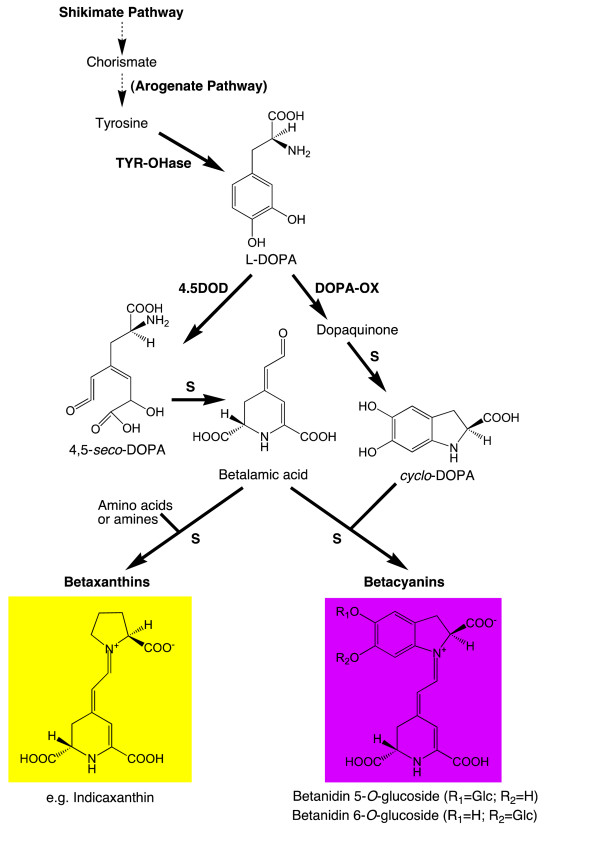
Figure 1
Figure 1
Schematic of the proposed biosynthesis pathway of betalains. Abbreviations are; 4,5DOD, DOPA-4,5-dioxygenase; DOPA-OX, DOPA oxidase; S, spontaneous conversion; TY-OHase, tyrosine hydroxylase. The steps for formation of the betacyanin glycosides are not shown.
Figure 2
Figure 2
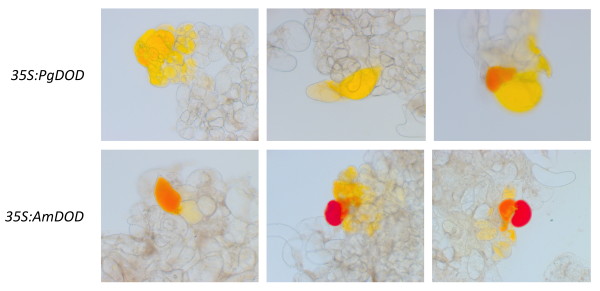
Pigment production in potato cell suspension cultures biolistically transformed with 35S: PgDOD or 35S: AmDOD and fed 10 mM L-DOPA. Examples are shown of cells with the resulting yellow to orange (35S: PgDOD) or yellow to red (35S: AmDOD) pigmentation.
Figure 3
Figure 3
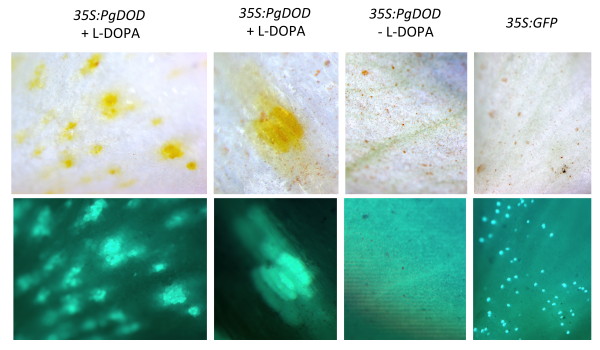
Betaxanthin production in antirrhinum petals transiently transformed with 35S: PgDOD or 35S: GFP. Plasmid constructs containing 35S: PgDOD or 35S: GFP were introduced into the adaxial epidermis of antirrhinum petals using particle bombardment. At 24 h after bombardment some 35S: PgDOD bombarded petals were infiltrated with 10 mM L-DOPA, while the other petals were infiltrated with water, and incubated for a further 24 h before observation. Representative petals are shown as viewed under white light (upper row) or blue light (lower row). The yellow, multi-cell foci for 35S: PgDOD petals fed with L-DOPA are shown at two magnifications.
Figure 4
Figure 4
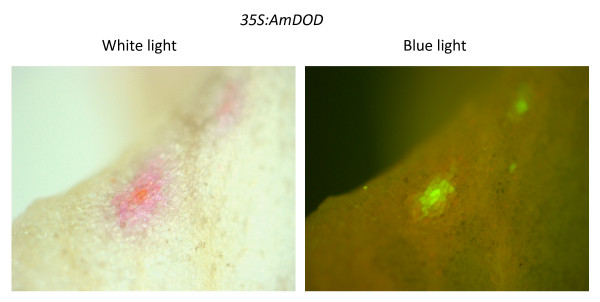
Pigment production in antirrhinum petals transiently transformed with 35S: AmDOD. A plasmid construct containing 35S: AmDOD was introduced into the adaxial epidermis of antirrhinum petals using particle bombardment. At 24 h after bombardment the bombarded petals were infiltrated with 10 mM L-DOPA and incubated for a further 24 h before observation. A representative petal is shown as viewed under white light (left) or blue light (right).
Figure 5
Figure 5
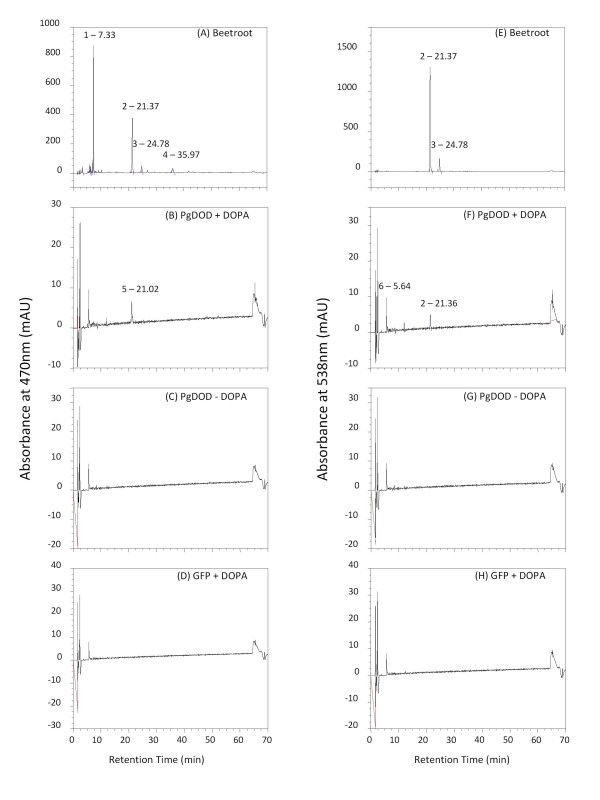
HPLC analysis of pigments produced in antirrhinum petals transiently transformed with 35S: PgDOD or 35S: GFP. HPLC analysis was conducted on the 35S: PgDOD and 35S: GFP antirrhinum petal material shown in Figure 3. Absorbance was monitored at 470 nm for betaxanthins or 538 nm for betacyanins. Chromatograms are for extracts from beetroot root (A and E), 35S: PgDOD antirrhinum infiltrated with L-DOPA (B and F), 35S: PgDOD antirrhinum without L-DOPA infiltration (C and G), 35S: GFP antirrhinum infiltrated with L-DOPA (D and H). The retention times of the major peaks are shown, and these were tentatively identified as per Table 1.
Figure 6
Figure 6
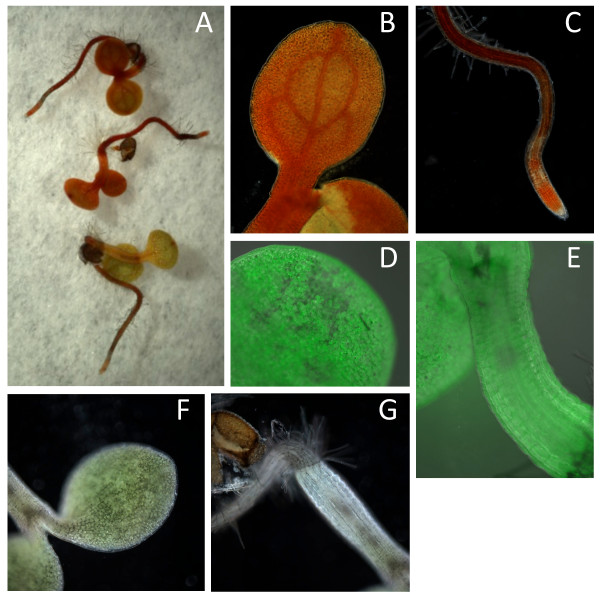
Betaxanthin production in arabidopsis seedlings stably transformed with 35S: AmDOD. 35S: AmDOD seedlings were grown on moistened filter disks either with (A to E) or without (F and G) 10 mM L-DOPA. Those fed L-DOPA accumulated yellow to orange/red pigments (A to C) and under blue light showed the autofluorescence typical of betaxanthins, as illustrated for the cotyledon (D) and hypocotyl (E). The seedlings not fed L-DOPA did not produce coloured pigments in either their cotyledons (F) or hypocotyls (G).
Figure 7
Figure 7
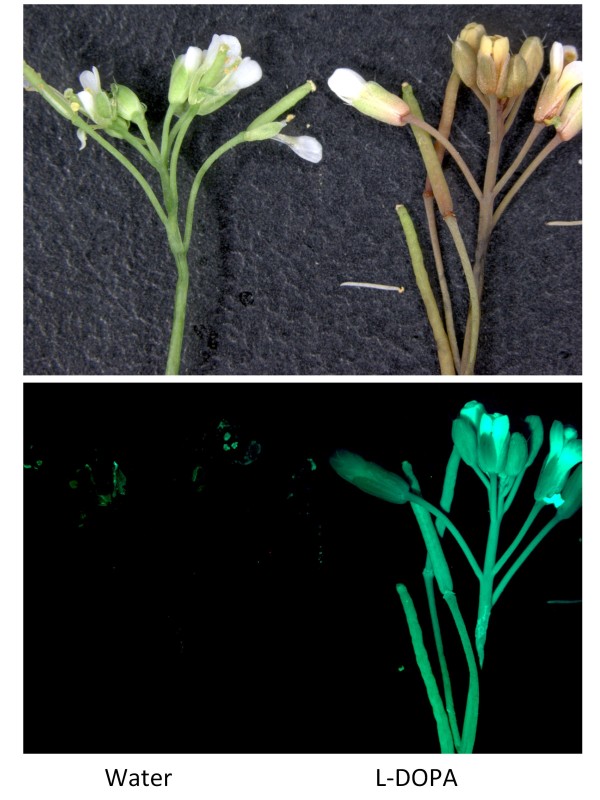
Pigment production in inflorescences of arabidopsis plants stably transformed with 35S: AmDOD. Inflorescences from 35S: AmDOD arabidopsis line 6 were infiltrated with either water or 10 mM L-DOPA for 24 h and examined under white light (upper panel) or blue light (lower panel). Those fed L-DOPA accumulated yellow to orange pigments and under blue light showed the autofluorescence typical of betaxanthins. The inflorescences not fed L-DOPA did not produce visible coloured pigments and did not show autofluorescence.
Figure 8
Figure 8
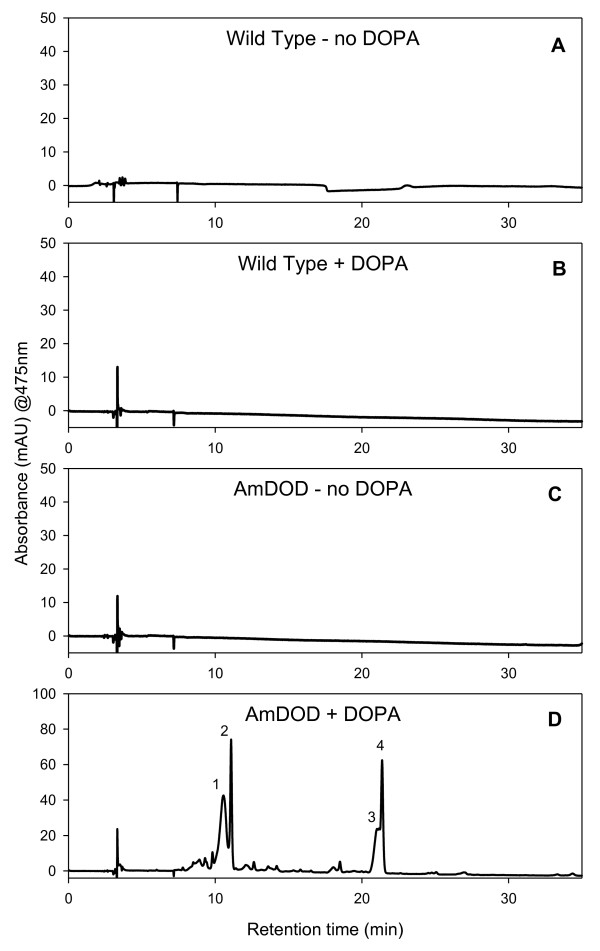
HPLC analysis of pigments produced in arabidopsis seedlings stably transformed with 35S: AmDOD. Seedlings, representatives of which are shown in Figure 6, were grown on moistened filter paper with or without the addition of 10 mM L-DOPA and the pigments present examined using HPLC. Samples from wild-type (non-transgenic) arabidopsis and from beetroot root were included for comparison. Absorbance was monitored at 475 nm for betaxanthins. The retention times of the major peaks are shown, and these were identified as betaxanthins per Table 2.

References

    1. Grotewold E. The genetics and biochemistry of floral pigments. Ann Rev Plant Biol. 2006;57:761–780. doi: 10.1146/annurev.arplant.57.032905.105248. - DOI - PubMed
    1. Tanaka Y, Sasaki N, Ohmiya A. Biosynthesis of plant pigments: anthocyanins, betalains and carotenoids. Plant J. 2008;54:733–749. doi: 10.1111/j.1365-313X.2008.03447.x. - DOI - PubMed
    1. Gould KS, Lister C. In: Flavonoids: Chemistry, Biochemistry and Applications. Andersen ØM, Markham KR, editor. CRC Press, Boca Raton; 2006. Flavonoid functions in plants; pp. 397–441.
    1. Davies KM. In: Plant Pigments and their Manipulation. Davies KM, editor. Blackwell Publishing, Oxford; 2004. An introduction to plant pigments in biology and commerce; pp. 1–22.
    1. Strack D, Vogt T, Schliemann W. Recent advances in betalain research. Phytochemistry. 2003;62:247–269. doi: 10.1016/S0031-9422(02)00564-2. - DOI - PubMed

Publication types

MeSH terms

LinkOut - more resources