


Contribution of higher risk genes and European admixture to Crohn's disease in African Americans
- PMID: 22411504
- PMCID: PMC3810419
- DOI: 10.1002/ibd.22931
Contribution of higher risk genes and European admixture to Crohn's disease in African Americans
Abstract
Background: African Americans (AAs) are an admixed population of West African (WA) and European ancestry (EA). Crohn's disease (CD) susceptibility genes have not been established. We therefore evaluated the contribution of European admixture and major established risk genes to AA CD.
Methods: Ninety-seven admixture informative markers were genotyped for ancestry estimates using STRUCTURE. Overall, 354 AA CD cases and 354 ethnicity-matched controls were genotyped for total 21 single nucleotide polymorphisms (SNPs) in ATG16L1, NOD2, IBD5, IL23R and IRGM by TaqMan or direct sequencing. Association was evaluated by logistic regression, adjusted for ancestry.
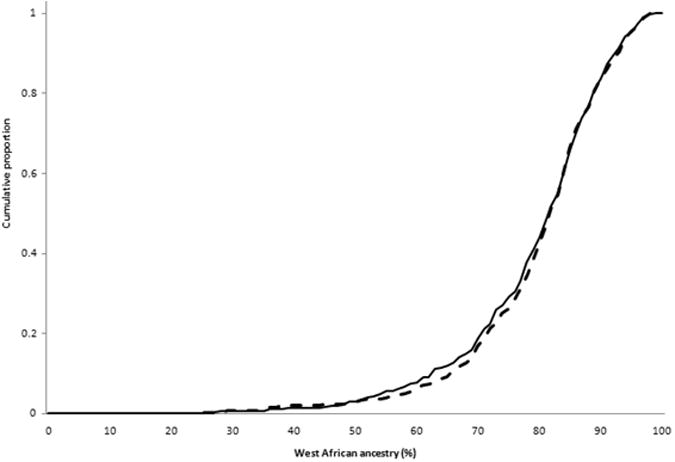
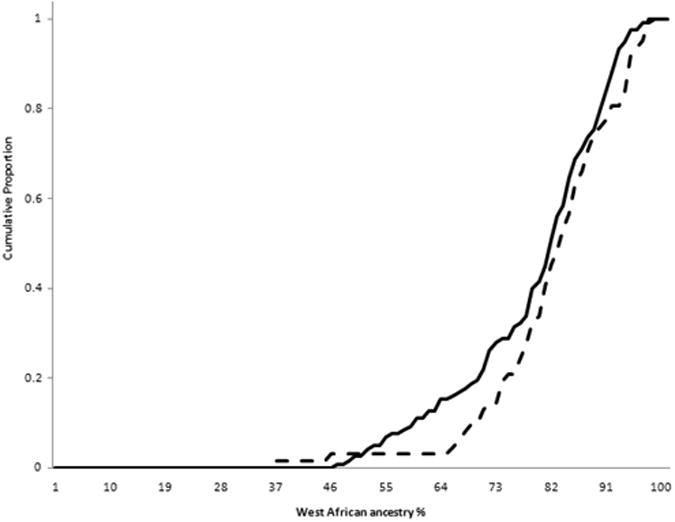
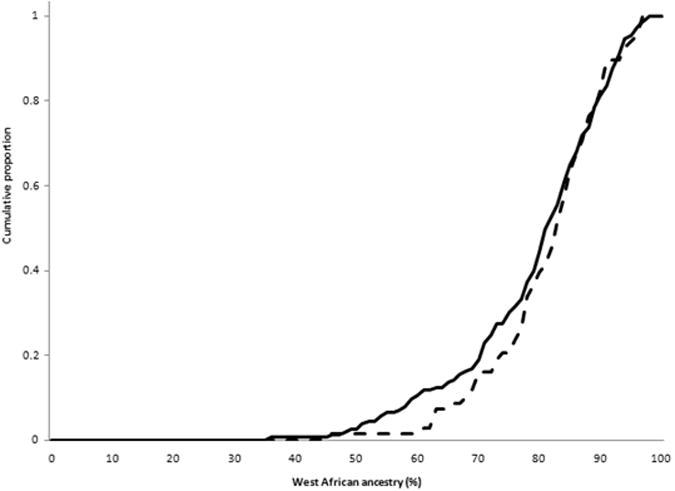
Results: Mean EA was similar among the CD cases and controls (20.9% and 20.4%, respectively, P = 0.58). No significant admixture differences were observed among 211 to 227 cases stratified by phenotypic subclassifications including onset, surgery, site, and behavior. CD was associated with NOD2 carrier (6.93% CD, 2.15% Controls, P = 0.007), ATG16L1 Thr300Ala (36.1% CD, 29.3% Controls, P = 0.003), SLC22A4 and SLC22A5 (IBD5 locus) functional SNPs (Leu503Phe [10.5% CD, 7.6% Controls, P = 0.05] and g-207c [41.3% CD, 35.7% Controls, P = 0.03], respectively), and IL23R rs2201841 (18.2% CD, 13.8% Controls, P = 0.03), but not IRGM variants, nor three African ancestral NOD2 nonsynonymous variants. IBD5 risk was recessive. An all-minor allele IBD5 haplotype from EA was associated (P = 0.05), whereas a more common haplotype isolating g-207c was not.
Conclusions: Specific functional gene variations contribute significantly to AA CD risk. Established NOD2, SLC22A4-A5, and ATG16L1 variants show increased CD risk, with IBD5 recessive. Although CD is more common in whites, European admixture is similar among AA cases and controls.
Copyright © 2012 Crohn's & Colitis Foundation of America, Inc.
Conflict of interest statement
Figures
References
-
- Calkins BM, Lilienfeld AM, Garland CF, Mendeloff AI. Trends in incidence rates of ulcerative colitis and Crohn's disease. DigDisSci. 1984;29:913–920. - PubMed
-
- Kurata JH, Kantor-Fish S, Frankl H, Godby P, Vadheim CM. Crohn's disease among ethnic groups in a large health maintenance organization. Gastroenterology. 1992;102:1940–1948. - PubMed
-
- Abramson O, Durant M, Mow W, Finley A, Kodali P, Wong A, Tavares V, McCroskey E, Liu L, Lewis JD, Allison JE, Flowers N, Hutfless S, Velayos FS, Perry GS, Cannon R, Herrinton LJ. Incidence, prevalence, and time trends of pediatric inflammatory bowel disease in Northern California, 1996 to 2006. J Pediatr. 2006;157:233–239. - PubMed
-
- Nguyen GC, Torres EA, Regueiro M, Bromfield G, Bitton A, Stempak J, Dassopoulos T, Schumm P, Gregory FJ, Griffiths AM, Hanauer SB, Hanson J, Harris ML, Kane SV, Orkwis HK, Lahaie R, Oliva-Hemker M, Pare P, Wild GE, Rioux JD, Yang H, Duerr RH, Cho JH, Steinhart AH, Brant SR, Silverberg MS. Inflammatory bowel disease characteristics among African Americans, Hispanics, and non-Hispanic Whites: characterization of a large North American cohort. Am J Gastroenterol. 2006;101:1012–1023. - PubMed
-
- Cheng CY, Kao WH, Patterson N, Tandon A, Haiman CA, Harris TB, Xing C, John EM, Ambrosone CB, Brancati FL, Coresh J, Press MF, Parekh RS, Klag MJ, Meoni LA, Hsueh WC, Fejerman L, Pawlikowska L, Freedman ML, Jandorf LH, Bandera EV, Ciupak GL, Nalls MA, Akylbekova EL, Orwoll ES, Leak TS, Miljkovic I, Li R, Ursin G, Bernstein L, Ardlie K, Taylor HA, Boerwinckle E, Zmuda JM, Henderson BE, Wilson JG, Reich D. Admixture mapping of 15,280 African Americans identifies obesity susceptibility loci on chromosomes 5 and X. PLoS Genet. 2009;5:e1000490. - PMC - PubMed
Publication types
MeSH terms
Substances
Supplementary concepts
Grants and funding
- U24 DK062429/DK/NIDDK NIH HHS/United States
- DK062423/DK/NIDDK NIH HHS/United States
- U01 DK062432/DK/NIDDK NIH HHS/United States
- UL1 TR000124/TR/NCATS NIH HHS/United States
- U01 DK062429/DK/NIDDK NIH HHS/United States
- U01 DK062422/DK/NIDDK NIH HHS/United States
- DK062431/DK/NIDDK NIH HHS/United States
- DK062420/DK/NIDDK NIH HHS/United States
- U01 DK062423/DK/NIDDK NIH HHS/United States
- DK062429/DK/NIDDK NIH HHS/United States
- DK062432/DK/NIDDK NIH HHS/United States
- DK062422/DK/NIDDK NIH HHS/United States
- U01 DK062413/DK/NIDDK NIH HHS/United States
- DK062413/DK/NIDDK NIH HHS/United States
- U01 DK062420/DK/NIDDK NIH HHS/United States
- U01 DK062431/DK/NIDDK NIH HHS/United States
LinkOut - more resources
Full Text Sources
Medical