


Major taste loss in carnivorous mammals
- PMID: 22411809
- PMCID: PMC3324019
- DOI: 10.1073/pnas.1118360109
Major taste loss in carnivorous mammals
Abstract
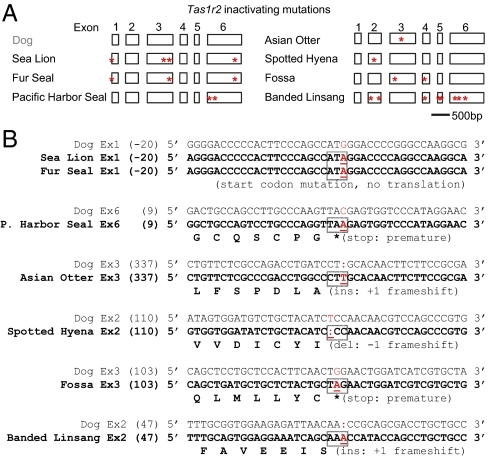
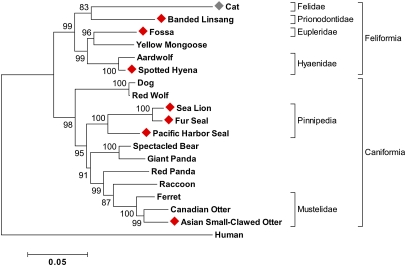
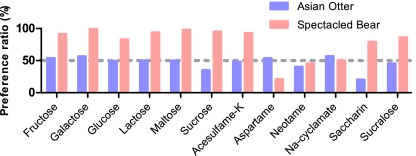
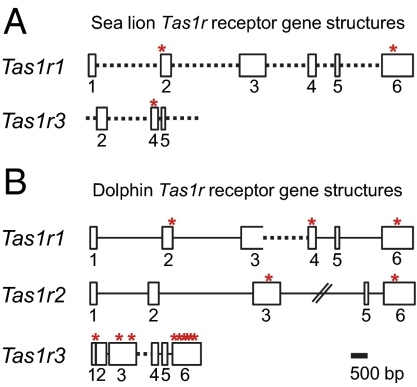
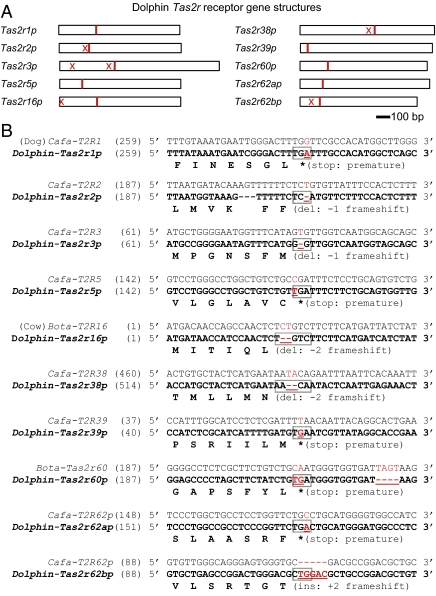
Mammalian sweet taste is primarily mediated by the type 1 taste receptor Tas1r2/Tas1r3, whereas Tas1r1/Tas1r3 act as the principal umami taste receptor. Bitter taste is mediated by a different group of G protein-coupled receptors, the Tas2rs, numbering 3 to ∼66, depending on the species. We showed previously that the behavioral indifference of cats toward sweet-tasting compounds can be explained by the pseudogenization of the Tas1r2 gene, which encodes the Tas1r2 receptor. To examine the generality of this finding, we sequenced the entire coding region of Tas1r2 from 12 species in the order Carnivora. Seven of these nonfeline species, all of which are exclusive meat eaters, also have independently pseudogenized Tas1r2 caused by ORF-disrupting mutations. Fittingly, the purifying selection pressure is markedly relaxed in these species with a pseudogenized Tas1r2. In behavioral tests, the Asian otter (defective Tas1r2) showed no preference for sweet compounds, but the spectacled bear (intact Tas1r2) did. In addition to the inactivation of Tas1r2, we found that sea lion Tas1r1 and Tas1r3 are also pseudogenized, consistent with their unique feeding behavior, which entails swallowing food whole without chewing. The extensive loss of Tas1r receptor function is not restricted to the sea lion: the bottlenose dolphin, which evolved independently from the sea lion but displays similar feeding behavior, also has all three Tas1rs inactivated, and may also lack functional bitter receptors. These data provide strong support for the view that loss of taste receptor function in mammals is widespread and directly related to feeding specializations.
Conflict of interest statement
The authors declare no conflict of interest.
Figures
Comment in
-
Mismatches between feeding ecology and taste receptor evolution: an inconvenient truth.Proc Natl Acad Sci U S A. 2012 Jun 5;109(23):E1464; author reply E1465. doi: 10.1073/pnas.1205205109. Epub 2012 May 4. Proc Natl Acad Sci U S A. 2012. PMID: 22562799 Free PMC article. No abstract available.
References
-
- Max M, et al. Tas1r3, encoding a new candidate taste receptor, is allelic to the sweet responsiveness locus Sac. Nat Genet. 2001;28:58–63. - PubMed
-
- Montmayeur JP, Liberles SD, Matsunami H, Buck LB. A candidate taste receptor gene near a sweet taste locus. Nat Neurosci. 2001;4:492–498. - PubMed
-
- Nelson G, et al. Mammalian sweet taste receptors. Cell. 2001;106:381–390. - PubMed
Publication types
MeSH terms
Substances
Associated data
- Actions
- Actions
- Actions
- Actions
- Actions
- Actions
- Actions
- Actions
- Actions
- Actions
- Actions
- Actions
- Actions
- Actions
- Actions
- Actions
- Actions
- Actions
- Actions
- Actions
- Actions
- Actions
- Actions
- Actions
- Actions
- Actions
- Actions
Grants and funding
LinkOut - more resources
Full Text Sources
Other Literature Sources
Miscellaneous
