. 2012 Mar 27;109(13):4762-7.
doi: 10.1073/pnas.1113466109. Epub 2012 Mar 12.

Reactive polymer enables efficient in vivo bioorthogonal chemistry

Affiliations

Reactive polymer enables efficient in vivo bioorthogonal chemistry

Neal K Devaraj et al. Proc Natl Acad Sci U S A. .

Abstract

There has been intense interest in the development of selective bioorthogonal reactions or "click" chemistry that can proceed in live animals. Until now however, most reactions still require vast surpluses of reactants because of steep temporal and spatial concentration gradients. Using computational modeling and design of pharmacokinetically optimized reactants, we have developed a predictable method for efficient in vivo click reactions. Specifically, we show that polymer modified tetrazines (PMT) are a key enabler for in vivo bioorthogonal chemistry based on the very fast and catalyst-free [4 + 2] tetrazine/trans-cyclooctene cycloaddition. Using fluorescent PMT for cellular resolution and (18)F labeled PMT for whole animal imaging, we show that cancer cell epitopes can be easily reacted in vivo. This generic strategy should help guide the design of future chemistries and find widespread use for different in vivo bioorthogonal applications, particularly in the biomedical sciences.


Conflict of interest statement

The authors declare no conflict of interest.

Figures
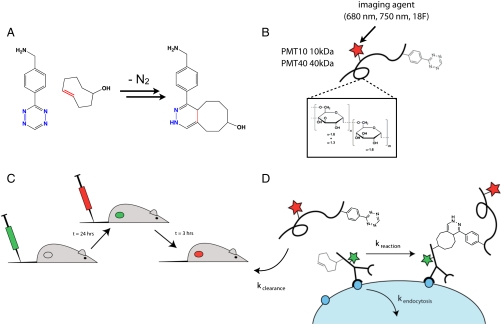
Fig. 1.
Fig. 1.
In Vivo Bioorthogonal Reactions. (A) Tetrazine cycloaddition with trans-cyclooctene forming a dihydropyrazine. (B) Schematic of PMT used in this study. The scaffold consists of dextran that has been aminated to allow attachment of tetrazine reactive groups as well as imaging agents such as near-infrared fluorophores and radioisotopes. (C) In vivo multistep delivery of imaging agent. A slow clearing targeting agent is administered first (green) and is given 24 h for localization and background clearance. Next, a lower molecular weight secondary agent (red) is delivered that rapidly reacts and is cleared from the background tissue much faster than the primary agent. (D) Kinetic parameters of consideration for in vivo clicking. The secondary tetrazine agent reacts with transcyclooctene antibodies at a given rate (kreaction). This rate is in competition with other rates including the clearance of the secondary agent from the body (kclearance) and internalization of the antibody (kendocytocis).
Fig. 2.
Fig. 2.
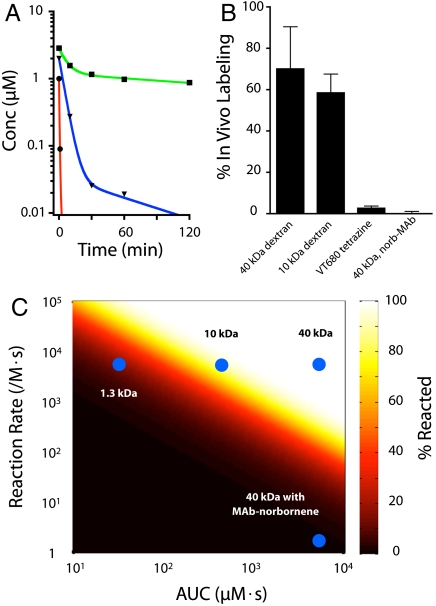
Optimization of In Vivo Chemistry with Polymer Modified Tetrazines (PMT). (A) Clearance kinetics of tetrazine-VT680 (red), PMT10 (blue) and PMT40 (green). (B) Efficiency of in vivo labelling of trans-cyclooctene modified leukocytes using various tetrazine cycloadditions. (C) Heat map showing predicted efficiency of reaction given a reaction rate and secondary clearance rate. The 1.3 kDa point represents the small molecule tetrazine-VT680. The highest efficiencies were observed for the fast tetrazine/trans-cyclooctene reaction using slow clearing PMT10 or PMT40. Use of either a faster clearing tetrazine or a much slower reaction greatly diminishes the efficiency of reaction as seen in plot in (B).
Fig. 3.
Fig. 3.
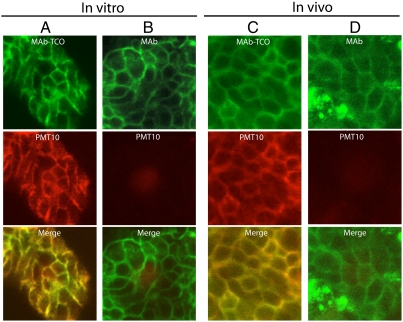
In Vitro and In Vivo Microscopy of Fluorescent PMT10 Targeting a Cancer Cell Epitope. Confocal imaging demonstrating targeting of PMT10 (750 nm) to trans-cyclooctene (TCO) antibodies (680 nm) on the surface of LS174T cells both in vitro and in vivo. (A) LS174T cells in culture labeled with TCO monoclonal antibodies followed by PMT10 (750 nm) labeling. (B) Same as previous except monoclonal antibodies lack TCO. (C) Cells in a LS174T xenograft in vivo labeled with TCO monoclonal antibodies followed by PMT10 (750 nm) labeling. (D) Same as previous except monoclonal antibodies lack TCO. See Materials and Methods for experimental details.
Fig. 4.
Fig. 4.
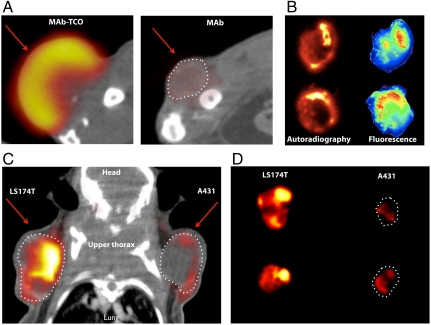
PET and Autoradiography using 18F Tetrazine Agents. (A) PET/CT fusion of LS174T tumor xenograft labeled using either trans-cyclooctene (TCO) monoclonal antibodies (MAb TCO) or control unlabeled antibodies (MAb) followed by 18F-PMT10. Arrows indicate location of the tumor xenograft. Bladder has been omitted for clarity. (B) Imaging using autoradiography (left side) and fluorescence reflectance (right side) of 1 mm LS174T tumor slices after targeting with fluorescent TCO monoclonal antibody and 18F-PMT10. (C) PET/CT fusion of mouse bearing A431 and LS174T tumors after targeting with anti-A33 TCO monoclonal antibodies followed by 18F-PMT10. Arrows indicate location of tumors and the liver has been omitted for clarity. (D) Autoradiography of representative 1 mm LS174T or A431 tumor slices after multistep targeting.

References

    1. Prescher JA, Dube DH, Bertozzi CR. Chemical remodelling of cell surfaces in living animals. Nature. 2004;430:873–877. - PubMed
    1. Rostovtsev VV, Green LG, Fokin VV, Sharpless KB. A stepwise huisgen cycloaddition process: copper(I)-catalyzed regioselective "ligation" of azides and terminal alkynes. Angew Chem Int Ed Engl. 2002;41:2596–2599. - PubMed
    1. Hong V, Steinmetz NF, Manchester M, Finn MG. Labeling live cells by copper-catalyzed alkyne-azide click chemistry. Bioconjug Chem. 2010;21:1912–1916. - PMC - PubMed
    1. Jiang H, et al. Imaging glycans in zebrafish embryos by metabolic labeling and bioorthogonal click chemistry. Journal of visualized experiments. 2011;JoVE (52) - PMC - PubMed
    1. Agard NJ, Prescher JA, Bertozzi CR. A strain-promoted [3 + 2] azide-alkyne cycloaddition for covalent modification of biomolecules in living systems. J Am Chem Soc. 2004;126:15046–15047. - PubMed

Publication types

MeSH terms

LinkOut - more resources