. 2012 Jun 1;94(3):460-8.
doi: 10.1093/cvr/cvs118. Epub 2012 Mar 12.

Dietary linoleate preserves cardiolipin and attenuates mitochondrial dysfunction in the failing rat heart

Affiliations

Dietary linoleate preserves cardiolipin and attenuates mitochondrial dysfunction in the failing rat heart

Christopher M Mulligan et al. Cardiovasc Res. .

Abstract

Aims: Cardiolipin (CL) is a tetra-acyl phospholipid that provides structural and functional support to several proteins in the inner mitochondrial membrane. The majority of CL in the healthy mammalian heart contains four linoleic acid acyl chains (L(4)CL). A selective loss of L(4)CL is associated with mitochondrial dysfunction and heart failure in humans and animal models. We examined whether supplementing the diet with linoleic acid would preserve cardiac L(4)CL and attenuate mitochondrial dysfunction and contractile failure in rats with hypertensive heart failure.

Methods and results: Male spontaneously hypertensive heart failure rats (21 months of age) were administered diets supplemented with high-linoleate safflower oil (HLSO) or lard (10% w/w; 28% kilocalorie fat) or without supplemental fat (control) for 4 weeks. HLSO preserved L(4)CL and total CL to 90% of non-failing levels (vs. 61-75% in control and lard groups), and attenuated 17-22% decreases in state 3 mitochondrial respiration observed in the control and lard groups (P < 0.05). Left ventricular fractional shortening was significantly higher in HLSO vs. control (33 ± 2 vs. 29 ± 2%, P < 0.05), while plasma insulin levels were lower (5.4 ± 1.1 vs. 9.1 ± 2.3 ng/mL; P < 0.05), with no significant effect of lard supplementation. HLSO also increased serum concentrations of several eicosanoid species compared with control and lard diets, but had no effect on plasma glucose or blood pressure.

Conclusion: Moderate consumption of HLSO preserves CL and mitochondrial function in the failing heart and may be a useful adjuvant therapy for this condition.


Figures
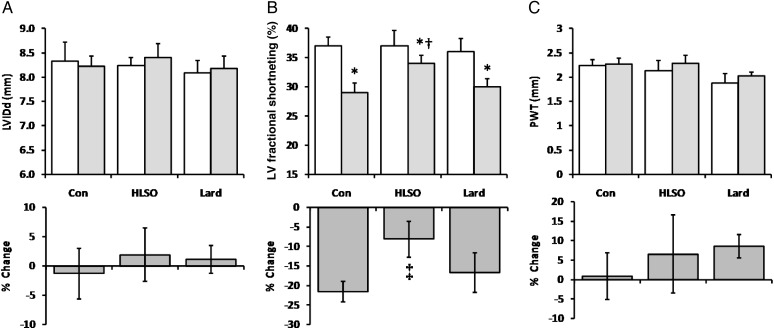
Figure 1
Figure 1
Echocardiography data from animals before (light bars; 21 months) and after (shaded bars; 22 months) the 4-week intervention period (n = 8/group). Data are means ± SEM for LV internal diameter in diastole (LVIDd; A), fractional shortening (FS; B), and LV posterior wall thickness (PWT; C). *P < 0.05 vs. pre-treatment levels; P < 0.05 vs. Con and lard post-treatment. P < 0.05 vs. Con and lard groups.
Figure 2
Figure 2
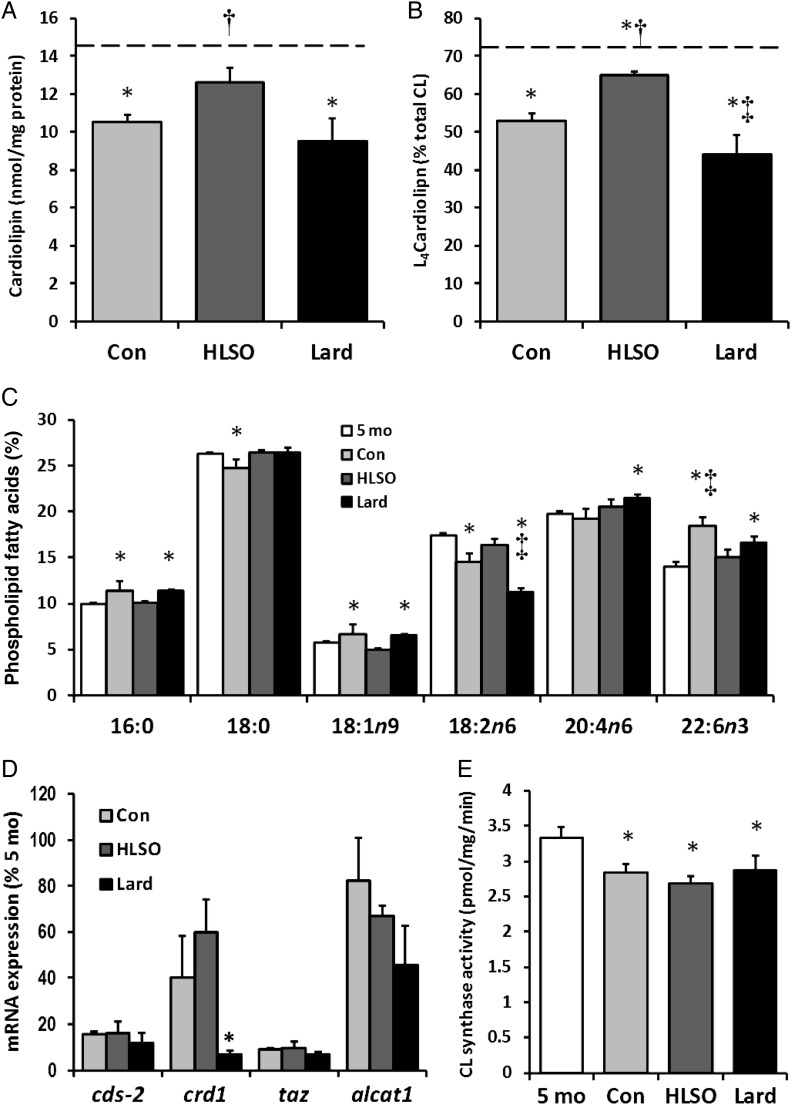
Cardiolipin and membrane fatty acid profiles. Total cardiolipin content (A) and the relative proportion of L4CL (B) in LV mitochondria decreased in all 22-month groups vs. 5-month baseline, but this loss was attenuated by the HSLO diet. Several alterations in the myocardial phospholipid fatty acid profile resulted from heart failure and diets, (C; see text for details). Effect of the diets on mRNA expression of CL metabolism genes (D; see text for details). (E) CL synthase activity. Data are means ± SEM (n = 8/group). Dashed bars represent the mean values of 5-month baseline controls (n = 6). *P < 0.05 vs. 5-month control; P < 0.05 vs. Con; P < 0.05 vs. Con and HLSO.
Figure 3
Figure 3
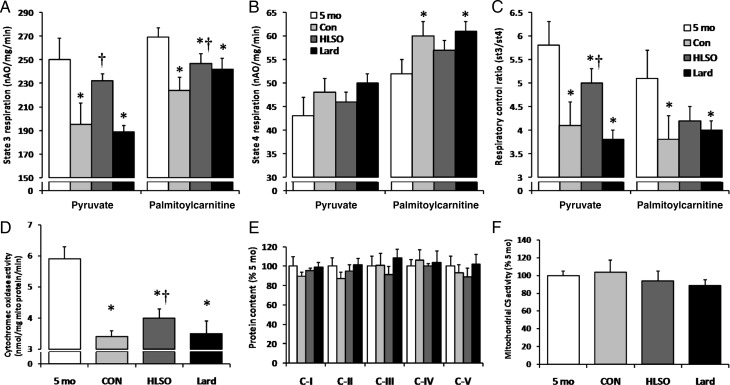
Left ventricular mitochondrial respiratory function. State 3 (ADP-dependent) respiration was lower in the control and lard groups using both pyruvate and palmitoylcarnitine as the substrate compared with 5-month baseline values, but was partially preserved in the HLSO-treated animals (A). State 4 (uncoupled) respiration tended to be elevated in the Con and lard groups vs. baseline, but this increase was attenuated in the HLSO group (B). The respiratory control ratio was lower in the control and lard groups using both pyruvate and palmitoylcarnitine as the substrate compared with 5-month baseline values, but was partially preserved in the HLSO-treated animals (C). Cytochrome oxidase activity in mitochondrial isolates was lower in all 22-month groups vs. 5-month baseline, but was significantly higher in the HLSO group compared with lard and control (D) groups. There were no significant effects of disease or diet on the relative protein contents of mitochondrial OXPHOS complexes (E) or citrate synthase activity (F). Data are means ± SEM (n = 8/group). *P < 0.05 vs. 5-month baseline; P < 0.05 vs. Con; P < 0.05 vs. all groups.
Figure 4
Figure 4
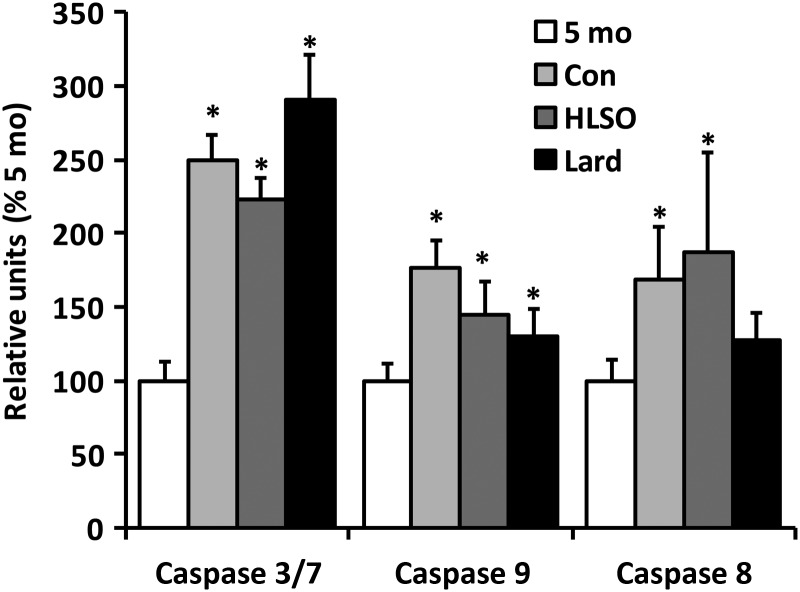
Caspase activities from myocardial homogenates. Elevations in caspase activities were observed in all older animals vs. 5 month (P < 0.05) with the exception of caspase 8 in the lard group. Caspase 3/7 activity was significantly lower in the HLSO and higher in the lard group compared with control rats (P ≤ 0.05). Data are means ± SEM (n = 4–8/group). *P < 0.05 vs. 5-month baseline; P < 0.05 vs. Con.
Figure 5
Figure 5
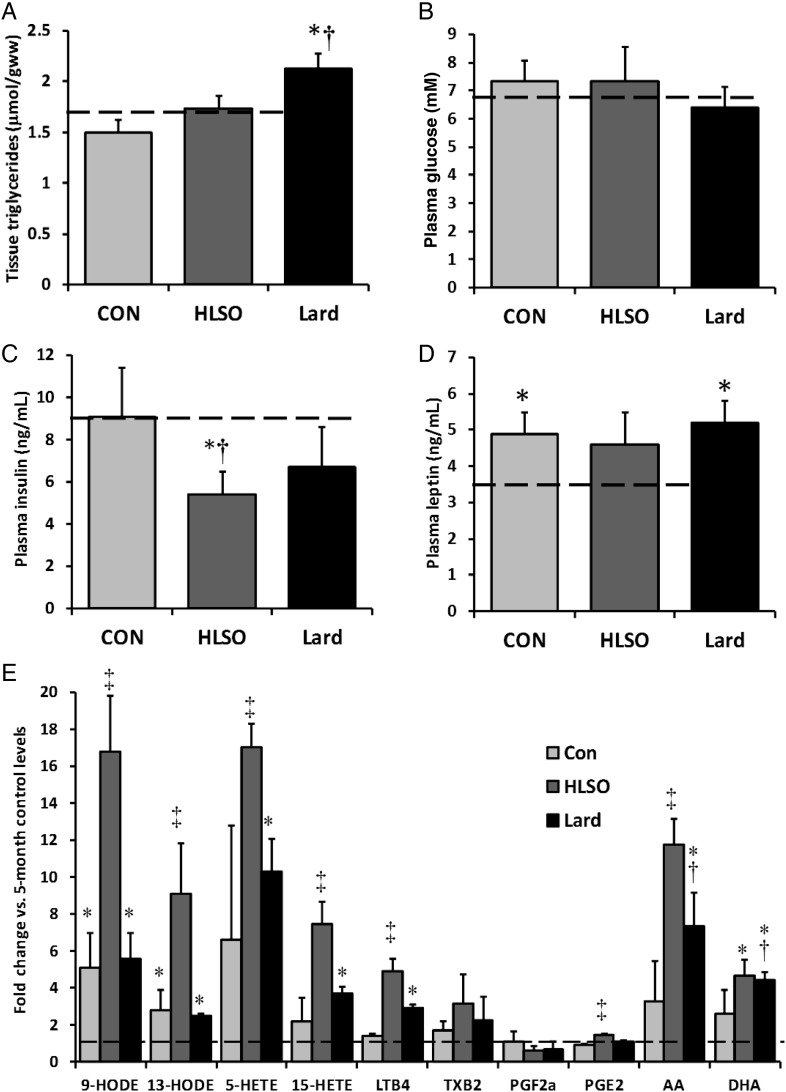
Myocardial TAG content and blood analyses. Tissue TAG content remained similar to 5-month baseline control levels in the 22-month control and HLSO groups, but was elevated by the lard diet (P < 0.05) (A). Plasma glucose levels were unchanged by HF or diet (B), but plasma insulin was lower in the 22-month HLSO group vs. 5- and 22-month controls (C). Plasma leptin was slightly elevated in all 22-month groups vs. baseline, but was unaffected by diet (D). Serum arachidonic (AA), docosahexaenoic acid (DHA), and several products of the n-6 PUFA lipoxygenase pathways were elevated in 22-month groups vs. 5-month control, and were dramatically elevated by the HLSO diet (E; see text for details). Data are means ± SEM (n = 8/group). Dashed bars represent the mean values of 5-month baseline values (n = 6). *P < 0.05 vs. 5-month baseline; P < 0.05 vs. Con; P < 0.05 vs. all groups.

References

    1. Hu FB. Diet and cardiovascular disease prevention the need for a paradigm shift. J Am Coll Cardiol. 2007;50:22–24. - PubMed
    1. Hu FB, Willett WC. Optimal diets for prevention of coronary heart disease. JAMA. 2002;288:2569–2578. - PubMed
    1. Krauss RM, Eckel RH, Howard B, Appel LJ, Daniels SR, Deckelbaum RJ, et al. AHA dietary guidelines: revision 2000: a statement for healthcare professionals from the Nutrition Committee of the American Heart Association. Circulation. 2000;102:2284–2299. - PubMed
    1. Lichtenstein AH, Appel LJ, Brands M, Carnethon M, Daniels S, Franch HA, et al. Diet and lifestyle recommendations revision 2006: a scientific statement from the American Heart Association Nutrition Committee. Circulation. 2006;114:82–96. - PubMed
    1. Rennison JH, McElfresh TA, Chen X, Anand VR, Hoit BD, Hoppel CL, et al. Prolonged exposure to high dietary lipids is not associated with lipotoxicity in heart failure. J Mol Cell Cardiol. 2009;46:883–890. - PMC - PubMed

Publication types