Care seeking for neonatal illness in low- and middle-income countries: a systematic review
- PMID: 22412355
- PMCID: PMC3295826
- DOI: 10.1371/journal.pmed.1001183
Care seeking for neonatal illness in low- and middle-income countries: a systematic review
Abstract
Background: Despite recent achievements to reduce child mortality, neonatal deaths continue to remain high, accounting for 41% of all deaths in children under five years of age worldwide, of which over 90% occur in low- and middle-income countries (LMICs). Infections are a leading cause of death and limitations in care seeking for ill neonates contribute to high mortality rates. As estimates for care-seeking behaviors in LMICs have not been studied, this review describes care seeking for neonatal illnesses in LMICs, with particular attention to type of care sought.
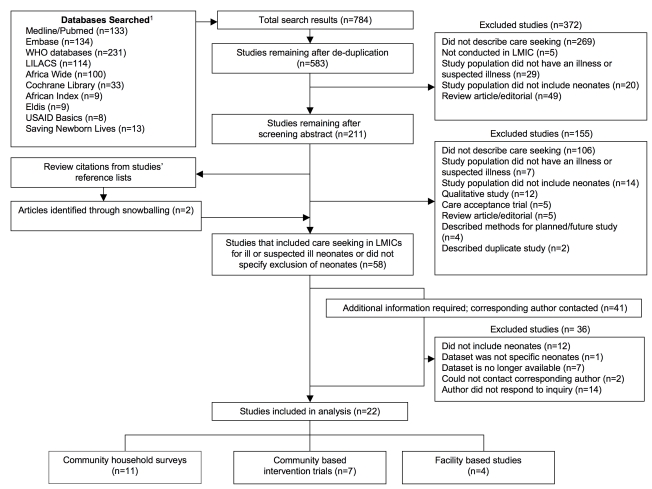
Methods and findings: We conducted a systematic literature review of studies that reported the proportion of caregivers that sought care for ill or suspected ill neonates in LMICs. The initial search yielded 784 studies, of which 22 studies described relevant data from community household surveys, facility-based surveys, and intervention trials. The majority of studies were from South Asia (n = 17/22), set in rural areas (n = 17/22), and published within the last 4 years (n = 18/22). Of the 9,098 neonates who were ill or suspected to be ill, 4,320 caregivers sought some type of care, including care from a health facility (n = 370) or provider (n = 1,813). Care seeking ranged between 10% and 100% among caregivers with a median of 59%. Care seeking from a health care provider yielded a similar range and median, while care seeking at a health care facility ranged between 1% and 100%, with a median of 20%. Care-seeking estimates were limited by the few studies conducted in urban settings and regions other than South Asia. There was a lack of consistency regarding illness, care-seeking, and care provider definitions.
Conclusions: There is a paucity of data regarding newborn care-seeking behaviors; in South Asia, care seeking is low for newborn illness, especially in terms of care sought from health care facilities and medically trained providers. There is a need for representative data to describe care-seeking patterns in different geographic regions and better understand mechanisms to enhance care seeking during this vulnerable time period.
Conflict of interest statement
ACCL is funded for research by NIH and USAID. In 2009, ACCL consulted for Saving Newborn Lives. All other authors have declared that no competing interests exist.
Figures
References
-
- Black RE, Cousens S, Johnson HL, Lawn JE, Rudan I, et al. Global, regional, and national causes of child mortality in 2008: a systematic analysis. Lancet. 2010;375:1969–1987. - PubMed
-
- World Health Organization. Neonatal and perinatal mortality: country, regional and global estimates. Geneva: World Health Organization; 2006.
-
- Black RE, Cousens S, Johnson HL, Lawn JE, Rudan I, et al. Global, regional, and national causes of child mortality in 2008: a systematic analysis. Lancet. 2010;375:1969–1987. - PubMed
-
- Young Infants Clinical Signs Study Group. Clinical signs that predict severe illness in children under age 2 months: a multicentre study. Lancet. 2006;371:135–142. - PubMed
-
- US National Library of Medicine. PubMed. Available: http://www.ncbi.nlm.nih.gov/pubmed. Accessed 21 October 2011. - PubMed