


Mutation analysis of RAD51D in non-BRCA1/2 ovarian and breast cancer families
- PMID: 22415235
- PMCID: PMC3326673
- DOI: 10.1038/bjc.2012.87
Mutation analysis of RAD51D in non-BRCA1/2 ovarian and breast cancer families
Abstract
Background: Recent data show that mutations in RAD51D have an aetiological role in ovarian carcinoma, yet mutations do not appear to be associated with an increased risk for breast cancer. We studied ovarian and breast cancer families having at least one woman affected by ovarian carcinoma, to assess the importance of RAD51D mutations in such families.
Methods: The coding region of the RAD51D gene was analysed in 175 BRCA1/2-negative families with family histories of both ovarian and breast cancer ascertained from two Canadian and two Belgian institutions.
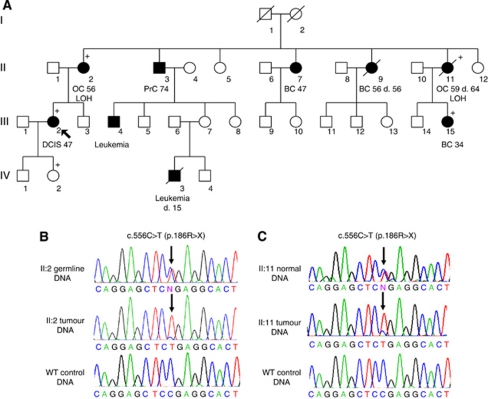
Results: We identified one previously reported deleterious mutation, p.Arg186(*) (c.556C>T), and two novel variants; missense substitution p.Cys119Arg and an intronic variant c.83-26A>G. p.Arg186(*) segregated with the disease in the family and two ovarian carcinomas available for analysis showed loss of the wild-type allele, but the novel variants are likely neutral.
Conclusion: RAD51D should be included in genetic screening of ovarian cancer families that do not have BRCA1/BRCA2 mutations. We show that mutations are more likely to be found in families with two or more ovarian cancers, or in probands with first-degree relatives with ovarian cancer, and we feel testing should be preferentially offered to affected women from such families.
Figures
References
-
- Banerjee S, Kaye SB, Ashworth A (2010) Making the best of PARP inhibitors in ovarian cancer. Nat Rev Clin Oncol 7(9): 508–519 - PubMed
-
- Loveday C, Turnbull C, Ramsay E, Hughes D, Ruark E, Frankum JR, Bowden G, Kalmyrzaev B, Warren-Perry M, Snape K, Adlard JW, Barwell J, Berg J, Brady AF, Brewer C, Brice G, Chapman C, Cook J, Davidson R, Donaldson A, Douglas F, Greenhalgh L, Henderson A, Izatt L, Kumar A, Lalloo F, Miedzybrodzka Z, Morrison PJ, Paterson J, Porteous M, Rogers MT, Shanley S, Walker L, Eccles D, Evans DG, Renwick A, Seal S, Lord CJ, Ashworth A, Reis-Filho JS, Antoniou AC, Rahman N (2011) Germline mutations in RAD51D confer susceptibility to ovarian cancer. Nat Genet 43(9): 879–882 - PMC - PubMed
-
- Meindl A, Hellebrand H, Wiek C, Erven V, Wappenschmidt B, Niederacher D, Freund M, Lichtner P, Hartmann L, Schaal H, Ramser J, Honisch E, Kubisch C, Wichmann HE, Kast K, Deissler H, Engel C, Müller-Myhsok B, Neveling K, Kiechle M, Mathew CG, Schindler D, Schmutzler RK, Hanenberg H (2010) Germline mutations in breast and ovarian cancer pedigrees establish RAD51C as a human cancer susceptibility gene. Nat Genet 42(5): 410–414 - PubMed
Publication types
MeSH terms
Substances
LinkOut - more resources
Full Text Sources
Other Literature Sources
Medical
Miscellaneous
