


The contribution of school breaks to the all-day physical activity of 9- and 10-year-old overweight and non-overweight children
- PMID: 22415372
- PMCID: PMC3399082
- DOI: 10.1007/s00038-012-0355-z
The contribution of school breaks to the all-day physical activity of 9- and 10-year-old overweight and non-overweight children
Abstract
Objectives: This study examines whether moderate-to-vigorous physical activity (MVPA), in at least 30-min school breaks (SB), helps to achieve the health-related amount of daily physical activity (PA) and whether these exercises influence after-school PA.
Methods: The ActiTrainer-based PA was monitored over two school days in 239 children aged from 9 to 10 (57.3% female; 20.1% overweight, and 19.2% obese), in Katowice, in February 2010. PA was assessed based on steps, heart rate, and duration of PA.
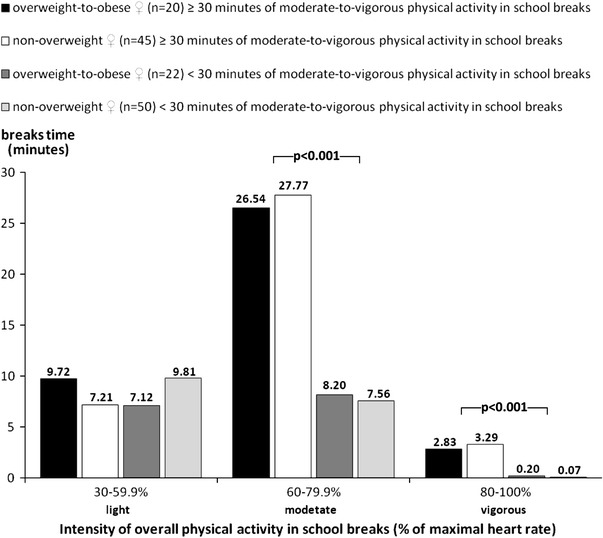
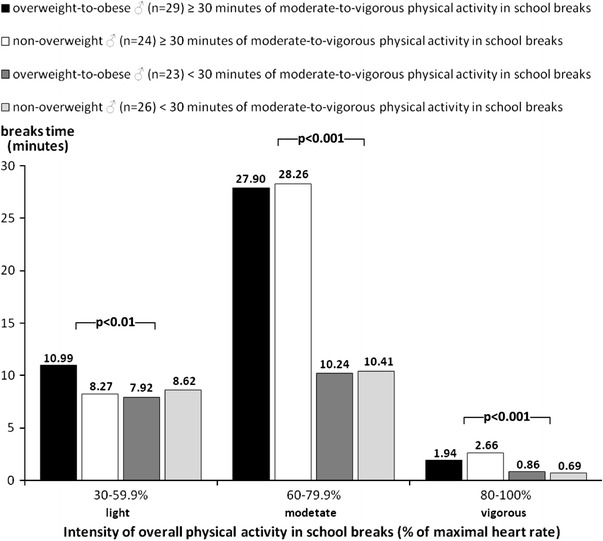
Results: MVPA, for 30 min during SB, represented an average of 1,258 steps for overweight girls and 1,620 steps for boys, and 1,336 steps for non-overweight girls and 1,758 steps for boys. Children with 30 min of MVPA during SB attained a higher daily amount of steps (p < 0.001) and duration of overall PA (p < 0.01), in comparison with less physically active children.
Conclusion: The daily 30 min of MVPA during SB amounts to 12.5% of the overall number of steps for girls and 16.3% for boys, thus contributing to higher school PA and overall PA and leading to the achievement of the health-related minimum of PA.
Figures
References
-
- Apfelbacher CJ, Cairns J, Bruckner T, Möhrenschlager M, Behrendt H, Ring J, Krämer U. Prevalence of overweight and obesity in East and West German children in the decade after reunification: population-based series of cross-sectional studies. J Epidemiol Community Health. 2008;62:125–130. doi: 10.1136/jech.2007.062117. - DOI - PubMed
-
- Cale L, Harris J. School-based physical activity interventions: effectiveness, trends, issues, implications and recommendations for practice. Sport Educ Soc. 2006;11:401–420. doi: 10.1080/13573320600924890. - DOI
-
- Cohen J. Statistical power analysis for the behavioural sciences. 2. New Jersey: Hillsdale; 1988.
-
- Cortina JM, Nouri H. Effect size for ANOVA design. 1. Thousand Oaks: Sage publications; 2000.
-
- Edwards S. The heart rate monitor guidebook to heart zone training. 5. Sacramento: Velopress; 2010.
Publication types
MeSH terms
LinkOut - more resources
Full Text Sources
Medical
